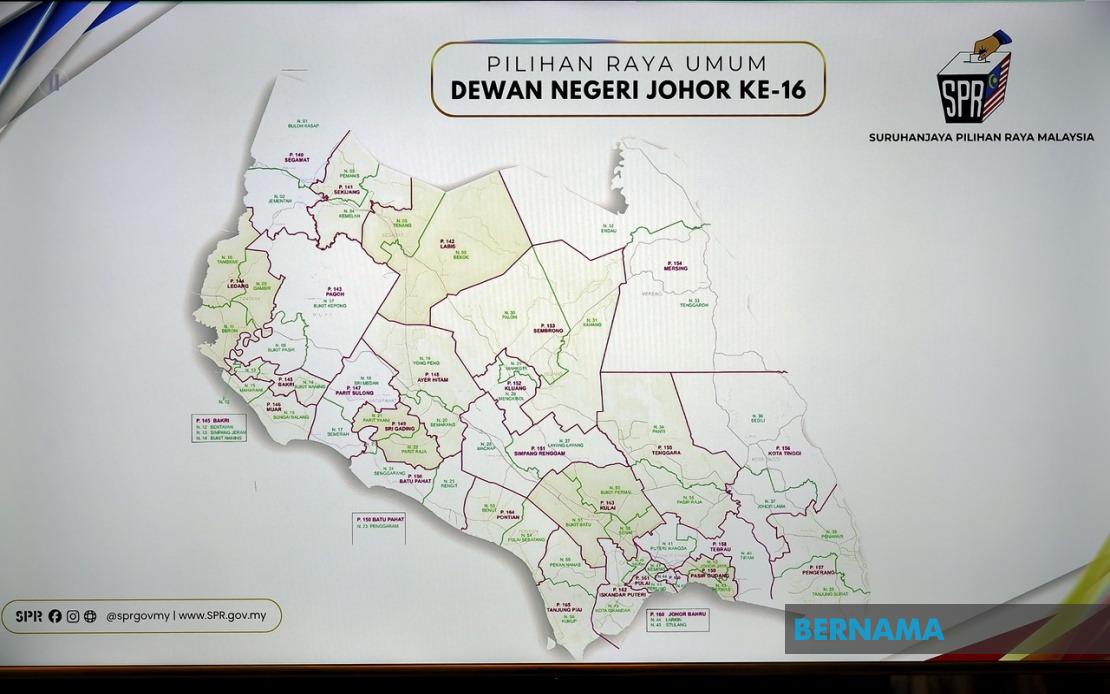
The 16th Johor state election formally commences tomorrow with nomination day, marking the beginning of an intensely competitive campaign season across the state's 56 assembly constituencies. From 9 am to 10 am, registered candidates will submit their nomination papers at designated centres statewide, after which the Election Commission will release the official roster of contenders following verification procedures. This electoral showdown culminates on July 11, with early voting opportunities provided on July 7 for eligible voters unable to cast ballots on the main polling date.
The electoral register reflects Johor's substantial voting population, with the Election Commission confirming that 2,727,926 citizens are eligible to participate in the election. This figure encompasses more than 2.7 million ordinary voters, alongside dedicated categories for 12,041 military personnel and their spouses and 12,710 police officers and their spouses. This comprehensive electorate underscores the significant democratic exercise ahead, as candidates from multiple political frameworks seek to win the confidence of voters across diverse demographic and geographical constituencies.
Pakatan Harapan has committed to fielding candidates in every available seat, deploying a coalition force comprising 20 representatives from Parti Keadilan Rakyat, 19 from Parti Amanah Negara, and 17 from the Democratic Action Party. This complete-coverage strategy reflects the coalition's determination to contest aggressively across all demographics and regions, signalling confidence in competing effectively even in traditionally challenging terrain. The allocation between coalition partners demonstrates calculated internal agreements about seat distribution and candidate viability assessments conducted during pre-nomination preparations.
Barisan Nasional has matched this ambition with an equally comprehensive slate spanning all 56 constituencies. The coalition deploys 36 United Malays National Organisation candidates, complemented by 16 from the Malaysian Chinese Association and four from the Malaysian Indian Congress. This composition reflects traditional BN power-sharing arrangements that have governed inter-party dynamics within the coalition for decades, though the specific numbers suggest shifting internal calculations about electoral competitiveness in various district types.
Perikatan Nasional maintains a more selective presence, with the Pan-Malaysian Islamic Party contesting 11 seats, Parti Pribumi Bersatu Malaysia fielding 16 candidates, and the Malaysian Indian People's Party competing for five constituencies. This more targeted approach suggests a coalition strategy focused on defending existing strongholds and strategic expansions rather than attempting universal coverage. The differential seat distributions between PN's partners indicate internal assessments about where each party maintains particular voter support or organisational advantages.
Additional political players are fragmenting the contest further. The Malaysian United Democratic Alliance, which secured one seat in the previous 2022 election, is contesting four constituencies this time, reflecting modest expansion ambitions. The Socialist Party of Malaysia fielded one candidate, maintaining minimal but symbolic participation. Parti Bersama Malaysia represents a newcomer making its electoral debut in Johor with 15 candidates, introducing untested variables into established political calculus and potentially splitting support among specific voter demographics.
The Election Commission has issued comprehensive advisory notices to all prospective candidates, emphasising procedural precision during the submission process. Candidates are strongly encouraged to verify their nomination documentation at the Returning Officer's Office or State Election Office before the submission window, reducing the likelihood of technical rejections that could eliminate otherwise viable contestants. Additionally, deposit payment completion and retention of receipts are mandatory, as candidates must present proof of financial commitment when formally filing their nomination papers to ensure compliance with electoral regulations.
Anticorruption oversight has been significantly strengthened for this election cycle. The Malaysian Anti-Corruption Commission has issued formal advisories to all candidates and political parties, reminding them of prohibitions against unlawful conduct under the MACC Act 2009 and the Election Offences Act 1954 (Amendment 2012). To enforce these standards actively, the commission has established five dedicated 24-hour operations rooms strategically positioned in Tampoi, Batu Pahat, Kluang, Segamat, and Mersing, providing the public with direct reporting channels for suspected corruption or abuse of power allegations during the campaign period.
The dissolution of the Johor State Legislative Assembly on June 1 set this electoral process in motion, following standard constitutional procedures for state elections. This election occurs against the backdrop of the 2022 Johor state election results, when Barisan Nasional secured dominance by winning 40 seats, Pakatan Harapan claimed 12 seats, Perikatan Nasional obtained three, and the Malaysian United Democratic Alliance captured a single seat. These results established the political baseline from which current campaign strategies have been developed, with governing and opposition parties alike calibrating their candidate selections and resource allocation based on previous performance data across individual constituencies.
The coming weeks will prove consequential for Malaysian politics regionally, as Johor remains the nation's second-most populous state with significant economic influence. Election outcomes will shape state government composition and potentially influence broader national political dynamics, particularly regarding coalition alignments and policy direction. The multiplicity of competing political frameworks—from traditional two-coalition competition to smaller parties seeking electoral relevance—suggests voters face genuinely complex choices reflecting Malaysia's evolving political pluralism, where traditional dominance patterns face ongoing challenge from newer political entrants and increasingly sophisticated electoral segmentation.

