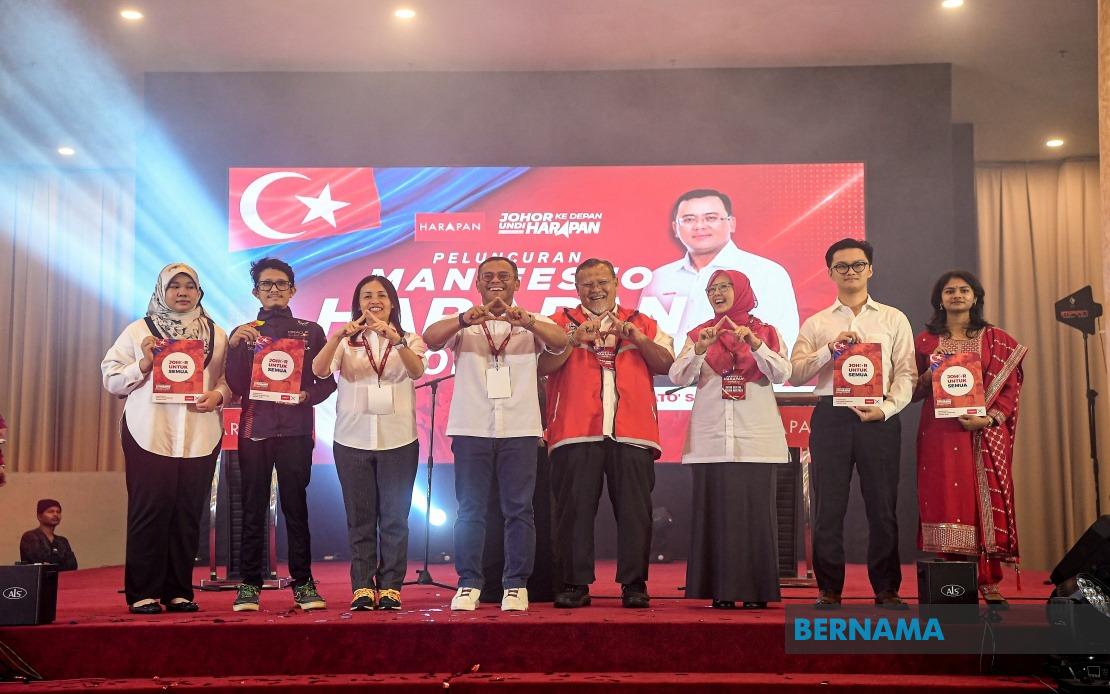
Pakatan Harapan is banking on its previous administrative performance in Johor as the primary credential for securing another mandate in the state election scheduled for July 11. The coalition's chairman for Johor, Aminolhuda Hassan, used the launch of PH's latest campaign manifesto to remind voters that the alliance had successfully fulfilled every commitment made in its 100-day programme following the 2018 general election, when it first assumed control of the state government. This argument forms a central pillar of PH's campaign strategy: establishing that the coalition does not merely make extravagant promises but possesses both the will and capacity to translate those pledges into tangible benefits for ordinary Johoreans.
The concrete initiatives that PH completed during its previous tenure in Johor provide substantial ammunition for this narrative. Among the ten major undertakings delivered were constitutional amendments restricting the Menteri Besar to a maximum of two consecutive terms—a democratic reform that addressed long-standing governance concerns. The coalition also introduced the Johor Health Card, a health insurance initiative designed to improve medical accessibility for residents, and overhauled the state's procurement process by implementing an open tender system aimed at reducing corruption and improving transparency in government spending. These were not merely symbolic gestures but represented fundamental shifts in how the state government conducts its operations.
The scope of PH's earlier manifesto extended into domains directly affecting household finances and daily living standards. The provision of ten cubic metres of free water monthly to eligible households addressed a practical concern for lower-income families, while the takaful scheme offered financial protection to senior citizens through a cooperative insurance mechanism. Meanwhile, the exemption of licence fees for street hawkers lowered barriers to entry for informal traders and small entrepreneurs seeking formality in their operations. The fifty per cent rent discount applied to arrears owed on People's Housing Project units provided meaningful debt relief for residents of affordable housing complexes, while the marriage incentives and higher education support schemes targeted young people during life-transition moments.
Aminolhuda's emphasis on this historical performance record reflects a strategic calculation that voters in Johor are more influenced by demonstrated competence than by campaign rhetoric. In Malaysian electoral politics, where state governments often operate with constrained budgets and limited fiscal autonomy, the ability to deliver immediate, visible benefits carries significant weight. PH's success in implementing these initiatives despite governing during a period of economic uncertainty and navigating complex state bureaucracies suggests that the coalition understands the mechanics of Johor's administration. This accumulated institutional knowledge, party officials contend, positions PH to execute its new manifesto more effectively than rivals lacking equivalent experience.
The presence at the manifesto launch of several senior figures underscored the national dimensions of this state contest. Amirudin Shari, a member of PH's Presidential Council, alongside PKR secretary-general Fuziah Salleh and component party representatives from DAP and Johor's PKR chapter, signalled that the coalition is treating the Johor election as consequential to broader factional dynamics within the federal government. For Prime Minister Anwar Ibrahim, securing a decisive victory in Johor—the second-largest state by population and historically a stronghold for Malay-Muslim political movements—would validate the government's broader agenda and strengthen his negotiating position within the cabinet and parliament.
Aminolhuda's confidence that future PH leadership would "continue the work led by Datuk Seri Anwar Ibrahim at the federal level" explicitly links the state election to national governance dynamics. This framing suggests that voters are effectively choosing between continuity with the current federal administration or creating a divergent state government that could obstruct or undermine federal initiatives. For residents of Johor who depend on coordinated federal-state action on matters ranging from water security to industrial development, the stakes of alignment extend beyond state-level patronage into cross-governmental coherence.
PH's decision to contest all fifty-six state seats in Johor represents a significant commitment of organisational resources and reflects confidence in its electoral prospects. The coalition calculated that spreading its candidates across the entire state, rather than concentrating efforts in strongholds, signals strength to voters and maximises the possibility of converting discontent with incumbent administrations into legislative gains. This comprehensive posture contrasts with more defensive campaign strategies and implies that PH strategists view the political terrain as relatively favourable.
The manifesto itself, branded as "Johor for All," attempts to position PH as inclusive and focused on universal benefits rather than narrow sectoral interests. This messaging strategy acknowledges the ethnic and religious diversity of Johor's population and attempts to neutralise arguments that PH represents particular communal constituencies. By emphasising completed delivery of earlier promises, Aminolhuda hoped to shift voter attention away from ideological disputes towards performance metrics and tangible improvements in quality of life.
Yet this reliance on historical performance carries inherent vulnerabilities. Voters' memories of earlier achievements can fade quickly, particularly if their lived circumstances have not substantially improved or if other political forces have effectively contested PH's credit-taking for earlier initiatives. Opposition parties have incentives to argue that PH's earlier efforts were inadequate, overcomplicated, or benefited only narrow segments of society. The passage of time since the 2018 election also means that populations have experienced intervening political changes and shifted their expectations.
The July 11 election will thus constitute a significant test of whether administrative competence and delivery records function as effective electoral currency in contemporary Malaysian politics, or whether voters prioritise other considerations including ethnic representation, religious governance, or protest against federal policies. PH's confidence rests ultimately on the proposition that voters prefer proven performance to untested alternatives—a premise that Malaysian electoral history has sometimes validated and sometimes confounded.

