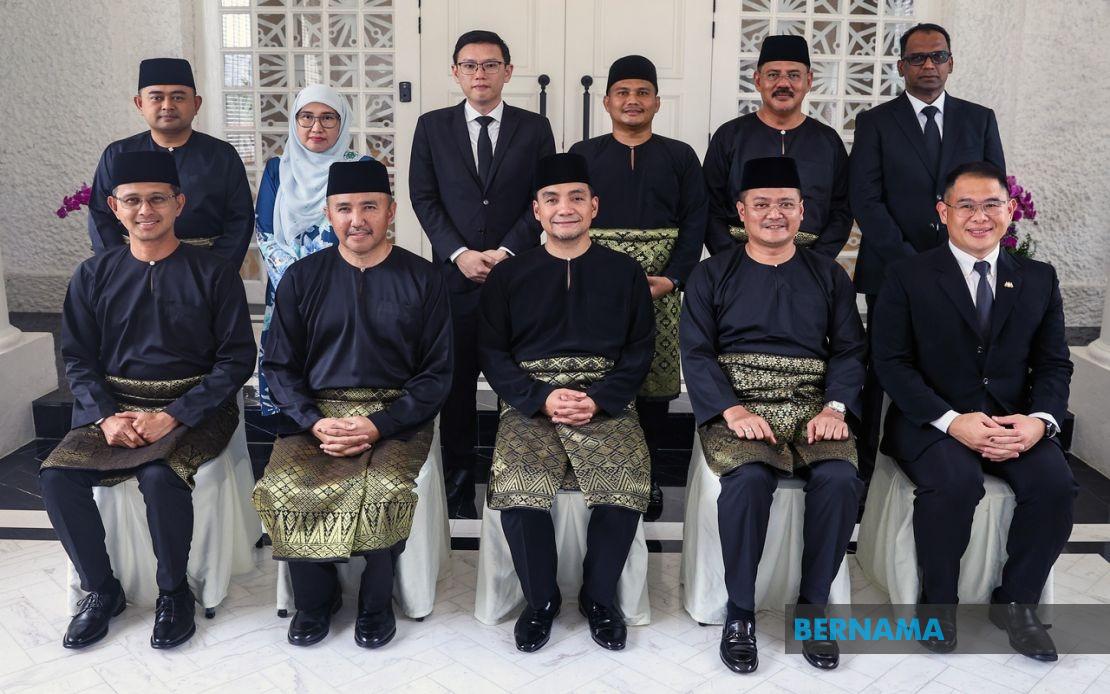
Johor's administrative transition has taken formal shape with the swearing-in of a 10-member State Executive Council that blends fresh talent with experienced governance. The ceremony, conducted before Tunku Mahkota Ismail at Istana Bukit Serene in Johor Bahru on July 18, marks the completion of the state government's structural reorganisation following Barisan Nasional's commanding performance in the 16th Johor State Election.
The new configuration introduces four untested appointments to the exco ranks, signalling Menteri Besar Onn Hafiz's strategy to inject new perspectives into state administration while maintaining continuity. Md Israk Abdullah, representing Kukup, assumes leadership of the Agriculture, Agro-Based Industry and Rural Development Committee—a critical portfolio for a state with substantial agricultural enterprises. P. Pannir Selvam from Perling takes charge of the Unity, Heritage and Culture Committee, bringing responsibility for interfaith relations and cultural preservation at a time when such portfolios carry heightened significance across Malaysia. Hasrunizah Hassan, the Pulai Sebatang assemblyman, heads the Women, Family and Community Development Committee, adding gender-focused representation to high-level decision-making. Dr Muhammad Naqib Md Ghazali completes the quartet as chairman of the Education and Information Committee, an appointment likely reflecting the government's emphasis on knowledge advancement and digital communication in a state increasingly focused on economic modernisation.
The retention of six previous exco members provides administrative stability during the transition period. These experienced hands maintaining their respective committee responsibilities ensure that ongoing projects and established departmental relationships experience minimal disruption. This measured approach to cabinet reshuffling reflects pragmatic governance—neither wholesale replacement that risks institutional memory loss nor complete stagnation that would suggest the election outcome lacked significance.
Onn Hafiz's own return as Menteri Besar for a second consecutive term underscores the electorate's confidence in his administration. His retention of the Machap state seat with an increased majority of 15,375 votes provides personal validation alongside his party's broader electoral endorsement. This dual validation—personal constituency support combined with organisational leadership renewal—strengthens his position heading into the new term, potentially enabling more assertive policy implementation than his first term might have permitted.
The electoral mandate underpinning these appointments carries substantial weight. Barisan Nasional's capture of 48 of 56 available state seats represents overwhelming dominance, providing the government with legislative flexibility rarely enjoyed in Malaysian state politics. This supermajority eliminates most practical constraints on executive decision-making and potentially enables ambitious infrastructure, economic development, and social programmes that opposition-heavy legislatures might block or impede. For Johor, historically influential in national politics, such decisive state-level control carries implications extending beyond its borders.
The portfolio distribution reflects contemporary governance priorities shaping Johor's development trajectory. Agriculture and agro-based industry leadership signifies continued emphasis on rural economic development despite the state's broader urbanisation trajectory. The prominence afforded to education and information—with Dr Muhammad Naqib's appointment—suggests recognition that knowledge economy transitions require dedicated high-level attention. Unity and heritage portfolios, often considered secondary in less diverse contexts, receive substantial committee resources here, reflecting Johor's multicommunal composition and the government's apparent commitment to inclusive governance frameworks.
From a Malaysian governance perspective, Johor's exco appointments demonstrate how state-level politics increasingly operates independently from federal dynamics. While Barisan Nasional remains the dominant national coalition, state governments led by opposition coalitions in Penang, Selangor, and previously Kedah have demonstrated that electoral outcomes diverge substantially by geography and context. Johor's decisive BN victory therefore represents specific Johor preference rather than automatic national party tide. This regional autonomy in electoral choice suggests that Malaysian voters increasingly evaluate state governments on localised performance metrics rather than federal party allegiance alone.
The gender representation within the new exco warrants examination. With one woman among ten members, Johor's executive structure reflects broader Malaysian underrepresentation of women in high-level government positions despite ongoing policy rhetoric around gender inclusion. Hasrunizah Hassan's appointment to the women and family development portfolio, while symbolically important, simultaneously reinforces patterns wherein female appointees frequently oversee traditionally gendered portfolios. This structural reality, common across Malaysian state and federal government, invites ongoing scrutiny regarding substantive gender equity advancement beyond token representation.
Institutional continuity extends beyond individual exco membership. The committee structure itself appears largely preserved, suggesting that the Menteri Besar views existing governance frameworks as fundamentally sound. Rather than reorganising committee jurisdictions to reflect new priorities, the incoming administration maintains established structures while introducing personnel changes. This conservative approach to institutional architecture contrasts with some incoming governments' impulses toward sweeping administrative reshuffling and may reflect either confidence in existing systems or pragmatic acknowledgment that major restructuring requires substantial implementation effort better deferred to later in a term.
Looking forward, these appointments establish the personnel through whom Johor's state government will engage with federal authorities, coordinate with neighbouring states, and implement development initiatives. The exco members' backgrounds and constituencies provide indirect indicators of geographic priorities—representation spans urban and rural districts, suggesting attempted balanced consideration of diverse Johor communities. However, the relative inexperience of four new members means the Menteri Besar and his senior, retained colleagues will likely exercise disproportionate influence during the inevitable learning curve that new appointees experience.
For Malaysian observers tracking state governance evolution, Johor's exco appointments exemplify how electoral victories translate into administrative power distribution. The transparency of the formal ceremony at Istana Bukit Serene and the rapid institutional completion of the executive structure demonstrate procedural efficiency that contrasts with some other Malaysian states' protracted leadership transitions. This administrative promptness may partly explain Barisan Nasional's continuing appeal to voters who prioritise competent institutional functioning alongside partisan ideology.

