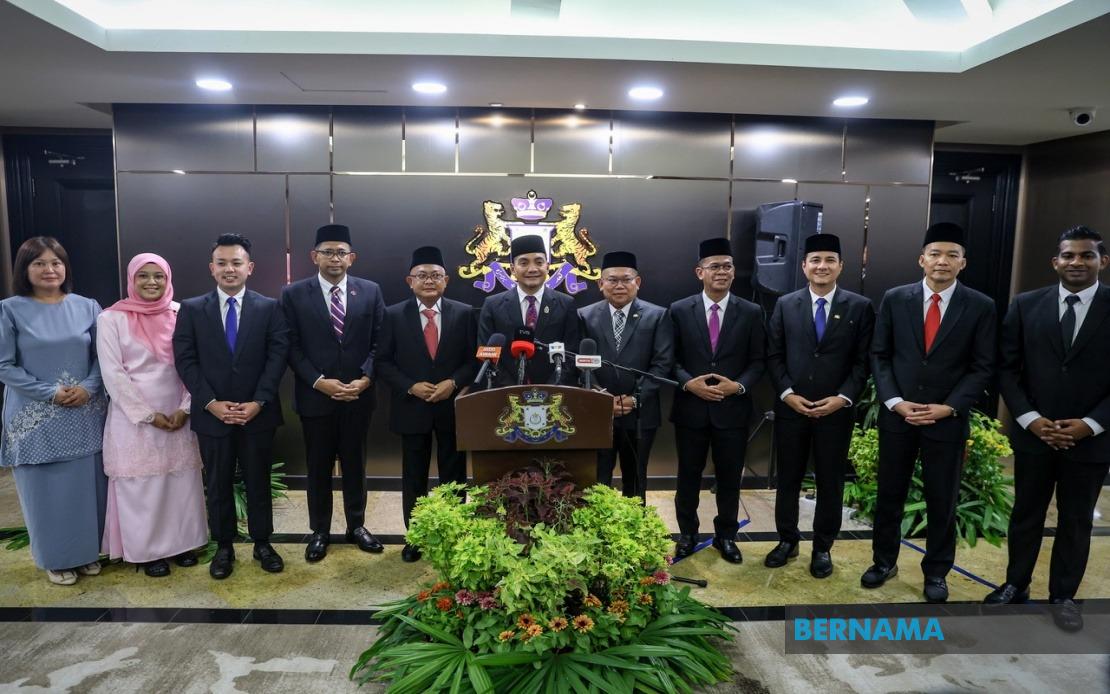
Johor has moved to bolster its administrative structure by appointing 10 deputy chairmen to key State Executive Council committees, a strategic decision intended to sharpen the state government's capacity to deliver programmes and resolve public concerns more swiftly. Menteri Besar Datuk Onn Hafiz Ghazi announced the appointments during a special press conference at Kota Iskandar on July 22, emphasising that the expanded leadership tier would enable the state to manage its development agenda more effectively as Johor pursues an ambitious trajectory toward becoming a fully developed state by 2030.
The timing of the restructuring reflects the escalating complexity of Johor's policy landscape and the need for enhanced coordination across government departments. As the state government pursues multiple concurrent initiatives under its 'Maju Johor 2030' framework and the Johor Economic Transformation Plan, the additional layer of deputy committee leadership is designed to distribute responsibilities more evenly and ensure no critical issue falls between bureaucratic cracks. The appointments carry the formal sanction of Tunku Mahkota Ismail, the Regent of Johor, validating them within the state's constitutional structure.
Onn Hafiz framed the expanded exco structure as essential to translating policy into on-the-ground results, particularly as Johor grapples with uneven development patterns across its multiple districts. The deputy committee chairmen are expected to serve as conduits between senior government leadership and field-level implementation, monitoring project progress, coordinating between agencies, and ensuring that state initiatives penetrate down to village and community levels. This represents a deliberate institutional response to a common challenge facing state governments across Malaysia: the gap between ambitious central planning and effective local execution.
The appointments underscore a governance philosophy that prioritises horizontal coordination alongside vertical delegation. Each deputy committee chairman will operate in tandem with the respective committee chairman rather than in isolation, fostering a collaborative approach rather than a command structure. This dual-leadership model, if executed well, can prevent siloing and encourage information-sharing across government functions. The emphasis on cross-departmental coordination suggests that Onn Hafiz's administration recognises that modern development challenges—infrastructure, skills training, business growth, and social welfare—seldom fit neatly into a single ministry's purview.
For Malaysian observers, the Johor expansion is noteworthy because it reflects broader patterns playing out across states as they attempt to modernise governance institutions inherited from earlier eras. Penang, Selangor, and other progressive states have similarly experimented with restructuring their exco systems to improve responsiveness. The Johor move indicates that administrative reform is becoming a competitive dimension of state governance in Malaysia, with administrations seeking to demonstrate superior institutional design as a badge of modern, efficient management.
The strategic backdrop involves Johor's aspirations to position itself as Malaysia's economic engine outside the Klang Valley corridor. The state government has been vocal about attracting foreign investment, developing its tech ecosystem, and creating high-value manufacturing capacity. An expanded administrative apparatus signals confidence in the scale of ambition and provides more human resources to pursue simultaneous projects. Whether the additional deputy committee chairmen materially accelerate decision-making or merely add layers to the bureaucracy will depend heavily on how effectively they reduce rather than elongate approval timelines.
Onn Hafiz's remarks emphasised the concept of inclusive development, noting that the appointments aim to ensure policies benefit all districts equitably. This reflects sensitivity to historical complaints from certain Johor districts—particularly in the northern and eastern regions—that development resources have concentrated disproportionately in areas closer to Kuala Lumpur or with stronger political patronage networks. By decentralising administrative authority through deputy committee chairmen, the state government may hope to give district-level concerns greater weight in policy discussions and budget allocation.
The appointments also carry implications for political management within Johor's coalition government. Creating additional exco positions allows the Menteri Besar to accommodate more assemblymen in the state administration without displacing existing committee chairmen, thus managing factional interests and expectations within the ruling coalition. This dimension of Malaysian state politics—using administrative positions as currency in coalition arithmetic—often escapes public commentary but represents a critical feature of how state governments actually function.
Looking ahead, the success of this restructuring will be measurable in concrete terms: whether infrastructure projects accelerate, whether citizen complaints are resolved faster, whether the business community perceives improved administrative responsiveness. These deputy committee chairmen will face scrutiny from both the media and the public regarding whether they constitute genuine value-add or mere bureaucratic inflation. In a state like Johor, where electoral competition remains intense and voter expectations for service delivery remain high, even symbolic administrative moves carry real political weight.
The appointment announcement arrives amid broader efforts by the Johor government to project an image of dynamic, forward-thinking governance. As the state competes with Penang and Selangor for the label of Malaysia's most progressively administered state, institutional innovation—whether real or largely symbolic—serves as part of the political messaging apparatus. The deputy committee chairmen will need to demonstrate genuine value through visible results if the restructuring is to accomplish its stated objectives rather than becoming another layer in an already complex state bureaucracy.

