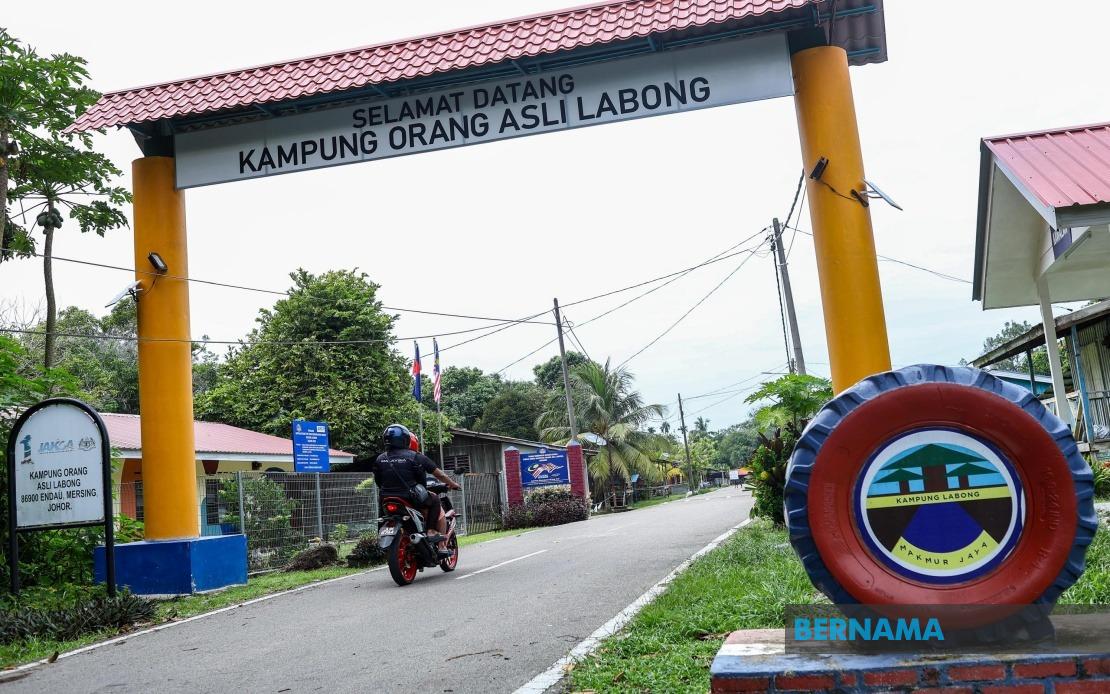
The Johor government's sustained commitment to advancing the welfare and socioeconomic standing of Orang Asli communities is yielding measurable results across indigenous settlements, with residents in Kampung Orang Asli Labong in Mersing providing direct testimony to the tangible impact of state-led development initiatives undertaken in partnership with the Department of Orang Asli Development (JAKOA). The collaborative framework has moved beyond rhetoric, translating into concrete support mechanisms that address both the immediate material needs and long-term capacity-building requirements of indigenous populations in the state.
At the heart of these efforts lies a recognition that effective governance within Orang Asli communities requires strengthening the institutional knowledge and administrative capabilities of traditional and elected leaders who serve as crucial intermediaries between villagers and state machinery. Mabot Sela, the 80-year-old Tok Batin of Labong, articulates this dynamic clearly, having benefited personally from leadership development courses coordinated by JAKOA that have enhanced his ability to navigate the complexities of contemporary village administration while maintaining cultural authenticity. His testimony underscores a nuanced approach that respects customary governance structures while equipping community leaders with modern administrative and communication skills necessary to advocate effectively for their constituents' interests.
The financial dimension of this empowerment strategy has proven particularly significant in alleviating immediate hardship among vulnerable populations who historically operated with minimal government support infrastructure. Mabot notes that the state government's decision to increase monthly allowances for village heads has provided meaningful relief from pressing daily expenses, particularly healthcare-related costs such as medication procurement. For an octogenarian community leader managing the health challenges accompanying advanced age, this incremental improvement in disposable income represents a substantive quality-of-life enhancement that extends beyond symbolic gesture to address genuine material deprivation. The allowance increase signals official recognition that leadership responsibilities within Orang Asli villages warrant appropriate compensation commensurate with the administrative burdens shouldered.
Beyond individual household economics, the broader allocation framework reflects Johor's determination to institutionalise support for indigenous populations. The state government's allocation of RM3.8 million in the preceding financial year to fund nine targeted initiatives demonstrates commitment operating at a meaningful scale, translating into support for more than 18,000 Orang Asli residents across Johor. This multi-initiative approach acknowledges that sustainable development cannot operate along a single dimension but requires integrated intervention spanning welfare provision, educational access, physical infrastructure enhancement, and community-level capacity development. The comprehensiveness of this framework suggests recognition that Orang Asli advancement cannot be addressed through piecemeal assistance but demands coordinated, systematic engagement across multiple policy domains.
The community perspective articulated by Labong residents reveals both gratitude for progress achieved and persistent aspirations for expanded opportunity pathways. Sekoi Janja, a 68-year-old villager, captures a generational inflection point in discussing how forest dependence and traditional subsistence patterns have gradually given way to hybrid economic arrangements requiring engagement with formal systems and market integration. Her emphasis on creating improved prospects for younger generations reflects awareness that contemporary Orang Asli communities navigate fundamentally transformed socioeconomic landscapes compared to their parents' experience. This generational consciousness indicates that development programmes resonating most powerfully are those clearly connected to youth economic mobility and expanded livelihood alternatives beyond traditional resource extraction.
Trader Norma Lonchai's advocacy for skills development and livelihood enhancement programmes articulates a crucial gap in current support architecture—the distinction between welfare provision and genuine economic empowerment. While direct financial assistance addresses immediate survival needs, her intervention highlights community awareness that sustained improvement requires investments in human capital development enabling Orang Asli individuals to participate competitively in broader economic markets. Her emphasis on skill acquisition and income-generation opportunities suggests that communities themselves recognise welfare dependency as insufficient for authentic development, and that meaningful advancement requires entrepreneurial capacity and technical competency. This framing aligns Orang Asli aspirations with broader Southeast Asian development philosophy emphasising human capability and productive economic participation.
The persistent challenges enumerated—notably crop damage from wild elephant incursions and hazards posed by roaming cattle—reveal environmental management dimensions inseparable from community welfare. Mabot's identification of these recurring issues underscores how development initiatives insufficient in scope risk leaving communities exposed to natural resource conflicts and hazards embedded within the interface between human settlements and wildlife habitat. Effective Orang Asli advancement must therefore integrate environmental stewardship and wildlife management components recognising that indigenous communities historically occupied landscape roles requiring sophisticated ecological knowledge. Contemporary development frameworks that fail to address these environmental dimensions inadvertently undermine other gains by leaving communities vulnerable to agricultural losses and safety threats.
The collaborative governance model between state government and JAKOA represents institutionalised recognition that Orang Asli development requires sustained interagency coordination rather than episodic interventions. JAKOA's expertise in indigenous affairs, combined with Johor's resource mobilisation capacity and state-level policy implementation authority, creates a structural framework within which development initiatives can operate with technical rigour and democratic accountability. This institutional architecture provides pathway through which community grievances can be systematised and channeled toward policy adjustment, as demonstrated by the documented responsiveness to allowance increase requests and leadership training needs. The model's scalability and replicability across Malaysia's states offers instructive precedent for federal-level coordination of indigenous development policy.
For Malaysian policymakers and regional development practitioners, Johor's approach offers several instructive insights regarding inclusive development in plural societies where indigenous minorities face persistent marginalisation and opportunity deficits. The integration of leadership capacity-building with direct financial support acknowledges that empowerment operates simultaneously at individual, household, and community levels, requiring multifaceted intervention. The emphasis on culturally-respectful governance arrangements that strengthen customary leadership structures rather than displacing them reflects deeper understanding that imposed external systems risk resistance and ineffectiveness. Furthermore, the willingness to increase allocations and expand programmes in response to expressed community needs demonstrates that indigenous communities themselves possess important diagnostic capacity regarding their development requirements, if institutional structures permit their voices to shape policy direction.
Looking forward, sustained Orang Asli advancement in Johor will likely depend on deepening this collaborative framework while addressing identified gaps in skills development, environmental management, and youth economic integration. The allocation of RM3.8 million, while significant, represents modest expenditure relative to overall state budgets, suggesting scope for enhanced investment as political commitment strengthens. Regional development comparisons reveal that jurisdictions investing 1-2 percent of state revenues into indigenous development initiatives achieve more substantial transformational outcomes than those treating such support as residual budget items. Johor's current trajectory indicates receptivity to incremental programme enhancement, though sustained political will across electoral cycles remains essential for consolidating gains and preventing regression to historical patterns of neglect.

