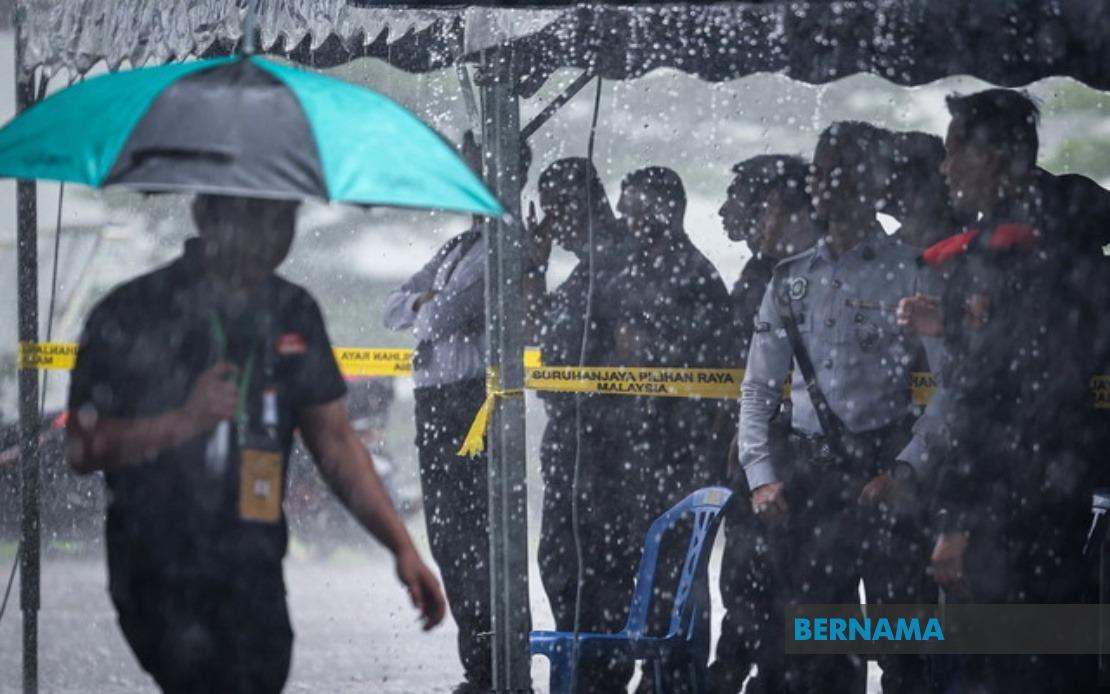
Early voting for the 16th Johor state election proceeded without significant interruption at the State Police Contingent Headquarters in Johor Bahru on July 7, even as torrential rain swept through the area during morning hours. A sudden downpour began at approximately 9.40 am, yet the carefully orchestrated voting process maintained its momentum throughout the day, demonstrating the readiness of electoral officials to manage weather-related challenges during the state's most significant electoral exercise in recent years.
Police personnel who arrived to cast their votes navigated the wet conditions with characteristic efficiency, moving quickly through the entrance to the polling centre to minimise exposure to the heavy rain. The initial inclement weather posed no logistical obstacles to the conduct of voting, as facilities had been established with adequate shelter and protection from the elements. Electoral officials and polling station staff remained at their posts without interruption, ensuring that every officer and spouse who presented themselves could exercise their franchise without delay.
Despite the meteorological challenges, a continuous flow of uniformed officers and civilian police personnel maintained steady progress through the voting stations throughout the day. The rain, which could have deterred participation in many other circumstances, appeared to have little dampening effect on the morale or determination of police voters, many of whom had specifically arranged their schedules to participate in this early voting opportunity. The orderly queuing and efficient ballot-casting processes reflected both institutional discipline and genuine civic engagement among law enforcement personnel.
Median observers covering the electoral proceedings adapted to the weather conditions by establishing makeshift shelter structures, with journalists and photographers utilising tent coverage to maintain their reporting positions while the downpour continued. Their presence underscored the public interest in documenting this early voting exercise, which serves as a barometer for broader electoral participation patterns ahead of the full polling day. The capacity of polling officials and security personnel to maintain operational continuity while accommodating media presence highlighted the organisational competence of the electoral administration.
The scale of police participation in this early voting arrangement reflects the special electoral provisions extended to members of the security and law enforcement establishment, recognising their irregular work schedules and operational demands. A total of 12,067 police personnel and their spouses participated in person at designated polling centres across Johor, representing a significant segment of the electorate whose votes would otherwise prove logistically complicated to facilitate on the standard polling day. Additionally, 643 police voters opted for postal voting, a mechanism that broadens accessibility for those unable to attend physical polling locations due to operational commitments or geographical constraints.
The 16th Johor state election represents a competitive and comprehensive electoral exercise that has mobilised significant resources and organisational capacity. With 172 candidates contesting across 56 state seats, the contest encompasses multiple political parties and independent candidates vying for representation in the state assembly. The geographical spread of these contests and the complexity of managing simultaneous voting across numerous constituencies underscores why early voting arrangements for specific constituencies—particularly those involving uniformed services—prove operationally valuable to electoral commissions.
The broader polling exercise will culminate on Saturday, when the general electorate numbering more than 2.7 million registered voters will proceed to cast their ballots across the state. This represents the largest electoral exercise in Johor's recent political calendar, with implications extending beyond state-level governance to national political dynamics. The early voting process for police personnel and their families thus serves as both a practical accommodation and an important preliminary indicator of electoral mobilisation and participation rates.
The management of early voting during adverse weather conditions carries implications for broader electoral accessibility and the resilience of Malaysia's electoral administration. As climate-related extreme weather events become more frequent across Southeast Asia, the capacity of electoral authorities to maintain voting operations and accessibility standards during rainstorms and other meteorological disruptions becomes increasingly relevant to democratic practice. The Johor experience demonstrates that properly resourced and trained electoral officials can maintain operational integrity despite environmental challenges that might otherwise compromise voting accessibility or security.
The successful conduct of police early voting in Johor Bahru reflects the institutional preparedness of both electoral commissions and law enforcement agencies to collaborate effectively in facilitating democratic participation. The State Police Contingent Headquarters served as an appropriate venue for this specialised voting arrangement, providing secure facilities with adequate capacity to process over 12,000 ballots efficiently. The absence of reported irregularities or operational disruptions suggests that contingency planning had accounted for various scenarios, including inclement weather, security considerations, and the logistical complexities of managing high-volume voting within a concentrated timeframe.

