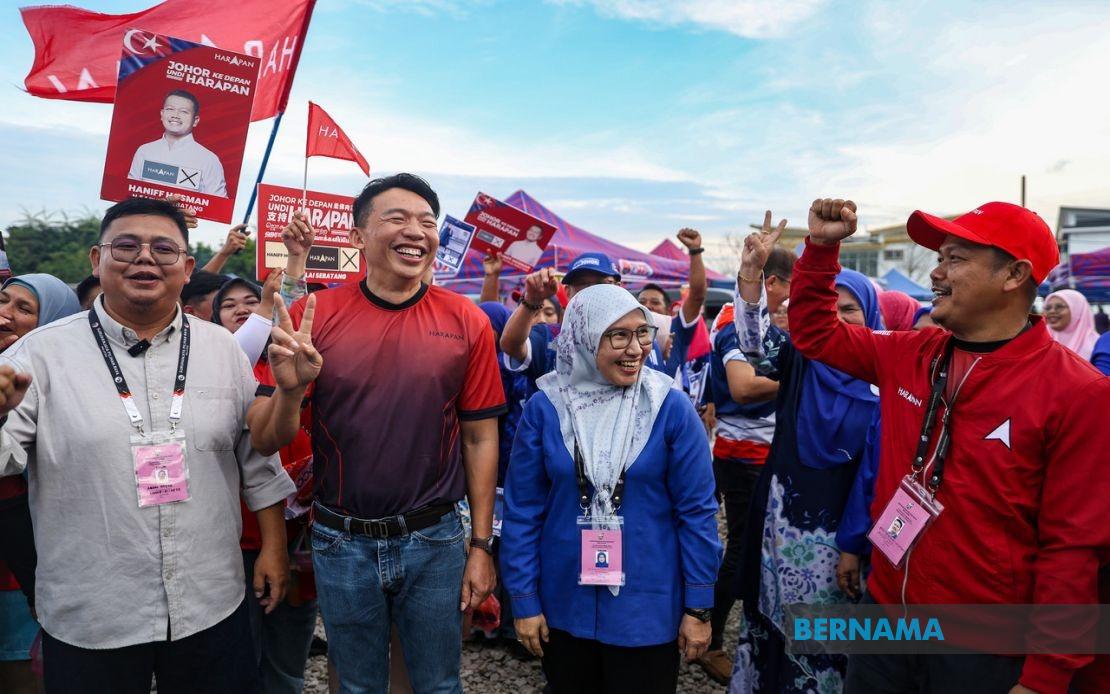
The streets of Pontian presented a rare tableau of political courtesy on June 29 when candidates from competing coalitions converged at the Taman Megah night market, their respective campaign entourages temporarily sharing the same ground. The encounter between three Pakatan Harapan hopefuls and a Barisan Nasional contender unfolded without incident, drawing curious glances from market-goers who witnessed an unscripted moment of inter-party civility that underscored how contemporary Malaysian electoral politics can transcend the typical adversarial posturing.
The gathering brought together Haniff @ Ghazali Hosman, Abd Razak Ismail, and Cheah Chee Hong, the three PH candidates contesting the Pulai Sebatang, Benut, and Kukup seats respectively, who had been conducting a joint campaign blitz when they encountered Hasrunizah Hassan, the BN standard-bearer for Pulai Sebatang. What might have sparked tension between representatives of the "red" and "blue" political camps instead dissolved into cordial acknowledgements and warm greetings, suggesting that Malaysia's electoral culture has matured beyond the acrimony that once characterized state-level contests.
The spontaneity of the meeting—unplanned and unmediated—gave it particular significance for observers tracking the health of democratic discourse in Johor. Night market visitors stopped to absorb the scene, perhaps reassured by the visible camaraderie between opponents who would otherwise be locked in competitive campaigns for the same constituencies. The candidates then proceeded to their respective voter engagement activities, maintaining their campaign momentum whilst having demonstrated that political competition need not preclude personal civility.
Haniff's reflection on the moment reframed it within the broader architecture of healthy democratic practice. He characterized the campaign environment in Pontian as orderly and disturbance-free, suggesting that the region had managed to maintain campaigning standards that prioritized peaceful competition over inflammatory rhetoric. His assertion that the encounter represented normal democratic functioning served to normalize the event rather than sensationalize it—an approach that itself signals confidence in the maturity of the electoral process.
Cheah expanded the frame beyond the immediate spectacle, using the encounter as a platform to reinforce his coalition's messaging to voters across all three constituencies. His emphasis on campaigning alongside colleagues underscored the collaborative nature of PH's positioning in Johor, even as individual candidates pursued separate seat allocations. The moment gave him unexpected visibility and a sympathetic narrative within which to pitch his appeal to voters.
Hashunizah's perspective added weight to the narrative that such encounters had become routine features of contemporary Malaysian campaigning rather than exceptional occurrences worthy of special remark. Her characterization of the situation as a normal reflection of democratic maturation in Johor suggested that previous electoral cycles may have been marked by greater tension and hostility. Her confidence in the controlled nature of the campaign environment, despite intensifying competitive activity, indicated that both major coalitions understood the importance of maintaining standards that would preserve public confidence in the electoral process.
The timing of this encounter carries particular significance given that the Johor state election was scheduled for July 11, with early voting set for July 7. With the contest entering its final stretch, the pressure on candidates to differentiate themselves and mobilize supporters typically intensifies. Against this backdrop, the willingness of competitors to greet one another civilly demonstrated restraint and confidence—presumably rooted in each side's assessment of its prospects and its understanding that escalating hostility would alienate moderate voters.
For Malaysian political analysts, such moments contribute to an emerging picture of electoral competition in which partisan intensity coexists with institutional respect and personal decorum. The contrast with more volatile electoral environments elsewhere in the region—and indeed within Malaysia's own recent history—suggests that state-level contests in Johor have developed conventions that separate campaign aggression from personal animus. This distinction proves crucial for sustaining public trust in democratic processes, particularly in constituencies where voters may hold diverse political sympathies.
The encounter also reflected broader shifts in how coalitions approach state-level contests. Both PH and BN have expanded their campaign activities to include market walkabouts and direct voter engagement, recognizing that retail politics remains essential to mobilizing support. The convergence of multiple campaign teams in the same geographic space, whilst occasionally awkward, has become unavoidable in densely populated areas. Managing such overlaps with grace rather than confrontation has become a mark of campaign sophistication.
Hashunizah's invocation of BN and Maju Johor as motivational touchstones indicated the continued salience of coalition identity in structuring electoral competition, yet her framing of the encounter as something that "further boosts our spirit to campaign harder" suggested that competitive energy could be channeled constructively rather than destructively. This rhetorical move—transforming a potential embarrassment or awkward moment into campaign motivation—reflected political maturity on her part.
The broader implications of this incident for Malaysian democracy extend beyond Johor's particular contest. In an era when political polarization threatens democracies globally, and when social media amplifies divisive messaging, the capacity of candidates to meet, acknowledge, and move forward peacefully represents a significant institutional achievement. The fact that such encounters now occur without generating scandal or triggering incident suggests that Malaysia's electoral system has internalized norms of respectful competition.
For voters observing this scene at the night market, the encounter likely provided assurance that their electoral choice, whilst important, existed within a framework of peaceful contestation and institutional stability. Both PH and BN candidates demonstrated through their conduct that they accepted the democratic process—with its risks of losing—and would participate within agreed boundaries. This implicit reassurance, conveyed through simple handshakes and greetings, may ultimately prove more persuasive to swing voters than any campaign slogan.

