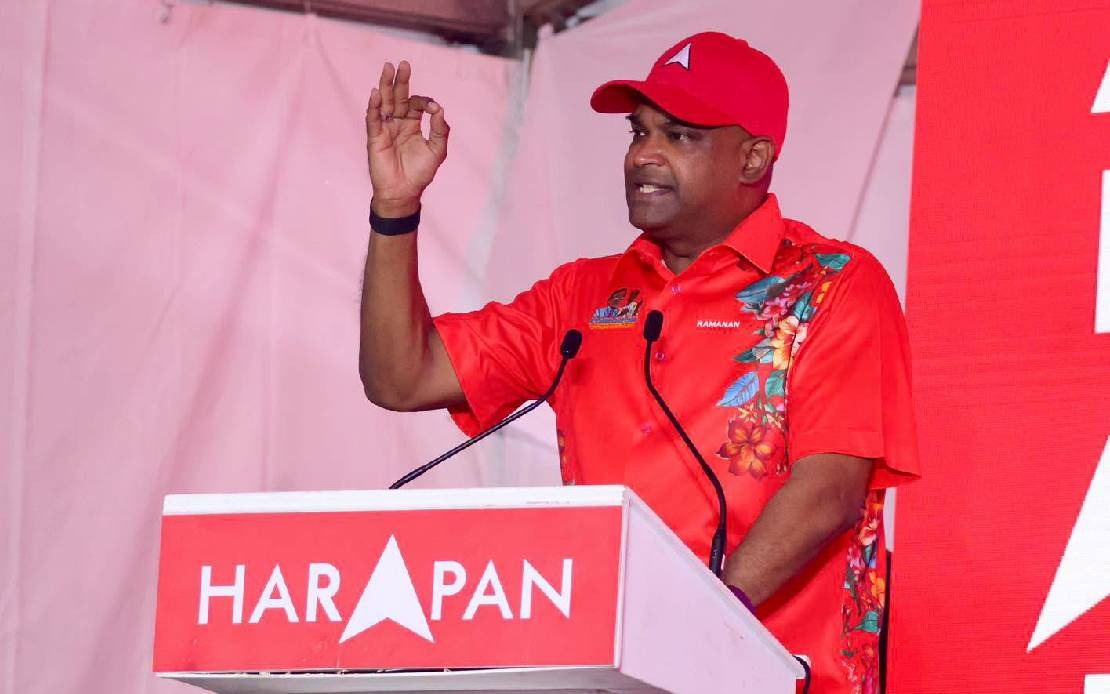
The Federal Government remains steadfast in its commitment to developing Johor, with senior PKR officials emphasising the administration's focus on the state through strategic investments and large-scale infrastructure initiatives. Speaking at a campaign roadshow in Simpang Renggam on Thursday, PKR Vice-President Datuk Seri R Ramanan underscored the federal government's dedication to ensuring that development benefits reach ordinary families across the state, framing Johor's progress as integral to the nation's broader economic agenda.
Ramanan's remarks come as Pakatan Harapan (PH) intensifies its campaign ahead of the July 11 state election, where 172 candidates are contesting across various constituencies. The timing of his statement is significant, as the coalition seeks to consolidate its political standing in Johor and demonstrate continuity between state and federal governance structures. The opposition's emphasis on alignment between different levels of government reflects a broader strategy to present unified administration as beneficial for implementation of development programmes.
The Johor Ke Depan, Undi Harapan roadshow, which featured multiple coalition representatives including Amanah Secretary-General Faiz Fadzil and state-level candidates, served as a platform to articulate the federal government's vision for the state. Among those present were PH candidates Nur Hafiz Roslan for Machap, Abd Razak Ismail for Benut, and Guna Balakrishnan for Layang-Layang, alongside Pakatan Harapan's state chief Datuk Seri Amirudin Shari. This multi-party presence underscored the coalition's attempt to project unity and common purpose.
Johor holds particular strategic importance within Malaysia's political landscape, serving as a crucial economic hub and a state where electoral dynamics can significantly influence national politics. The region's development trajectory affects not only its 4.1 million residents but also broader Southeast Asian economic corridors, given Johor's geographic position and commercial significance. Consequently, assurances regarding federal investment in the state carry weight beyond provincial concerns, touching on questions of national resource allocation and regional competitiveness.
Ramanan specifically highlighted the range of assistance programmes being delivered across the state, suggesting that the federal government's commitment extends beyond headline infrastructure projects to encompass direct welfare support. This dual approach—combining large-scale development with targeted assistance—reflects attempts to address both long-term structural economic needs and immediate household-level concerns. For Malaysian voters, particularly those in lower-income brackets, such welfare initiatives often prove decisive in electoral calculations.
The PKR official's call for voters to grant PH the state election mandate explicitly links electoral outcomes to governance efficiency. The argument presented is that political alignment between state and federal authorities reduces bureaucratic friction and accelerates project implementation. However, this framing also implicitly suggests that divided government—where different coalitions control state and federal levels—could impede development. Such claims warrant scrutiny, as institutional capacity and competent administration often matter more than political alignment alone.
Johor's electoral significance is amplified by its competitive political terrain, where no single coalition holds overwhelming dominance. The state has historically served as a bellwether for national political trends, and its outcome in state elections can influence perceptions of momentum heading into general elections. For PH, victory or strong performance in Johor would provide validation of its federal administration's popularity, while losses might suggest vulnerability in traditional support bases.
The reference to early voting scheduled for July 7, preceding the main election on July 11, indicates the election commission's effort to accommodate diverse voter circumstances. This logistical detail carries implications for campaign strategy, as parties must sustain momentum across an extended voting period. Early voters often include civil servants, the elderly, and those with mobility constraints—demographics whose voting patterns can diverge from the general electorate.
For readers across Southeast Asia observing Malaysian politics, Johor's election represents a window into how established coalition governments campaign when seeking to renew state-level mandates. The emphasis on tangible development outcomes and administrative efficiency reflects pragmatic electioneering, yet it also highlights fundamental questions about how emerging economies balance competing demands for infrastructure investment, fiscal sustainability, and social spending. Malaysia's experience, as a more developed Southeast Asian economy, offers instructive lessons for neighbouring countries navigating similar governance challenges.
The broader context suggests that federal-state relations in Malaysia continue to evolve, with coalition governments increasingly emphasising integrated planning and coordinated resource deployment. Johor's case illuminates how political parties frame development narratives during electoral contests, using infrastructure and welfare programmes as evidence of governance competence. Whether such promises translate into measurable improvements in living standards and economic opportunity remains an ongoing question that extends beyond election cycles into the realm of sustained policy implementation.

