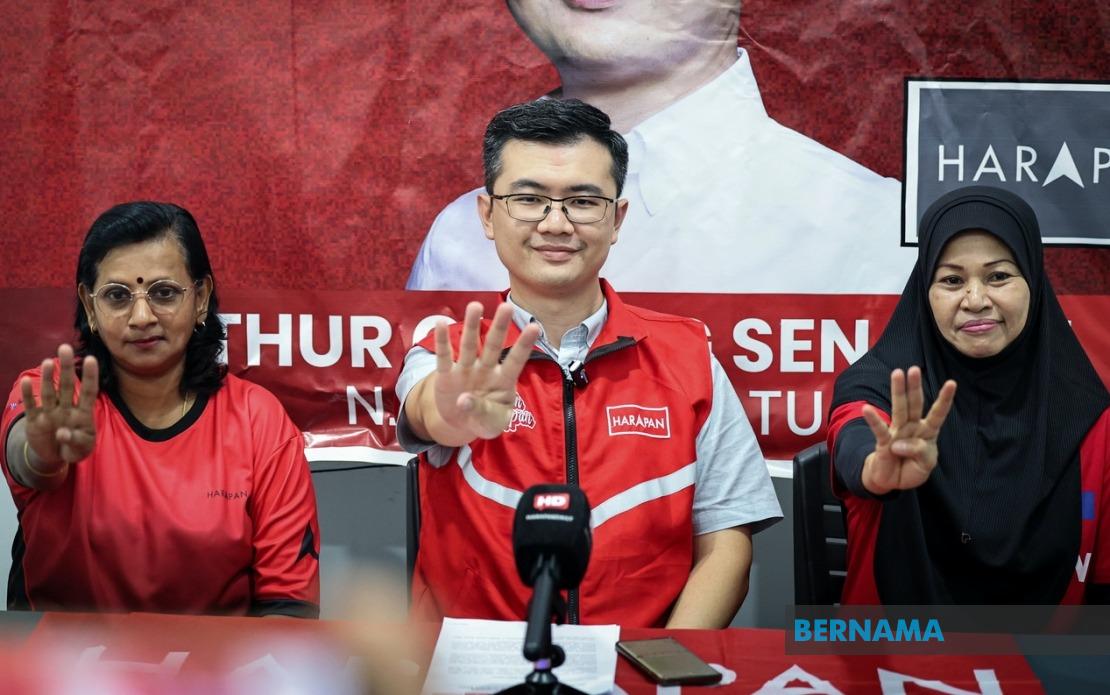
Arthur Chiong Sen Sern, the Pakatan Harapan assemblyman defending his Bukit Batu state seat, is accelerating his campaign machinery in the final stretch before Johor's July 11 polling day, placing significant emphasis on achieving a voter turnout exceeding 60 per cent. The incumbent, who secured his position in 2022 with a wafer-thin majority of just 137 votes, appears acutely aware that elevated participation rates could fundamentally shift the electoral dynamics in his favour, particularly given the competitive nature of the constituency.
Speaking at his campaign operations headquarters in Kulai, Chiong articulated his conviction that higher turnout would brighten his prospects for retaining the seat. His strategy reflects a calculated understanding of electoral mathematics in a marginal constituency where every voter's participation carries outsized significance. The 2022 Johor election drew a voter turnout of around 54.9 per cent, establishing a baseline that Chiong now seeks to surpass by six percentage points. This numerical target is not arbitrary; it represents his assessment of the threshold at which demographic and socio-economic advantages within the Bukit Batu electorate could work decisively in his favour.
The Pakatan Harapan machinery operating in Bukit Batu has substantially intensified its ground operations, with campaign workers engaging voters across ethnic and community lines. Chiong reported positive feedback from constituents of various racial backgrounds, suggesting that the messaging resonating from the PH campaign is gaining traction at the grassroots level. This inclusive outreach strategy, emphasising cross-community engagement, signals PH's broader approach to consolidating support in an increasingly diverse electorate where no single demographic majority exists.
Chiong characterised the political culture in the constituency as exemplifying "mature politics," noting that competing candidates maintain civility and mutual respect despite the intensity of electoral competition. This observation carries deeper implications for Malaysian politics, where recent state and federal elections have occasionally been marked by acrimonious exchanges and polarising rhetoric. The Bukit Batu contest, by Chiong's account, reflects a counter-trend toward substantive policy discussion and measured competition based on track record and future vision rather than personal attacks or divisive messaging.
The incumbent's confidence in voter discernment reflects a broader belief in electoral wisdom among Malaysian constituents. Chiong expressed faith that voters would exercise their democratic prerogative responsibly, choosing representatives based on demonstrated capability and future commitment rather than transient political considerations. This framing positions the election not merely as a contest between individuals or parties, but as an exercise in collective decision-making about developmental direction and leadership quality.
Chiong's campaign platform comprises seven substantive policy pillars demonstrating an effort to address multiple dimensions of constituent welfare and community development. The proposed data centre industry career bridge aims to create employment pathways in a high-value sector, positioning Bukit Batu residents for participation in Malaysia's digital economy. Road widening on FT001 and implementation of smart traffic management systems respond to congestion and infrastructure challenges likely affecting daily commuting patterns. Upgrading health clinic facilities addresses healthcare accessibility, a perennial concern in suburban constituencies, while free Malay and History tuition classes target educational equity for economically disadvantaged students.
Addressing youth vulnerabilities through anti-vape and anti-drug initiatives acknowledges the social challenges confronting suburban communities where substance abuse patterns warrant targeted intervention. Tourism industry strengthening and school facility expansion round out a manifesto emphasising inclusive development spanning economic, infrastructural, social, and educational dimensions. Chiong's framing of these commitments not as campaign rhetoric but as continuations of his first-term implementation efforts attempts to establish credibility through demonstrated follow-through rather than abstract promises.
The emphasis on experienced leadership, strong governmental relationships, and persistent problem-solving reflects a more technocratic campaign approach. Chiong positions himself as a capable administrator capable of delivering tangible improvements in constituent quality of life through effective governance and sustained engagement rather than ideological positioning or partisan appeals. This pragmatic stance may particularly resonate with swing voters in suburban constituencies who prioritise service delivery and developmental outcomes over partisan identity.
The competitive margin in 2022—a mere 137-vote victory—fundamentally shapes Chiong's strategic calculations. In such marginal seats, conventional campaign intensification carries genuine impact, as even marginal shifts in voter participation or preference distribution could prove decisive. The 60 per cent turnout threshold Chiong targets likely reflects internal polling or demographic analysis suggesting that increased participation would disproportionately benefit his candidacy, whether through mobilising sympathetic non-voters or leveraging demographic advantages among higher-propensity voter segments.
For Malaysian voters observing state electoral contests as leading indicators of national sentiment, the Bukit Batu race carries broader significance as a test of incumbent PH performance in maintaining its 2022 state gains. Beyond Johor, state elections increasingly function as mid-term assessments of federal government competence and popularity. A strong Chiong performance would provide PH with evidence of electoral durability, while defeat would suggest erosion in constituencies the coalition considered secure—a potentially consequential development for national political trajectories.
Early voting scheduled for July 7 provides an opportunity for voters to participate before the main polling day, potentially easing congestion and expanding overall participation. The mechanisms facilitating early voting may prove particularly relevant for working professionals and those with scheduling constraints, potentially broadening the electorate beyond typical turnout patterns. The effectiveness of both main-day and early-voting participation in reaching Chiong's 60 per cent threshold will provide concrete evidence of whether suburban constituencies are becoming more or less engaged with electoral processes during this transition period in Malaysian politics.
As polling day approaches, the Johor state election will offer signals about voter priorities in 2024, the relative strength of competing coalitions beyond the federal level, and the trajectory of electoral politics in Malaysia's most economically developed state after Selangor. Bukit Batu's specific result will demonstrate whether narrow 2022 victories can be consolidated through effective governance and targeted campaigning, or whether marginal seats remain fundamentally volatile spaces where demographic shifts and turnout dynamics constantly reshape political fortunes.

