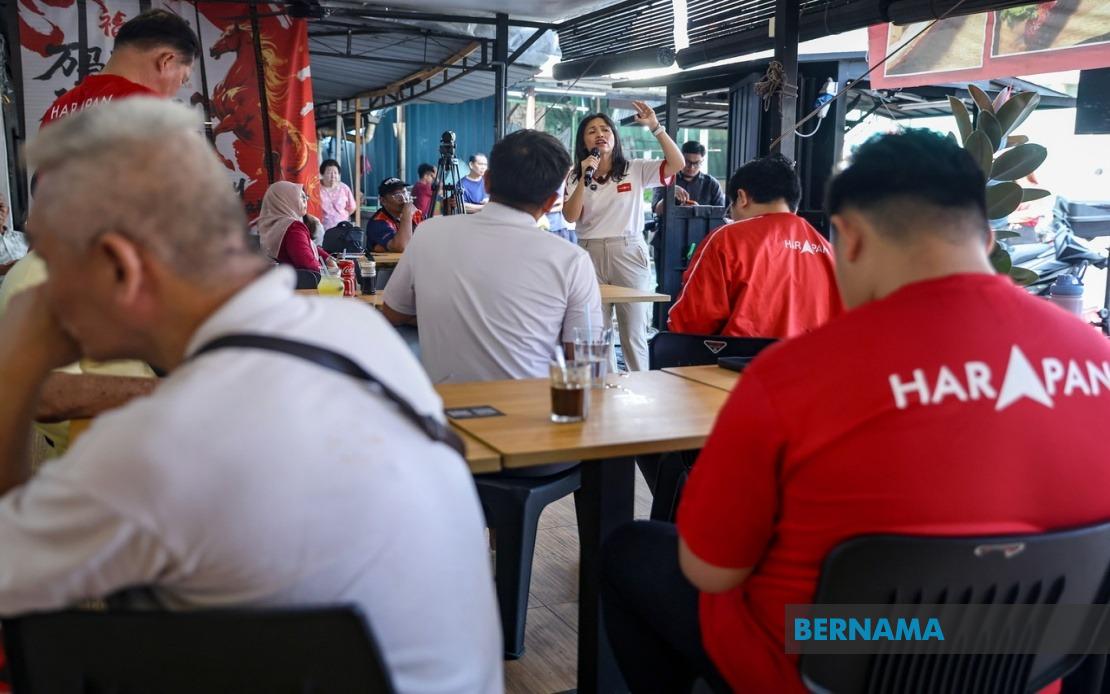
The Johor state election campaign has been overshadowed by fresh allegations of political impropriety involving a vocational education event. Johor DAP chairman Teo Nie Ching has called on Menteri Besar Datuk Onn Hafiz Ghazi to provide a full explanation regarding complaints from parents and students claiming they were compelled to participate in what began as an ostensibly neutral technical and vocational programme but allegedly morphed into a political rally for the ruling coalition.
The controversy centres on the Johor MARA TVET Roadshow held at the Inland Revenue Board (LHDN) Hall in Kluang on July 4. According to Teo, attendees were warned that missing the event would be recorded as absenteeism, raising questions about whether participation was truly voluntary or effectively mandated. More significantly, the Deputy Communications Minister contends that the programme was subsequently weaponised for electoral purposes, with Onn Hafiz allegedly instructing participants to support the Barisan Nasional candidate by explicitly mentioning the candidate's numerical designation on the ballot paper.
The allegation strikes at a fundamental tension within Malaysia's electoral framework: the blurred line between permissible government communication and impermissible party campaigning. Teo articulated the precise legal and ethical dilemma with surgical precision, noting that while she has no objection to the Menteri Besar's participation in government functions, the crucial question is whether a state facility was appropriately utilised. If the roadshow was genuinely a government initiative, mixing partisan electioneering into its programme would constitute a violation of election law and administrative propriety. Conversely, if it was fundamentally a party event, using public infrastructure and requiring attendance under threat of disciplinary consequences would represent an abuse of state authority.
The DAP party has reportedly obtained documentary evidence supporting its case, including the formal programme itinerary, official correspondence directing compulsory attendance, and what Teo describes as video footage capturing the allegedly inappropriate partisan remarks. This documentation suggests the accusations are not mere hearsay but rather grounded in tangible records that could be scrutinised by electoral authorities. Such evidence would be material if opposition parties decide to lodge formal complaints with the Election Commission, which possesses investigatory powers and the authority to sanction electoral violations.
Teo's framing of the issue through the lens of parental concern rather than purely partisan criticism adds emotional weight to the complaint. By emphasising that she speaks not simply as a political operative but as a mother troubled by the pressures placed on young people, she attempts to elevate the narrative beyond typical election-cycle accusations. This rhetorical strategy acknowledges that many Malaysians, regardless of political affiliation, harbour concerns about the instrumentalisation of educational institutions and the coercion of minors into political situations.
The incident arrives amid broader scrutiny of governance practices in Johor and intersects with contemporary anxieties about whether state resources and administrative authority are being deployed impartially during election periods. For voters and observers in Peninsular Malaysia, such allegations feed into longstanding concerns about executive overreach and the consolidation of power by dominant political actors. The Johor elections, contested across 56 state seats with 172 candidates, have already generated considerable tension, and these accusations may further polarise the electorate in the final days before polling on July 11.
Onn Hafiz's recent criticism of several federal policies, which Teo characterised as unwarranted score-settling, provides additional context for understanding the political temperature. The Menteri Besar has suggested that national policies are imposing unnecessary burdens on Johor residents, implicitly holding the federal government accountable. Teo counters that such criticism is hypocritical given that major federal policies require Cabinet approval, and that attributing policy success to the state government while blaming failures on federal leadership constitutes selective accountability rather than honest governance. This rhetorical sparring reveals the deeper fault lines in Johor politics.
Lim Kit Siang, the veteran Pakatan Harapan leader present at the event, seized the moment to appeal for broader political reconciliation. His call for voters to reject racial politics in favour of a unifying Malaysian identity represents the coalition's broader messaging strategy in the Johor contest. By invoking concepts of equality, freedom, prosperity, and human rights, Lim attempts to position the opposition as defenders of inclusive governance against what he implicitly characterises as divisive majoritarianism. Whether such appeals resonate with Johor voters, who have historically been more receptive to Barisan Nasional's governance model, remains uncertain.
The timing of these allegations is strategically significant. With early voting already underway on July 7 and general polling scheduled for July 11, the opposition faces a compressed window to amplify concerns about electoral conduct and administrative impropriety. The Pakatan Harapan candidates, including Wong Bor Yang contesting the Senai seat, may leverage these allegations to mobilise support among voters sceptical of incumbent governance. However, the efficacy of such last-minute accusations depends heavily on media amplification and whether they resonate with voter anxieties about institutional fairness.
The broader implications for Malaysian electoral politics are noteworthy. If substantiated, allegations of state resources being leveraged for partisan purposes during election periods would represent a troubling erosion of the principle that public institutions must remain neutral during democratic contests. The precedent could normalise such practices across different states and administrations, further corroding public confidence in electoral integrity. For the Election Commission, these complaints signal a need for heightened vigilance and enforcement regarding the inappropriate use of government facilities and the coercion of citizens into political activities.
The Johor state election thus becomes a microcosm of broader challenges facing Malaysian democracy: the tension between centralised executive power and democratic accountability, the instrumentalisation of public institutions for partisan gain, and the difficulty of enforcing ethical standards across different levels of government. These themes will likely continue to shape electoral discourse well beyond the July 11 polling day.

