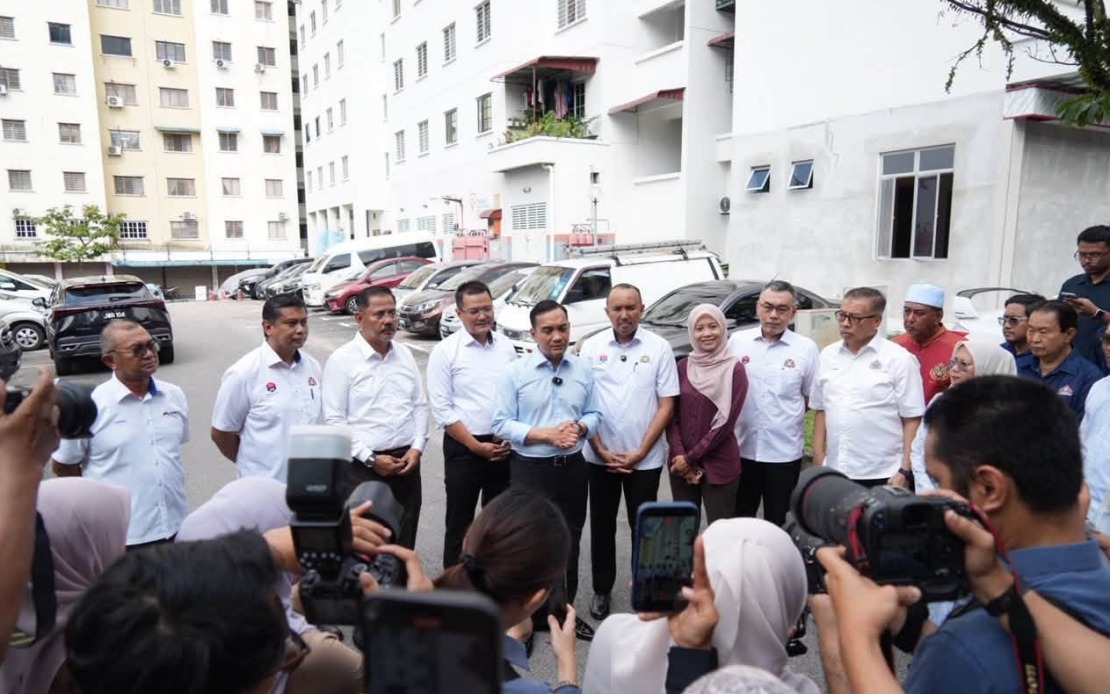
The Johor state government has launched a substantial RM50 million investment programme focused on repainting low-cost and public housing units throughout the state, reflecting a strategic approach to upgrading residential infrastructure for lower-income families. The initiative represents a meaningful commitment to neighbourhood renewal, with Datuk Mohd Jafni Md Shukor, chairman of the State Housing and Local Government Committee, framing the effort as essential to community wellbeing beyond surface-level improvements.
The scope of this undertaking is considerable. The repainting scheme will encompass 170 separate housing blocks distributed across 26 strategically selected locations throughout Johor, affecting a total of 11,693 residential units. When fully implemented, the project is projected to directly enhance living conditions for approximately 46,772 residents, making it one of the more substantial state-level housing improvement initiatives in recent years. The breadth of coverage indicates a recognition that housing quality affects a substantial proportion of the state's population.
Mohd Jafni articulated a perspective that extends beyond conventional understanding of cosmetic renovation work. He emphasised that painting projects, while seemingly superficial, generate far-reaching effects on community morale and resident satisfaction. A freshly maintained residential environment contributes to psychological comfort, he suggested, while simultaneously reinforcing residents' confidence that their interests remain central to state government planning. This framing positions the initiative within a broader social development agenda rather than merely addressing aesthetic decay.
The execution of this programme involves coordination among multiple state entities, demonstrating the administrative architecture required for large-scale public housing projects. The Johor State Housing Development Corporation (PKPJ) and the Local Government Division of the Johor State Secretary's Office assume primary implementation responsibility. Supporting institutions include the Johor Bahru City Council (MBJB), Iskandar Puteri City Council (MBIP), Pasir Gudang City Council (MBPG), and the Kulai Municipal Council (MPKu), creating a networked implementation structure across different municipal jurisdictions.
Quality assurance emerged as a critical emphasis during Mohd Jafni's inspection visit to the Desa Muafakat Apartments, conducted alongside Menteri Besar Datuk Onn Hafiz Ghazi. Both officials reminded implementing agencies and contractors that workmanship standards, occupational safety protocols, and cleanliness requirements must be rigorously maintained throughout project execution. This explicit attention to quality control reflects lessons learned from previous infrastructure projects where rapid deterioration undermined initial investment benefits.
The Desa Muafakat site visit revealed interconnected housing challenges extending beyond repainting needs. Officials identified slope subsidence concerns adjacent to the apartment parking facilities and internal road damage within the housing complex. These observations suggest that the broader repainting initiative occurs within a context of comprehensive housing stock maintenance challenges, with multiple systems requiring attention simultaneously. Such findings are representative of ageing public housing complexes across Southeast Asia, where deferred maintenance compounds over time.
The initiative's timing within Johor's broader development strategy warrants consideration. The state has positioned itself as an economic growth centre, yet such aspirations require concurrent investment in residential quality standards. Housing environment improvements directly affect workforce stability and retention, particularly for service sector employees in Iskandar Puteri and Johor Bahru's commercial zones. Improved housing conditions may therefore indirectly support economic objectives by enhancing resident satisfaction and reducing migration pressures.
For Malaysian policymakers across other states, the Johor model presents several relevant considerations. The allocation represents a significant but achievable per-unit investment when distributed across multiple years, suggesting scalability within constrained state budgets. The multi-agency coordination framework could be adapted to different state contexts, though implementation effectiveness ultimately depends upon local administrative capacity and inter-agency cooperation levels.
The programme also intersects with broader national housing policy discussions. Malaysia's persistent gap between housing demand and adequate supply particularly affects lower-income households, making maintenance of existing stock increasingly important. Rather than expanding housing quantity, Johor's focus on quality improvement acknowledges that many lower-income families will occupy existing public housing units long-term, making environmental quality enhancement a practical priority.
Politically, the initiative demonstrates state government responsiveness to constituent concerns about neighbourhood conditions. Housing quality affects daily lived experience more tangibly than many policy initiatives, making visible improvements a demonstrated commitment to lower-income voters. The public inspection visits by senior officials underscore administrative engagement with ground-level implementation rather than top-down programme announcement alone.
Implementation challenges will test project sustainability. Painting work in tropical climates requires specialized materials and techniques to ensure durability. The explicit quality control emphasis suggests organisers anticipate this challenge, though contractor compliance with extended maintenance requirements remains critical. Long-term success depends not merely on initial painting completion but on sustained maintenance systems that prevent rapid re-deterioration, a challenge that resource-constrained local councils frequently struggle to manage.
The RM50 million investment ultimately represents a calculated decision that environmental quality improvements generate measurable returns in resident satisfaction and community cohesion. For Johor residents in lower-income housing, visible state investment in their residential environment carries significance beyond the repainting itself, symbolizing recognition that their neighbourhoods matter within broader state development priorities.

