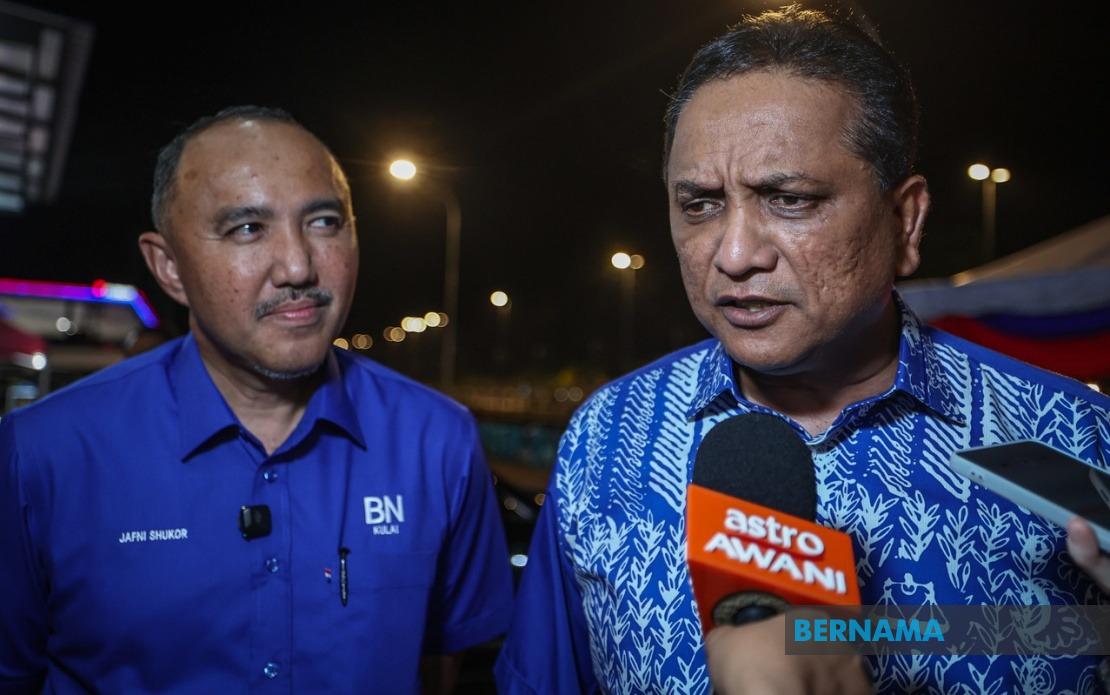
A senior UMNO politician has firmly rejected suggestions that Johor's Regent, Tunku Mahkota Ismail, exercises improper control over the state administration, characterising the accusation as a gross distortion of the constitutional relationship between the palace and elected officials. Datuk Seri Reezal Merican Naina Merican made these comments in Johor Bahru on June 25, pushing back against what he views as a deliberate misrepresentation of the Regent's legitimate role and responsibilities within the state's governance framework.
Reezal Merican, a member of UMNO's Supreme Council, argued that the Regent's public statements on matters affecting Johor's development should be understood within the context of institutional oversight rather than as evidence of palace dominance over elected government. The distinction he seeks to draw reflects long-standing constitutional principles in Malaysia's federal system, where hereditary rulers maintain certain supervisory and ceremonial functions even as elected representatives hold executive authority. His intervention in the debate signals concern among UMNO leadership that the issue could become a liability during the forthcoming state election campaign.
The controversy emerged following the departure of Datuk Dr Mohd Puad Zarkashi from UMNO, the former Speaker of the Johor State Legislative Assembly who alleged that Menteri Besar Datuk Onn Hafiz Ghazi had effectively become subordinate to palace interests. Puad Zarkashi's decision to leave the party and publicly air such grievances represents a significant blow to party unity during a sensitive electoral period, forcing party officials to mount a public defence of both the Menteri Besar and the constitutional arrangement with the palace.
According to Reezal Merican's interpretation, every action undertaken by the Regent falls squarely within his constitutional authority and reflects his obligation to safeguard Johor's interests. This framing attempts to recast palace involvement not as interference but as the legitimate exercise of powers that the state constitution explicitly grants to the Regent. The argument rests on the distinction between advice or guidance offered to elected officials—which is portrayed as appropriate—and outright control, which Reezal Merican insists does not exist.
The timing of these allegations is particularly sensitive, as Johor prepares to conduct state elections with nomination day set for June 27 and polling scheduled for July 11. Political observers have noted that such claims about palace influence can resonate with voters concerned about the balance of power, making Reezal Merican's public rebuttal a calculated move to neutralise criticism before campaign momentum builds. His emphasis that UMNO's leadership has never discussed the party being controlled by the palace suggests an effort to establish party unity around a reassuring narrative.
Reezal Merican pointedly questioned the motives behind Puad Zarkashi's decision to bring the royal institution into partisan political debate at such a critical juncture. This line of argument attempts to delegitimise the departure and subsequent criticism by suggesting they represent an attempt to exploit constitutional arrangements for personal or factional advantage. The implication is that introducing palace-government tensions into election discourse serves no legitimate purpose and potentially damages the careful political consensus that has underpinned Johor's stability.
The constitutional role of Malaysia's state rulers remains a nuanced topic, with the Regent serving as custodian of Islamic affairs, ceremonial head of state, and possessing certain prerogative powers. However, the interpretation of how these powers should be exercised in relation to elected governments continues to generate debate among constitutional scholars and practitioners. Reezal Merican's position reflects the mainstream UMNO understanding that the Regent's interventions, when they occur, represent checks and balances rather than the assertion of parallel executive power.
From a broader Malaysian and Southeast Asian perspective, the Johor situation illustrates ongoing tensions within constitutional monarchies regarding the proper scope of royal authority in modern, democratically-elected governments. Similar questions have emerged periodically in Thailand, where the monarchy's constitutional position has been more explicitly tested, and in other Commonwealth realms where debates about the extent of vice-regal influence occasionally surface. The relative restraint with which such disputes are typically handled in Malaysia reflects a political culture that has evolved to manage potential conflicts between institutions.
For the Barisan Nasional coalition heading into these elections, resolving the perception of internal discord becomes crucial to maintaining voter confidence. Reezal Merican's intervention as an UMNO Supreme Council member carries weight because it demonstrates institutional support for the current Menteri Besar and attempts to close off debate that could undermine party cohesion. The BN's electoral prospects in Johor depend partly on projecting an image of unified governance and stable palace-government relations.
The episode also reflects the particular dynamics of Johor politics, where the state's commercial importance and large population make it a significant battleground for electoral competition. The Regent's public profile in state affairs has historically been more visible than in some other states, which may explain both the allegations and the vehemence with which party officials defend the current arrangement. How voters ultimately respond to these competing narratives about institutional relationships could influence the trajectory of not only Johor politics but also broader perceptions of constitutional stability within Malaysia's federal system.

