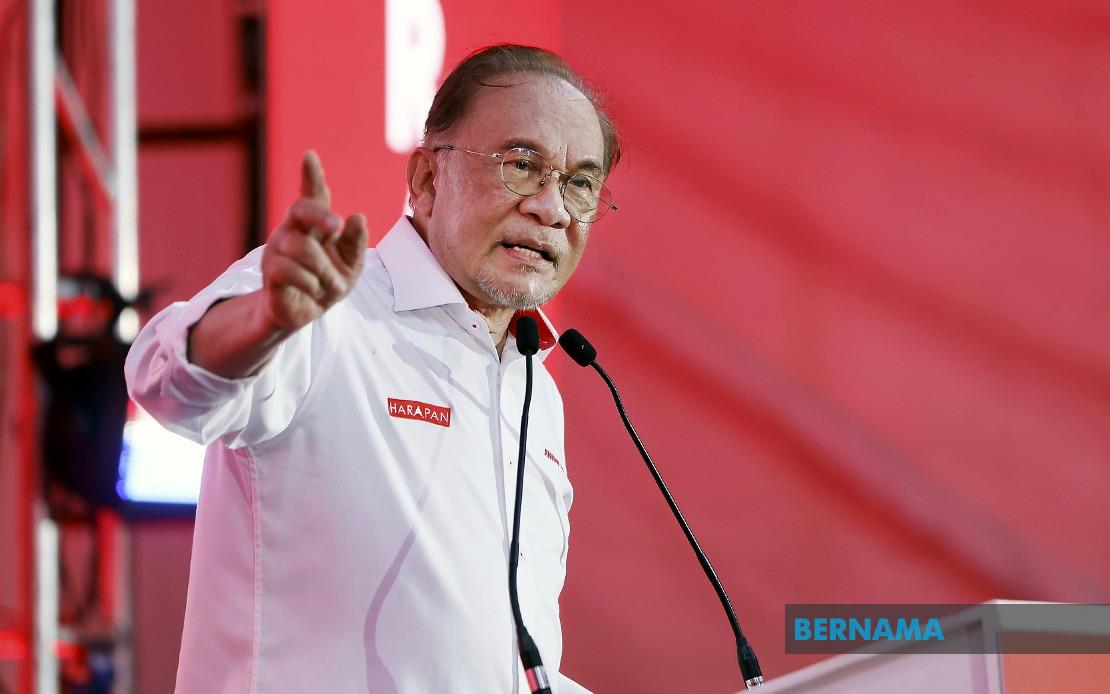
Prime Minister Datuk Seri Anwar Ibrahim has set a clear benchmark for Johor's political leadership, calling on voters to elect representatives who combine strategic vision with decisive action. Speaking in Johor Bahru on July 4 as Pakatan Harapan (PH) commenced its election campaign, Anwar emphasised that the state's progress depends on choosing officials capable of understanding public concerns and translating them into policy outcomes. The coalition chairman's appeal reflects growing recognition that electoral success increasingly hinges on demonstrating practical competence rather than relying on traditional factional appeals.
Anwar's message carries particular weight in Johor, Malaysia's second-largest state by population and a crucial economic engine for the country. The state's political trajectory has shifted markedly in recent years, with voters demonstrating willingness to reject incumbent administrations when dissatisfied with governance outcomes. The Prime Minister's emphasis on leaders who "truly understand the pulse of the people" suggests PH intends to position itself as the party attuned to ground-level economic grievances and community concerns, a strategy that proved effective during previous electoral cycles across the peninsula.
The Pakatan Harapan campaign strategy emphasises inclusivity and national unity as central themes. Anwar's call for elected representatives who serve "Malays, Chinese, Indians" working collaboratively underscores the coalition's attempt to project itself as transcending communal divisions—a positioning that has resonated in urban and suburban areas where multiethnic cooperation generates tangible benefits. By framing the election around shared development objectives rather than identity-based politics, PH aims to appeal to voters fatigued by zero-sum communal rhetoric.
Pakatan Harapan's organisational commitment to this contest is substantial. The coalition has fielded candidates in all 56 state constituencies, with the party composition reflecting internal power-sharing arrangements: PKR (20 candidates), Amanah (19), and DAP (17). This distribution reveals careful negotiations among coalition partners to maintain equilibrium while maximising competitive positioning in diverse constituencies. The three-party structure, while sometimes cumbersome, allows PH to deploy specialist appeal in different regions—DAP's urban strength, PKR's broad multiethnic reach, and Amanah's positioning within Muslim-majority areas.
The broader competitive landscape reveals intensifying three-way contest dynamics. With 172 candidates competing for 56 seats across the state, individual constituencies will witness several-cornered contests featuring PH candidates alongside opposition representatives from Perikatan Nasional and other groupings. This fragmentation potentially favours organised coalitions that can concentrate voter support, advantages that Pakatan Harapan has historically leveraged effectively in previous state contests.
Anwar's personal campaign presence signals the election's significance within PH's overall political strategy. By embarking on an intensive seven-programme campaign itinerary covering multiple constituencies on the opening day, the Prime Minister demonstrated direct engagement rather than remaining in Kuala Lumpur. Such ground-level involvement serves multiple purposes: it energises local party machinery, generates media coverage amplifying PH's messaging, and allows Anwar to assess grassroots sentiment directly. For a Prime Minister navigating complex coalition governance at federal level, maintaining strong state-level performance becomes operationally crucial.
The timing of Johor's election carries implications extending beyond state boundaries. Electoral momentum frequently influences subsequent political calculations at the federal level, particularly regarding coalition stability and ministerial positioning within government. A strong PH performance in Johor would strengthen Anwar's negotiating position within his multiparty federal administration, while conversely, disappointing results could embolden internal critics questioning his strategic direction. Southeast Asian political observers monitoring Malaysian developments understand that state elections often serve as bellwethers for shifting voter sentiment across the region's largest economy.
Logistical arrangements for the July 11 polling day include early voting on July 7, providing flexibility for voters with scheduling constraints. This staggered voting approach, increasingly standard across Malaysian electoral contests, tends to increase overall participation rates while reducing congestion at polling stations. The preparation timeline between campaign commencement and polling day—roughly one week—reflects compressed campaign schedules becoming normalised in Malaysian politics, requiring parties to maintain sophisticated voter contact operations and media strategies.
For Malaysian and Southeast Asian observers, this election illuminates broader regional political dynamics concerning how multiethnic democracies balance identity-based politics with performance-based governance assessments. Voters in Johor, like their counterparts across the region, increasingly evaluate parties on their capacity to deliver tangible improvements in living standards, employment opportunities, and social services. Anwar's campaign framing around visionary leadership and inclusive development reflects this shift, suggesting Malaysian politics continues evolving beyond the purely communal calculations that dominated previous electoral cycles.
The stakes extend to coalition stability considerations affecting federal governance. Pakatan Harapan's continued electoral viability depends substantially on demonstrating that its multiparty structure can generate positive outcomes for voters, justifying the compromises and complexity inherent in coalition governance. Johor's election provides an important test of whether PH's grassroots machinery remains capable of mobilising voter support effectively, translating the Prime Minister's policy rhetoric into electoral advantage. Results will inform subsequent political calculations regarding coalition consolidation and potential expansion ahead of the next federal general election.

