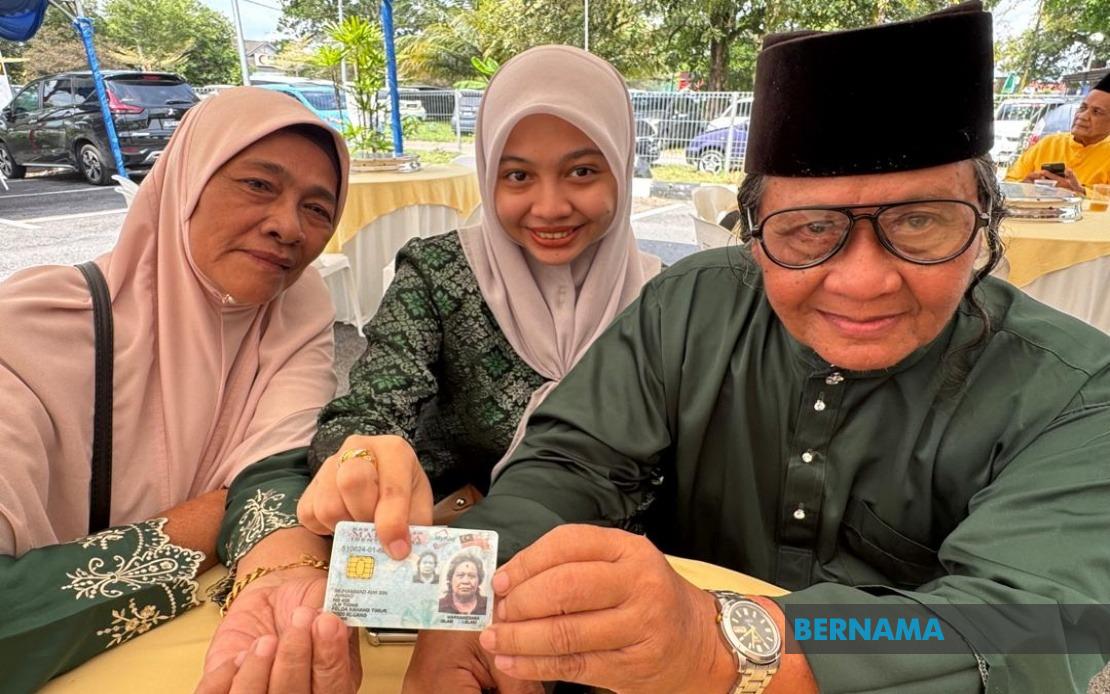
For Muhammad Awi Ahmad of Felda Kahang Timur, turning 75 years old brought an unexpected but profoundly meaningful gift: formal ownership of the 4.2-hectare plantation and residence he has tended for nearly four decades. His milestone birthday coincided with a land title handover ceremony in Kluang on June 24, marking the culmination of a frustrating 25-year journey through the bureaucratic system. The timing felt providential to the Felda veteran, whose persistence through three separate applications—rejected in 1990 and 2000 before finally succeeding under the current Johor administration—illustrates the institutional inertia that has long plagued Malaysia's Federal Land Development Authority settlers.
The ceremony distributed ownership titles to 210 recipients drawn from three districts across Johor: Kluang, Kota Tinggi, and Mersing. Johor Menteri Besar Datuk Onn Hafiz Ghazi presided over the event at Dewan Dato' Onn in Rumah Komuniti Parlimen Sembrong, underscoring the state government's commitment to resolving what had become a persistent source of economic and social vulnerability for plantation workers. The approval process for Muhammad Awi's application took approximately one year under the current administration—a dramatic acceleration compared to the decade-long delays that characterized earlier efforts. This improvement in processing timelines suggests a deliberate policy shift to address the accumulated backlog of land title applications that have languished within government offices.
The significance of this resolution extends far beyond individual cases like Muhammad Awi's. According to official figures, 27,639 out of 27,642 Felda settlers in Johor who submitted applications have now received ownership titles—a completion rate of 99.9 percent. This near-total resolution of the outstanding land claims represents a watershed moment for one of Malaysia's oldest and most important agricultural communities. For a state that has historically served as a cornerstone of the federal Felda scheme, achieving such comprehensive land tenure security signals a genuine commitment to stabilizing the livelihoods of thousands of farming families who have built their lives around these schemes since the scheme's inception in the 1950s.
The generational implications of delayed land titles became starkly apparent through the perspective of younger settlers and their children. Norliyani, the 25-year-old daughter of Muhammad Awi representing the second generation of Felda families, articulated a concern that transcends mere property rights. Unlike their parents—many of whom originally migrated to Felda settlements from other regions and retained connections to ancestral villages—younger Felda members have no alternative homes to return to. For them, the plantation is not merely a livelihood but an identity and inheritance. Without secured ownership titles, the land their parents cultivated risked passing to others or reverting to government control, leaving subsequent generations without either ancestral land or financial security.
This intergenerational dimension touches on a vulnerability that has long characterized Felda communities. First-generation settlers possessed psychological and sometimes practical options to return to their places of origin if the scheme failed or conditions deteriorated. Second and third-generation settlers, by contrast, have integrated into local communities, established schools and social networks, and developed expectations of permanence. The absence of clear land ownership created a precarious situation where families could invest decades of labour into developing their holdings without legal assurance that this work would benefit their children. The title handover ceremony thus represented not just property transfer but the establishment of intergenerational wealth stability for families that have otherwise operated under persistent legal uncertainty.
Mohd Farhan Mohamad's experience provides another window into the timeline of this unresolved issue. At 43 years old, he spent nearly two decades seeking a land title for his family's Felda Pasak holding in Kota Tinggi. His initial application in 2006 was intended to fulfill his father Mohamad Masek's wish to secure ownership of land cultivated since the 1980s. Only after a reapplication submitted the previous year—made without genuine expectation of approval—did the current government finally process and grant the title. This pattern of repeated applications stretching across fifteen to twenty-five years reflects a systemic failure in administration rather than legitimate legal obstacles, suggesting that previous governments had either deprioritized Felda land claims or lacked mechanisms to process them efficiently.
The resolution carries particular weight for Malaysian agricultural policy and rural development. The Felda scheme has historically functioned as both a land development initiative and a social programme, settling rural populations and creating stable farming communities. However, the land title uncertainty undermined the scheme's fundamental purpose by denying settlers the security necessary to invest in improvements, access credit for farm development, or plan for succession. Banks hesitate to lend against property without clear title, limiting settlers' ability to modernize equipment or diversify crops. The resolution of these title issues therefore potentially unlocks economic opportunities for individual farmers and improves the broader financial health of participating communities.
Menteri Besar Onn Hafiz Ghazi's leadership in accelerating these approvals signals a policy reorientation within Johor's governance structure. The marked improvement in processing times—from rejections after years-long waits to approvals within approximately one year—indicates either enhanced administrative capacity, prioritization of outstanding applications, or simplified approval procedures. For a state with 27,642 Felda settlers, such administrative improvements represent substantial institutional reform. Other Malaysian states with significant Felda populations will likely benchmark Johor's performance, potentially creating expectations for similar expedited processing elsewhere.
The near-complete resolution of Johor's outstanding Felda land claims raises questions about similar backlogs in other states. Felda settlements exist across Malaysia, yet the land title issue appears to have been most acute in Johor. Whether other states have already resolved comparable issues or continue to sit on thousands of pending applications remains unclear. The successful conclusion of Johor's programme could serve as a template for nationwide completion, or it could highlight regional disparities in how effectively different state governments have addressed this longstanding concern affecting agricultural communities under their jurisdiction.
Beyond the administrative achievement, the ceremony acknowledged the emotional and social dimensions of land ownership for settler communities. Muhammad Awi's characterization of the title as a birthday gift—one that ended decades of worry and uncertainty—underscores how land tenure security operates at the intersection of legal documentation and human dignity. For families that have invested their labour, raised their children, and built community ties around agricultural land, formal ownership transforms abstract bureaucratic status into tangible security. The ceremony's public recognition of these titles, with the Menteri Besar's attendance and formal handover protocols, also validated the legitimate claims of settlers whose contributions to national food security had previously been underappreciated by government systems.
The path forward for Johor's Felda communities now involves translating land ownership into economic and social gains. With titles in hand, settlers can access formal credit markets, pursue land improvements, or plan succession for younger family members. The remaining 0.1 percent of outstanding applications—the three cases among 27,642—will likely be resolved through individual investigation and processing. For a scheme that has operated with legal ambiguity for decades, the achievement of near-universal title clarity represents a meaningful, if overdue, recognition of settlers' rights and contributions to Malaysian agriculture.

