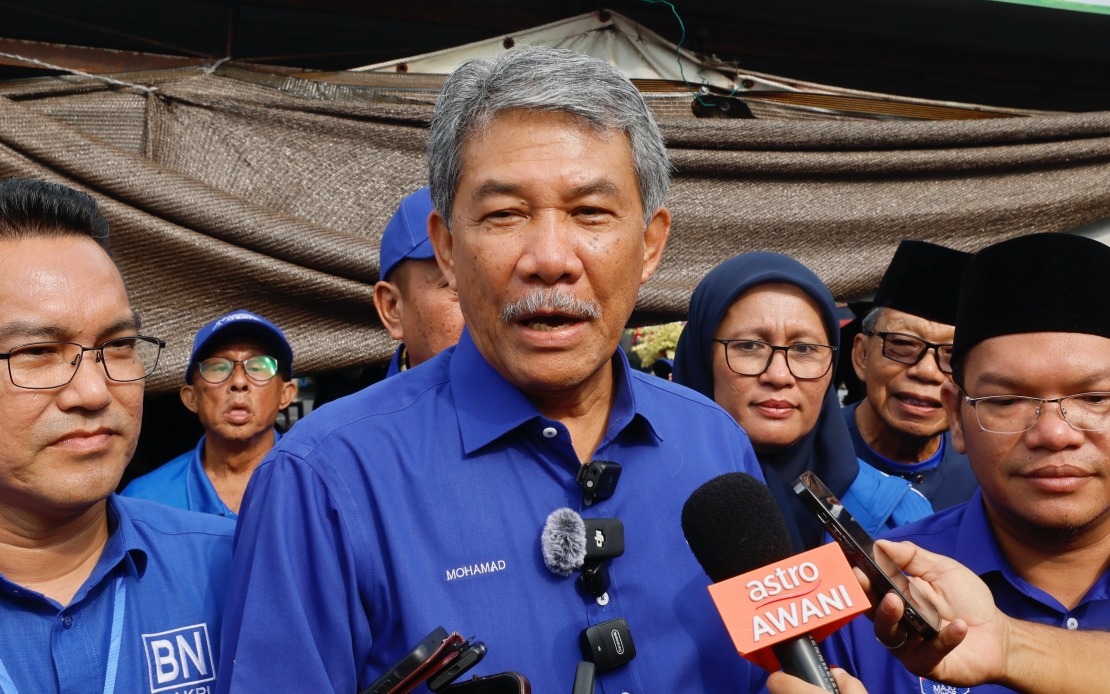
As Malaysia's Johor state enters its pivotal election campaign phase, senior UMNO figure Datuk Seri Mohamad Hasan has sounded a cautionary note to all contesting parties, stressing that political competition must not devolve into personal invective or destabilise the broader federal coalition arrangement. Speaking during an engagement with constituents in Tiram, the Foreign Minister emphasised that while parties retain full freedom to articulate their distinct policy platforms and electoral propositions, the manner in which they pursue these offerings must reflect institutional maturity and respect for the governing partnership currently managing the nation.
The distinction Mohamad drew between principled policy debate and corrosive personal attacks carries particular significance in Malaysia's current political landscape. Since the formation of the Unity Government at federal level, the delicate equilibrium between multiple coalition partners—spanning UMNO, PKR, DAP, and other component parties—has functioned despite underlying ideological differences and historical rivalries. State-level contests, particularly one as consequential as Johor's, possess the potential to generate friction that reverberates upward, threatening collaborative arrangements that have enabled the federal administration to function. Mohamad's intervention essentially articulates a framework wherein territorial political competition need not translate into wholesale rupture of broader governance partnerships.
Central to Mohamad's messaging was a characterisation of healthy electoral conduct that tolerates good-natured jesting and rhetorical sparring without crossing thresholds into personalised attacks targeting individuals or their reputations. He positioned this calibration as essential to preserving the bilateral trust necessary for coalition partners to continue working effectively on national matters, from economic policy to security affairs. The implication underlying his remarks is that the Johor electorate and participating parties bear responsibility for demonstrating political sophistication—distinguishing between vigorous competition for state-level authority and conduct that would fundamentally compromise functional relationships at Putrajaya.
Significantly, Mohamad directly addressed persistent speculation linking the Johor election to efforts to obtain a pardon for former Prime Minister Datuk Seri Najib Tun Razak, dismissing such narratives as baseless. He articulated a constitutional argument emphasising that a state menteri besar possesses no institutional capacity to influence federal clemency decisions, which remain the exclusive prerogative of the Yang di-Pertuan Agong. This clarification appears designed to insulate the state contest from associations with the Najib question, which remains contentious and potentially divisive both within and between coalition partners. By reframing the election as purely a state-level governance mandate rather than a vehicle for addressing federal-level controversies, Mohamad sought to establish boundaries around legitimate campaign discourse.
The timing of these remarks reflects the compressed nature of Johor's electoral cycle. With polling scheduled for July 11 and early voting commencing the following day, the campaign period remains relatively brief, intensifying pressure on participants to communicate their messages rapidly and effectively. The acceleration of this timeline potentially elevates risks of heated rhetoric or boundary-testing statements designed to generate media attention. Mohamad's public intervention appears intended as a preemptive restraint on such impulses, signalling that senior coalition figures will scrutinise campaign conduct and respond critically to perceived violations of collaborative norms.
The structural context further illuminates why Mohamad felt compelled to articulate these expectations. Johor represents UMNO's traditional electoral stronghold, and the party's performance in this contest carries implications for its broader positioning within both the coalition and Malaysian politics more widely. A competitive election could tempt UMNO operatives toward aggressive tactics aimed at maximising their vote share relative to partners. Similarly, opposition parties and coalition partners competing for seats possess incentives to differentiate themselves sharply from rivals. Mohamad's intervention essentially established a floor beneath acceptable competitive intensity, framing restraint not as weakness but as strategic sophistication.
For Malaysian and Southeast Asian observers, the nuances in Mohamad's position illuminate ongoing tensions within Malaysia's experiment with multi-party coalition governance. Unlike the consolidated party control characteristic of some regional neighbours, Malaysia's Unity Government requires continuous negotiation and restraint from participating entities. State elections test whether such arrangements can sustain genuine internal competition while maintaining coalition cohesion. The Johor contest thus functions as a bellwether for the viability of this political model, with particular relevance for how coalition partners manage future territorial contests across Peninsular Malaysia.
The Foreign Minister's invocation of rule of law principles and constitutional propriety also reflects broader efforts by coalition leadership to establish governance as a unifying framework transcending partisan differences. By emphasising that Malaysia operates under supremacy of law and that federal institutions function according to constitutional parameters, Mohamad sought to depersonalise governance, positioning it as a technocratic exercise rather than patronage distribution or factional advancement. This framing implicitly encourages campaign participants to focus on administrative competence, service delivery, and policy implementation rather than on personal animosities or factional loyalties.
The 56-seat Johor State Legislative Assembly contest, with 172 candidates competing across the full roster, presents a competitive landscape without clear predetermined outcomes. The scale of candidate participation and seat availability suggests substantive competition rather than token opposition, implying that various factions across the political spectrum believe they possess realistic prospects of electoral success. Such competitive conditions increase the likelihood of heated rhetoric unless countered by leadership messaging like Mohamad's. The election thus becomes an important test case for whether Malaysian political parties have internalised lessons about preserving institutional arrangements that serve broader national interests.
Looking forward, the implementation of Mohamad's prescriptions will depend substantially on compliance from both coalition members and opposition forces. Ensuring mature campaign conduct requires voluntary restraint from political actors operating under incentive structures that often reward aggressive positioning. The Foreign Minister's status and his articulation of penalties—implicit though they may be—for violating collaborative norms should provide meaningful deterrent effects. Nevertheless, the true measure of Malaysian political maturity will emerge through the concrete choices made by campaign participants during the remaining days before July 11, demonstrating whether electoral competition can coexist with coalition functionality.

