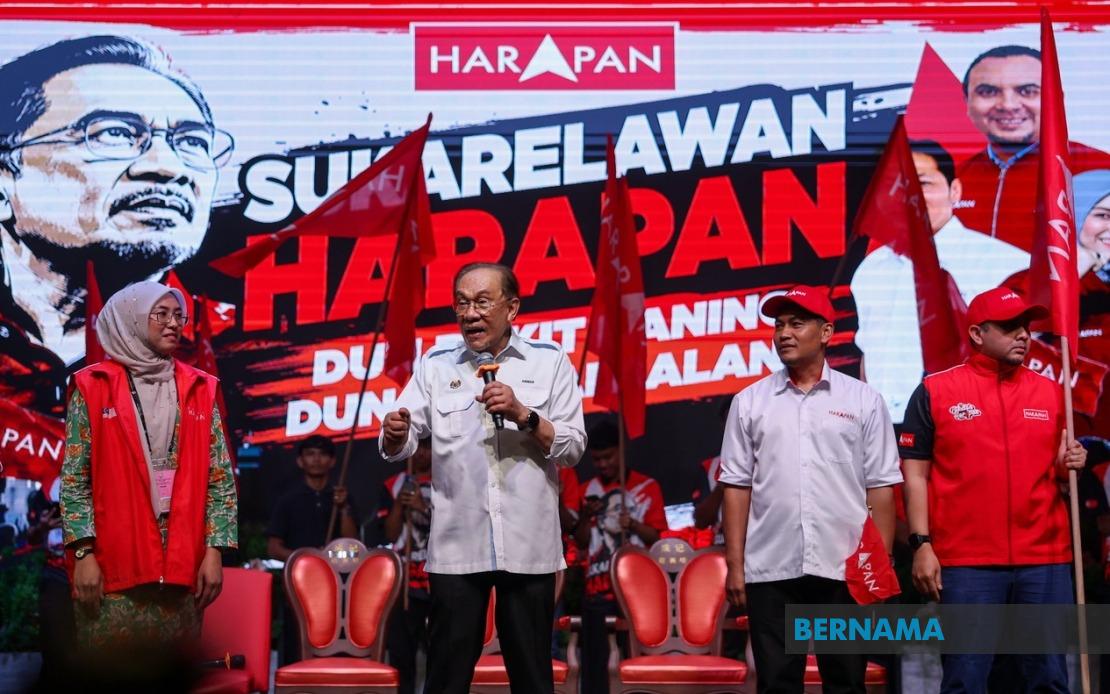
Prime Minister Datuk Seri Anwar Ibrahim has appealed to young voters in Johor to move away from polarising identity-based political messaging and instead cast their ballots for leaders who demonstrate genuine commitment to tangible improvements in their daily lives. Speaking at a volunteer campaign programme in Muar for the Bukit Naning state seat, Anwar positioned the forthcoming election as a decisive moment for the younger generation to exercise meaningful influence over the nation's trajectory by prioritising substantive issues over emotional grievances.
The Pakatan Harapan chairman articulated his vision for a future where electoral choices are anchored in pragmatic considerations rather than communal anxieties. Education access, economic opportunities, and regional development infrastructure should form the basis of voters' decisions, he suggested, rather than allowing fear-mongering narratives about different ethnic communities to determine outcomes. This positioning reflects a broader PH strategy to reframe Johor's election around competence and delivery rather than the identity-focused messaging that has traditionally dominated Malaysian electoral contests.
Anwar articulated his frustration with the persistence of what he termed a "rotten political system" that deliberately cultivates mistrust among ordinary citizens along ethnic lines whilst enabling those in power to pursue self-enrichment unchecked. He directly addressed the various demographic groups present at the event—Malay, Chinese, and Indian youth—with a unified call to action, suggesting that internal communal divisions serve primarily to distract from institutional corruption and elite privilege. His framing positions intergenerational solidarity against these divisive tactics as both a moral imperative and a practical pathway to systemic change.
The Prime Minister observed with evident satisfaction the substantial turnout of younger participants at the Muar gathering, interpreting their engagement as evidence of shifting political consciousness within Malaysia's younger demographic. He reflected on his lengthy career in electoral politics, characterising this particular moment as exceptionally significant and historically noteworthy. The enthusiasm displayed suggested to him that a genuine appetite for political transformation exists among voters least invested in maintaining existing power structures.
Anwar instructed campaign volunteers to undertake grassroots outreach across residential areas and local communities with a consistent message: that meaningful political change remains achievable through collective action and strategic voting. He framed the election not merely as a state-level contest but as an opportunity to establish precedent and momentum for broader national transformation. The emphasis on door-to-door organising and hyper-local messaging suggests PH's recognition that securing Johor requires mobilising voter bases through traditional ground campaigns rather than relying solely on national political narratives.
The broader political context for this election involves 172 candidates competing for 56 state assembly seats, with polling scheduled for July 11. Early voting will occur on July 7, providing an extended window for participation. The scale of the contest and compressed timeframe underscore the intensity of competition in what represents a crucial test of PH's electoral viability in a state historically dominated by opposition coalitions.
Anwar moved beyond campaign rhetoric to articulate a philosophical position on contemporary Malaysian nationalism, arguing that ethnicity-centred political messaging represents an anachronistic relic incompatible with the nation's standing as an independent, sovereign state. He characterised racial divisiveness as fundamentally corrosive to the social cohesion that constitutes Malaysia's enduring comparative advantage in a volatile region. The implication of his argument is that Malaysia's future prosperity and stability depend upon transcending the identity politics framework that has long structured its electoral competitions.
In this philosophical register, Anwar presented racial harmony not as a naive aspirational ideal but as a hardheaded practical necessity reflective of demographic reality. Malays, Chinese, Indians, and Orang Asli communities coexist within Malaysian territory, making coexistence predicated on mutual respect and reciprocal concern an inescapable requirement rather than an optional virtue. He suggested that Malaysia's continued peaceful stability despite its heterogeneous composition warranted gratitude and reinforced the feasibility of pluralistic democratic governance.
The Prime Minister's optimism about Malaysia's future rested substantially on his observations of the younger generation's apparent rejection of inherited communal categories and their demonstrated openness to alternative political frameworks. This assessment carries significant weight given the centrality of youth mobilisation to PH's electoral strategy across multiple recent contests. If indeed younger voters are shifting away from traditional identity-based voting patterns, the implications for Malaysia's political economy could prove substantial and durable.
Anwar concluded his remarks with an exhortation that young citizens recognise their agency and responsibility in constructing Malaysia's future direction rather than positioning themselves as passive observers of elite political competition. This framing inverts traditional power relationships by suggesting that electoral outcomes depend fundamentally on youth participation and that demographic cohorts have both the capacity and the obligation to reshape national trajectories. The message carries implicit suggestion that failure to mobilise and vote constitutes passive complicity in perpetuating existing systems that prioritise elite interests above collective wellbeing.
For Johor specifically, the election represents a test of whether PH can consolidate support among younger voters and translate anti-establishment sentiment into concrete electoral advantage. The party's performance on July 11 will provide crucial indicators regarding the durability and breadth of the political realignment that Anwar envisions, with implications extending well beyond this single state contest to shape understanding of Malaysia's broader political trajectory in the coming years.

