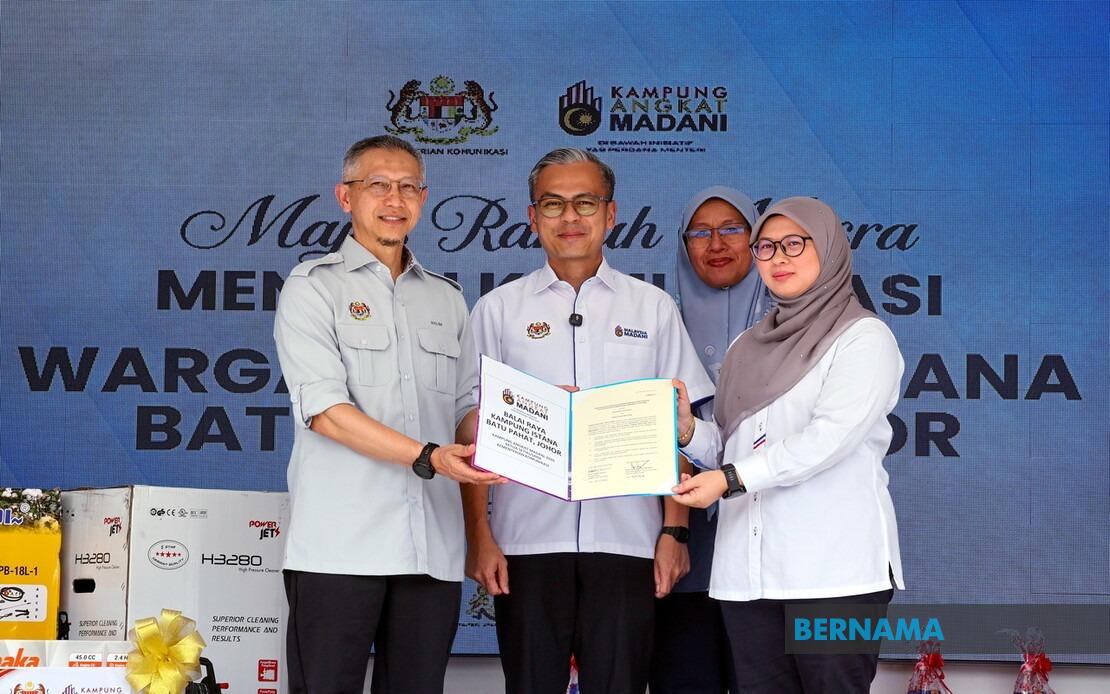
The upcoming Johor state election should be a choice about the state's future rather than an endorsement of any particular individual, according to Pakatan Harapan Communications Director Datuk Fahmi Fadzil. Speaking during a campaign stop in Batu Pahat on July 4, Fahmi sought to reframe the electoral narrative away from what he characterised as divisive personal narratives that have emerged during the campaign period. His comments represent an effort by PH to steer the conversation toward policy and governance issues that might resonate more broadly across Johor's electorate.
Fahmi's intervention came directly in response to statements made by Datuk Nazifuddin Mohd Najib, who suggested that a Barisan Nasional victory would reflect public backing for a pardon for his father, former Prime Minister Datuk Seri Najib Razak. The Communications Minister described such attempts to frame the election around individual personalities rather than substantive issues as concerning and counterproductive. He argued that linking electoral outcomes to personal matters rather than governance capabilities represents a fundamental misunderstanding of what voters should be considering when they cast their ballots.
The framing of elections around individuals versus issues carries significant implications for how Malaysian voters engage with democratic processes. Fahmi's emphasis on redirecting attention to state development and leadership quality suggests PH recognises that personality-driven campaigns can cut in unpredictable directions. By arguing that voters should resist being drawn into personal narratives, the Communications Minister was essentially appealing to a more issue-focused electorate that prioritises economic recovery and administrative competence over emotional or factional considerations.
Fahmi further elaborated on what he views as the core mistake in assuming that voter support can ever be taken for granted. He stressed that political parties must continuously earn public confidence rather than rely on historical voting patterns or demographic assumptions. This observation addresses a significant shift in Malaysian electoral dynamics over recent years, where traditional voting blocs have become increasingly volatile and unpredictable. The notion that support constituencies can simply be assumed reflects outdated political thinking that no longer matches reality on the ground.
The Communications Minister specifically cited instances of cross-party support emerging ahead of the election as evidence of changing political alignments. He referenced backing for Pakatan Harapan candidates from figures previously associated with UMNO and Bersatu, including former Rengit assemblyman Datuk Dr Mohd Puad Zarkashi. Such endorsements, Fahmi suggested, demonstrated that even within traditionally aligned voter communities, individuals are reassessing their political choices based on contemporary performance and future prospects rather than historical party loyalties.
The support from former opposition-aligned figures carries particular symbolic weight in Johor, where UMNO has historically maintained dominant electoral control. If individuals with established credentials within the Barisan Nasional framework are now publicly supporting Pakatan Harapan candidates, this signals deeper questioning of incumbent assumptions about electoral destiny. Fahmi presented such developments not merely as tactical gains but as indicators of genuine shifts in how voters across different backgrounds are evaluating their options.
Fahmi also addressed concerns about whether DAP's support among non-Malay voters remains as reliable as in previous elections. He reframed the entire premise of the question, arguing that no political party should ever regard any demographic group as a permanent voting base requiring minimal effort to maintain. Instead, he contended that successful political leadership demands continuous engagement, demonstrated competence, and sustained commitment to improving conditions for all communities. This approach attempts to transform what could be seen as a vulnerability for DAP into a broader statement about modern electoral expectations.
The election scheduled for July 11 involves 172 candidates competing for 56 seats across Johor, with early voting scheduled for July 7. The competition represents one of Malaysia's larger state-level contests and carries significance beyond Johor itself, as results could provide signals about broader national electoral trends and voter sentiment toward both coalitions. Fahmi's campaign messaging emphasises that voters should focus on which coalition and leadership team can better deliver economic recovery and development, particularly given Johor's importance as a major commercial and industrial state.
The distinction Fahmi drew between personality-focused and issue-focused electoral campaigns reflects broader debates within Malaysian politics about how to elevate campaign discourse. By explicitly rejecting what he characterised as problematic attempts to instrumentalise electoral results for personal rehabilitation, the Communications Minister positioned PH as appealing to voters' higher instincts toward collective progress. Whether this framing gains traction with voters will partly depend on how effectively both coalitions communicate their development visions and governance records in the remaining campaign period.
For Malaysian observers watching Johor politics, the election represents a test of whether voters will prioritise governance and economic outcomes over partisan loyalty or personal considerations. Fahmi's messaging suggests PH believes the answer is yes, and that voters are sophisticated enough to evaluate complex trade-offs between coalitions based on performance and future potential. The outcome will reveal whether contemporary Malaysian voters genuinely focus on such considerations or whether other factors continue to drive electoral behaviour.

