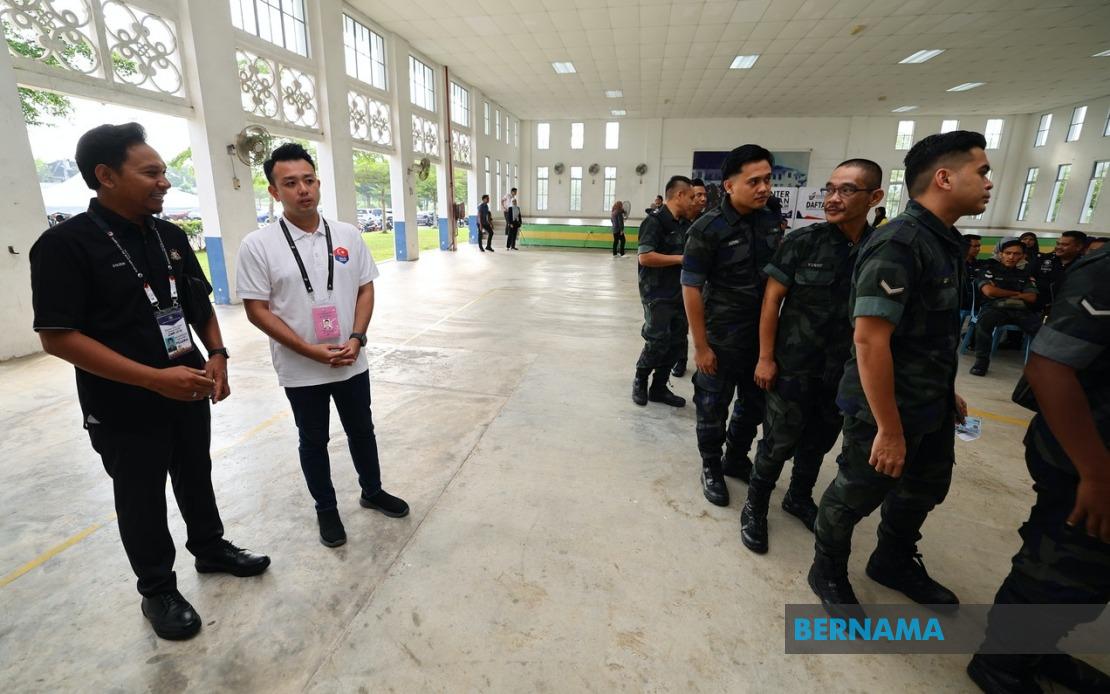
With the Johor state election set for Saturday, political candidates from the three major coalitions set aside their intensifying campaign efforts on Thursday to witness the early voting process unfold at various military and police installations across the state. The decision by candidates to observe proceedings at these dedicated voting centres underscores the significance both parties place on transparency and procedural integrity during the electoral process, particularly when it comes to members of the security forces who are granted early access to the ballot.
The Layang-Layang constituency drew particular attention when all three competing candidates made appearances at the 5th Battalion General Operations Force Camp in Simpang Renggam. Guna Balakrishnan representing Pakatan Harapan, Chua Jian Boon for Barisan Nasional, and Abd Mutalip Abd Rahim from Perikatan Nasional coordinated their visits to observe how voting proceeded among the camp's personnel. This tripartite presence demonstrated a rare moment of cross-coalition cooperation in the electoral process, with contenders united in their commitment to monitor fairness rather than divided by partisan interests.
Similar scenes played out in other contested seats across Johor. The Tenggaroh constituency saw Muhamad Amerul Muhamad of Perikatan Nasional, Mohd Youzaimi Yusof representing Barisan Nasional, and Md Yusof Dawam from Pakatan Harapan converging at the Iskandar Camp early voting centre in Mersing. Their presence reflected a pattern whereby candidates recognised the importance of maintaining public confidence in the electoral machinery, particularly in constituencies expected to be closely contested. The participation of candidates from across the political spectrum helped signal to voters that all major parties remained committed to upholding the integrity of the democratic process.
Prominent figures from the election race were also visible at other facilities. Lim Chin Eng, noted as the oldest candidate participating in the Johor polls, attended proceedings at the Johor Contingent Police Headquarters. Muhammad Faezuddin Mohd Puad, Pakatan Harapan's contender for the Kempas seat, positioned himself at the Kempas Police Station, while Datuk Jafni Md Shukor, the Barisan Nasional aspirant for Bukit Permai, observed operations at the Kulai District Police Headquarters. These distributed appearances ensured that candidates maintained visibility across multiple voting venues rather than concentrating their presence in a single location.
Beyond the political contestants, Malaysia's security establishment also maintained a visible presence throughout the early voting exercise. Army Chief General Tan Sri Azhan Md Othman visited the Iskandar Camp in Mersing alongside Major General Datuk Ahmad Shuhaimi Mat Wajab, commander of the 21st Special Service Group. Their attendance underscored the military's investment in ensuring that the electoral process for serving personnel proceeded without incident and adhered strictly to Election Commission protocols. Separately, Johor's police chief Datuk Ab Rahaman Arsad fulfilled his civic duty by casting his own vote at Dewan Dato Onn within the Johor Police Headquarters compound, visibly participating in the democratic exercise he helps oversee.
The early voting arrangements were designed to accommodate the operational constraints that security personnel face, given their duty commitments that might otherwise prevent them from voting on polling day itself. A total of 20,607 registered voters from security backgrounds participated in the Thursday early voting exercise. This cohort comprised 8,544 personnel from the Malaysian Armed Forces together with their spouses, and 12,063 police officers along with family members. The scale of early voting infrastructure required to service this population demonstrated the Election Commission's logistical commitment to ensuring the franchise remained accessible to all eligible citizens regardless of their employment circumstances.
Despite challenging weather conditions with brief rainfall at several polling locations throughout the morning, the voting process maintained momentum and orderliness. Security personnel arrived in scheduled waves beginning from eight in the morning, moving through voting stations in a disciplined fashion that reflected their professional backgrounds. The staggered arrival system, coordinated by Election Commission officers, prevented congestion while maintaining public health protocols and allowing election officials to manage voter flow effectively across the various designated stations.
The Election Commission operated 64 early voting centres beginning at eight in the morning, with closing times staggered between noon and six in the evening depending on individual venue locations and their respective voter registrations. This flexible scheduling accommodated the varying shift patterns and operational requirements of military units and police formations positioned throughout Johor, from urban centres like Johor Bahru to more remote installations in districts such as Mersing and Simpang Renggam. The geographical distribution of voting centres reflected the state's infrastructure reality and the dispersed nature of security force deployments.
With 172 candidates contesting across the 56 seats available in the Johor State Legislative Assembly, the upcoming Saturday election represents a significant engagement with the state's voters. The participation observed during Thursday's early voting session provided an early indicator of voter enthusiasm among security personnel, whose early engagement with the electoral process set the tone for the broader state election scheduled to take place three days later. The visible commitment by candidates and security officials to observe and participate in the process helped reinforce public perception of electoral integrity at a time when trust in democratic institutions remains paramount to Malaysia's political health.
The early voting exercise also carried symbolic weight beyond mere logistical necessity. By demonstrating their willingness to observe proceedings and participate visibly in the electoral process, candidates conveyed to security personnel—a constituency of considerable importance given their concentration in certain geographic areas—that all major political groupings respected their voting rights and welcomed their democratic participation. This outreach was particularly significant given the security forces' critical role in maintaining national stability and their traditional position as non-partisan guardians of national institutions. The candidates' presence signalled respect for this institutional role while simultaneously engaging with this important voter segment during a pivotal electoral moment for Johor.

