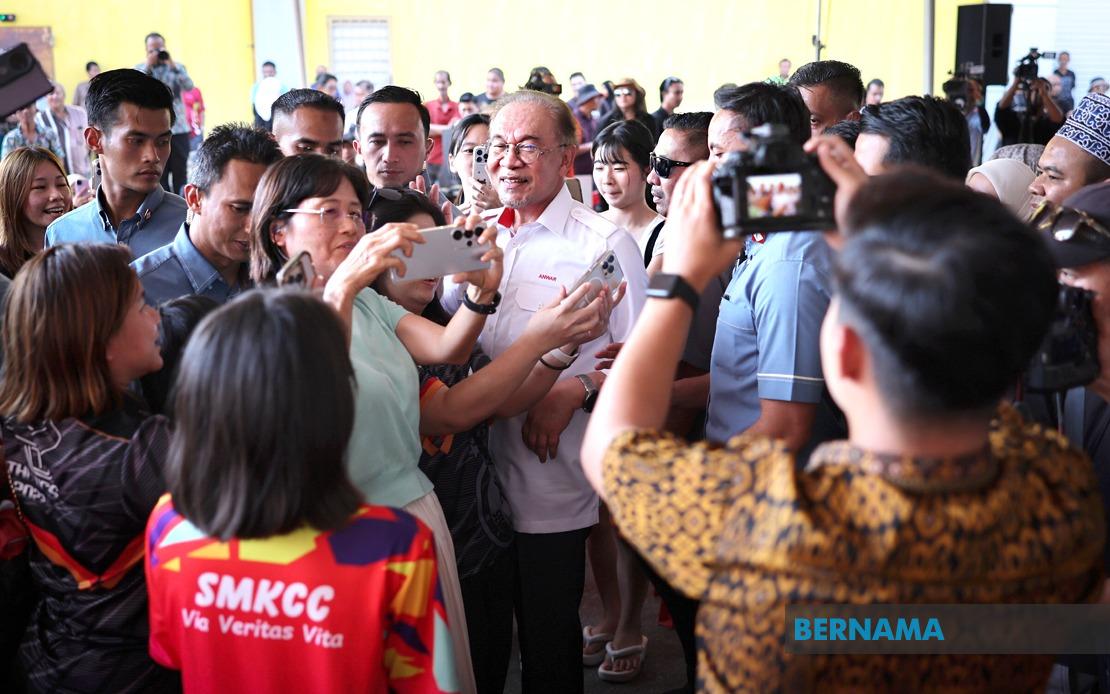
The 16th Johor State Election has entered its final and most decisive phase, with all political contenders deploying their remaining resources and leadership firepower in a concentrated push to secure voter support before the official campaign period concludes at 11:59 pm today. The competition to govern Malaysia's southernmost state has gradually built momentum over the past two weeks, and today marks the culmination of intensive grassroots mobilisation across 56 constituencies, where a total of 172 candidates are vying to claim their seats in the state assembly.
Pakatan Harapan's campaign machinery, helmed by party Chairman Datuk Seri Anwar Ibrahim, has orchestrated a comprehensive tour across five pivotal constituencies designed to energise the opposition coalition's candidate base and reinforce voter confidence in its vision. The Prime Minister's itinerary began in the Bukit Gambir state seat and subsequently moved through the strategically important constituencies of Bukit Batu and Layang-Layang, with the day's activities scheduled to culminate in Pasir Gudang at the 'Johor Ke Depan, Undi Harapan Grand Finale Programme'. This approach underscores PH's strategy to leverage the Prime Minister's national profile and position him as the figurehead representing the coalition's development agenda for Johor. In his social media messaging, Anwar Ibrahim also appealed for spiritual support, requesting prayers that the coalition's endeavours would proceed smoothly as voters head to the ballot boxes tomorrow.
Within the PH alliance, individual candidates have adopted more granular tactics suited to local constituencies. Suhaizan Kaiat, the coalition's candidate for the Larkin seat, opted for a more intimate engagement strategy by conducting a casual shopping mall walkabout in the city, accompanied by Amanah Vice President Datuk Seri Dr Dzulkefly Ahmad. This grassroots approach reflects a recognition that direct voter interaction in everyday spaces often proves more persuasive than large-scale rallies, allowing candidates to address specific local concerns and build personal connections that may influence voting behaviour. Suhaizan has characterised the feedback and concerns voiced by constituents throughout the two-week campaign as a mandate he feels personally accountable to deliver should he secure election to the state assembly.
Barisan Nasional has pursued a markedly different strategic emphasis, with party Chairman Datuk Seri Dr Ahmad Zahid Hamidi choosing to frame the final campaign day through a spiritual and moral lens. The Deputy Prime Minister's participation in a 'BN Grand Supplication & Doa Selamat' event in the Kulai district signals the coalition's attempt to connect the electoral process to voters' faith-based sensibilities and their desire for good governance rooted in moral principles. This approach carries particular resonance in a Muslim-majority state where religious values remain influential in political decision-making. Additionally, the incumbent Johor Menteri Besar and BN's Machap seat candidate Datuk Onn Hafiz Ghazi adopted a notably humble tone in his final campaign message, publicly apologising to the people of Johor for any shortcomings in his administration. This acknowledgment of administrative limitations, delivered through a Facebook video, represents an attempt to position BN's leadership as accountable and reflective rather than defensive.
Bersatu, a coalition partner of both Pakatan Harapan and Barisan Nasional in different configurations, has also sought to influence the election outcome through its party leadership. Bersatu President Tan Sri Muhyiddin Yassin has encouraged Johor voters to assess the competing parties based on information gathered during the campaign period and make selections aligned with their vision for state governance. His intervention underscores Bersatu's effort to maintain visibility and relevance in a three-way contest where larger coalitions threaten to overshadow smaller parties.
Bersama, another significant player in the electoral contest, has structured its final campaign activities around high-profile leadership figures, with Datuk Seri Rafizi Ramli and Nik Nazmi Nik Ahmad anchoring the 'Ceramah Finale BERSAMA' event. Rafizi's promise to deliver a comprehensive summary and counter-analysis of election-period issues in his closing speech reflects the party's strategy to position itself as offering substantive policy debate rather than personality-driven politics. This intellectual framing attempts to differentiate Bersama from competitors and appeal to voters seeking evidence-based governance proposals.
MUDA, Malaysia's newest significant political force, has similarly deployed its leadership to mobilise support in the final hours before polling. The party's 'Puteri Wangsa Grand Finale Lecture' represents a youth-oriented campaign strategy, with party President Amira Aisya Abd Aziz emphasising the fundamental democratic power held by state residents. MUDA's messaging centres on voter agency and the significance of electoral participation, appealing particularly to younger demographics who may feel alienated by traditional political establishments.
Weather conditions present a practical consideration that could influence voter turnout tomorrow. According to the Malaysian Meteorological Department, most Johor areas are forecast to experience clear morning conditions, though afternoon thunderstorms remain a possibility. While generally not catastrophic for electoral participation, afternoon rain could deter some voters, particularly in constituencies where transportation infrastructure or voter motivation remains fragile. Election officials and parties alike will monitor weather patterns closely, as unexpected precipitation can suppress turnout among less committed voters.
The 16th Johor State Election represents a significant inflection point in Malaysian politics, as the outcome will shape parliamentary dynamics and provide early indication of voter sentiment following the federal government's recent policy initiatives and economic management. A strong opposition performance could embolden Pakatan Harapan's position ahead of the next federal election, while a Barisan Nasional victory would demonstrate the coalition's continued electoral viability despite corruption allegations and leadership turbulence in recent years. The result will also clarify the trajectory of Bersatu, which has pursued an ambiguous political course, and may determine whether newer parties like MUDA and Bersama can establish substantive parliamentary representation. As 172 candidates seek to secure one of 56 seats, the competing visions for Johor's development, governance standards, and political direction will ultimately be determined by the state's electorate in what political analysts regard as a closely contested election.

