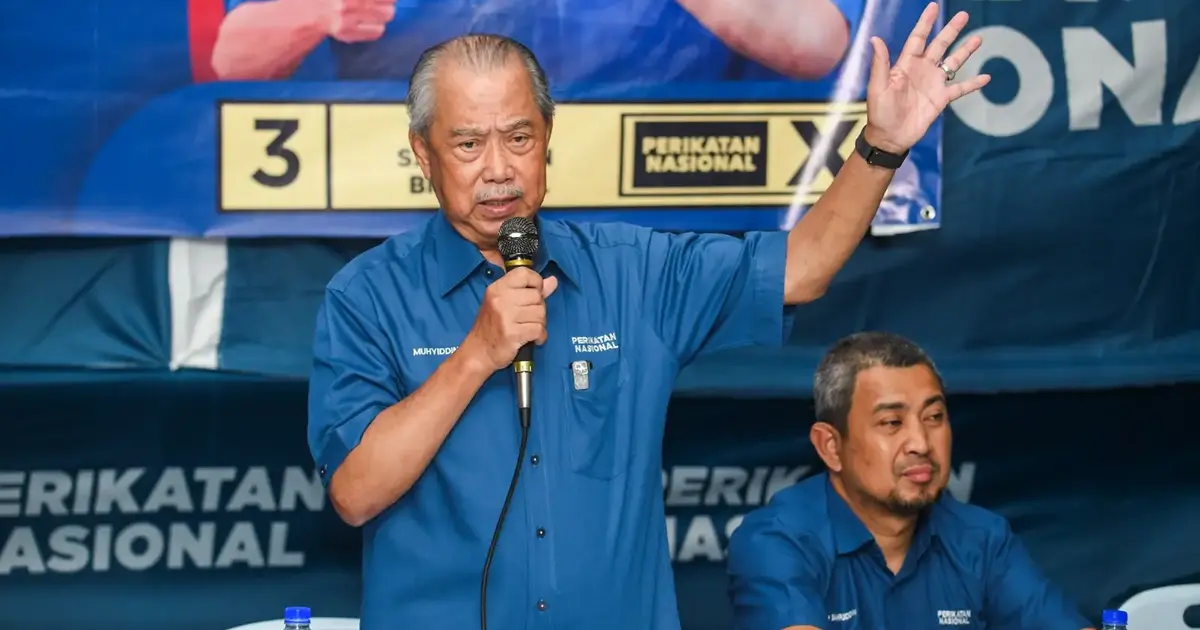
Bersatu party president Muhyiddin Yassin has pushed back against speculation connecting the timing of the Johor state election with any possible move toward releasing former Prime Minister Najib Razak, insisting that the two developments operate on entirely separate tracks within Malaysia's political and judicial systems.
Muhyiddin's statement addresses a persistent undercurrent of political commentary suggesting that strategic electoral calculations might influence decisions regarding Najib's incarceration. The Bersatu leader's intervention underscores the sensitivity surrounding Najib's status within ruling coalition circles, particularly as Johor prepares for a crucial state-level contest that will test voter sentiment toward the current government.
The former prime minister, convicted in 2020 of abuse of power related to misappropriated 1MDB funds, remains the most prominent figure caught in Malaysia's post-2018 anticorruption reckoning. His case continues to shape political alignments, with Umno—where Najib retains significant influence—navigating between acknowledging the verdict and maintaining party solidarity. Muhyiddin's clarification suggests frustration with narrative threads linking electoral strategy to criminal justice outcomes, a connection that could undermine public confidence in both processes.
The Johor election carries outsized significance for the federal coalition government. As a historically Umno-dominated stronghold, the state represents crucial testing ground for voter appetite ahead of any general election. Speculation about Najib's fate inevitably colours discussions of Umno's electoral standing, since the party must balance punishing distance from the scandal-tainted figure against alienating supporters who view his imprisonment as politically motivated persecution.
Muhyiddin's intervention establishes clear institutional boundaries. By emphasizing Najib's convicted status, the Bersatu president signals that any clemency or early release would represent a executive decision operating independently of electoral calendars. This framing protects the judiciary from suggestions of political interference while simultaneously defending the government against accusations of using electoral timing to mask unpopular decisions regarding Najib.
Yet the very necessity of Muhyiddin's statement reveals the tight interweaving of criminal justice and electoral politics in contemporary Malaysia. When senior coalition figures must publicly divorce two significant developments from each other, it typically indicates substantial public perception that they remain connected. The Johor election will inevitably occur within a political environment shaped by Najib's case, regardless of whether direct causal links exist.
For voters and political analysts, Muhyiddin's position reflects broader questions about Malaysia's transition from the 1MDB scandal era. The country has spent four years attempting to move forward from allegations of monumental corruption, yet key figures remain imprisoned and judicial processes continue unfurling. The Johor election provides opportunity to gauge whether Malaysian voters have genuinely absorbed accountability measures or whether they view anticorruption efforts as selectively applied political weaponry.
Umno faces particular pressure navigating these currents. The party cannot entirely repudiate Najib without acknowledging complicity in earlier party governance, yet associating too closely with him invites voter backlash against perceived attempts to rehabilitate a disgraced figure. Muhyiddin's statement offers coalition partners a template for separating electoral calculations from justice system outcomes, allowing government figures to contest the Johor election without appearing to court Najib's rehabilitation.
The broader regional context matters as well. Southeast Asian democracies struggle with similar tensions between accountability and political rehabilitation. How Malaysia manages Najib's case while conducting competitive elections sends signals about whether countries in the region can sustain anticorruption efforts without collapsing into purely partisan judicial weaponization. Muhyiddin's insistence on maintaining separation between these domains contributes, however modestly, to international perceptions of institutional integrity.
Muhyiddin's clarification also implicitly acknowledges Bersatu's own vulnerability on governance issues. The party, formed by defectors from Umno and Mahathir's circle, stakes significant political capital on presenting itself as reform-oriented and committed to cleaning up Malaysian governance. Allowing suggestions that the Johor election timing influenced Najib's fate would directly undermine this brand positioning, potentially damaging Bersatu's appeal to voters seeking substantive change rather than surface-level political musical chairs.
Moving forward, the Johor election will occur against this carefully established institutional backdrop. Campaign messaging will almost inevitably touch upon governance standards, party integrity, and the government's approach to accountability. However, Muhyiddin's intervention has established a public record asserting that electoral outcomes and criminal justice decisions remain institutionally distinct, a position that provides political cover for whichever direction federal leadership ultimately chooses regarding Najib's incarceration status.

