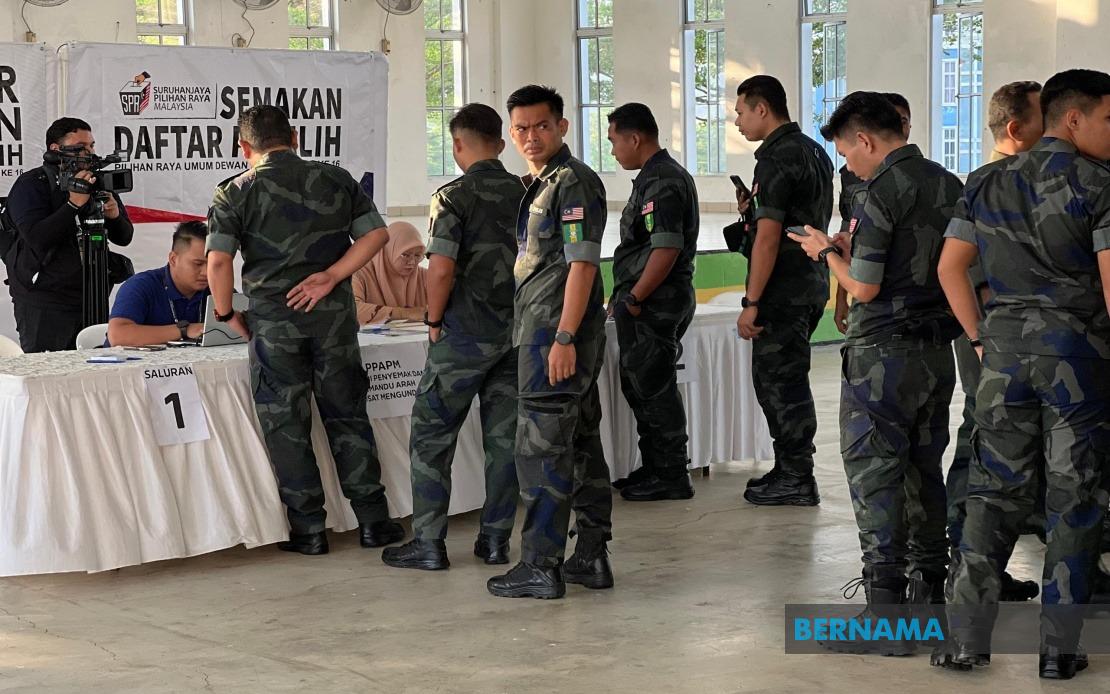
The Johor state election process entered a new phase on Friday as 64 early voting centres unlocked their doors at 8 am, providing military and police personnel with a dedicated opportunity to cast their ballots before the main polling day scheduled for Saturday. This arrangement accommodates the unique voting schedules required for members of the security establishment and their spouses, who collectively number 24,751 eligible voters across the state.
The Election Commission's logistical framework divides these advance voters into two distinct groups based on their institutional affiliations. The Malaysian Armed Forces contingent, comprising 12,041 uniformed personnel and their spouses, will exercise their franchise at 11 designated polling centres distributed across Johor. This arrangement ensures that military voters have convenient access to voting facilities without disrupting operational commitments or requiring extended absences from their postings.
The Police Royal Malaysia and General Operations Force component represents the larger segment of early voters, with 12,710 individuals scheduled to cast votes at 53 separate polling locations. This wider distribution of polling centres reflects the dispersed nature of law enforcement deployments across the state, allowing police officers and their families to vote in proximity to their station assignments or residential addresses. The substantial difference in the number of centres allocated to police and armed forces voters underscores the geographic spread of policing operations throughout Johor's various districts.
The voting timeline accommodates the staggered closure of these facilities, with the Election Commission scheduling sequential shutdowns beginning at noon and extending until 6 pm. This graduated approach prevents the logistical bottlenecks that might occur if all centres closed simultaneously, while also allowing election officials to manage vote tallying and administrative procedures in manageable tranches throughout the afternoon. The phased closure system represents standard practice for early voting arrangements in Malaysian elections.
Weather conditions across Johor on Friday presented favourable circumstances for voting, with multiple districts including Batu Pahat, Muar, Pontian and Tangkak experiencing sunny skies. Clear weather typically correlates with higher voter turnout as it removes precipitation-related barriers to travelling to polling stations. The positive meteorological conditions stood in contrast to the monsoon patterns that occasionally challenge electoral participation in Malaysian states with tropical climates.
The early voting exercise serves as a preliminary gauge of electoral engagement and operational efficiency ahead of the much larger exercise scheduled for Saturday, when approximately 2.7 million ordinary voters will participate in selecting representatives for all 56 state seats in the Johor state assembly. The scale of Saturday's main polling day dwarfs the current early voting process, making Friday's proceedings essentially a calibration run for the electoral machinery and personnel who will manage the significantly expanded operation.
For Malaysian readers tracking Johor's political trajectory, this state election carries considerable significance given the state's economic importance and its role as a bellwether for broader regional political sentiment in the southern Peninsular region. The participation of security forces in Johor's electoral process reflects broader Malaysian democratic principles that extend voting rights universally among eligible citizens, regardless of professional affiliation. The institutional accommodation of military and police voting schedules demonstrates the Election Commission's acknowledgment that public servants require special provisions to balance their civic responsibilities with their occupational obligations.
The advance voting arrangement also reflects practical realities of security force deployments that may make Saturday participation difficult or impossible for some personnel. By offering early voting facilities, the Election Commission removes a potential barrier to democratic participation for this segment of the population, ensuring that electoral participation is not inadvertently compromised by the demands of security sector employment. This logistical consideration has long been standard practice in Malaysian electoral administration.
The detailed breakdown of voting centres by institutional affiliation provides transparency regarding the Election Commission's preparation for the polling exercise and offers reassurance that adequate facilities exist to accommodate the expected voter turnout among security personnel. The disparity in centre allocation between armed forces and police voters reflects both the differing sizes of these constituencies and the geographic distribution patterns of their respective postings throughout Johor's landscape.
As Johor voters prepared for Saturday's main election, Friday's early voting process moved forward without reported complications, suggesting that the electoral infrastructure functioned smoothly and that election officials had adequately positioned themselves to manage the advance voting operation. The successful execution of early voting procedures typically indicates positive auguries for the main polling day's conduct, though the substantially larger numbers expected on Saturday will present more complex logistical challenges for the Election Commission and its deployment of poll workers across the state's 56 constituencies.

