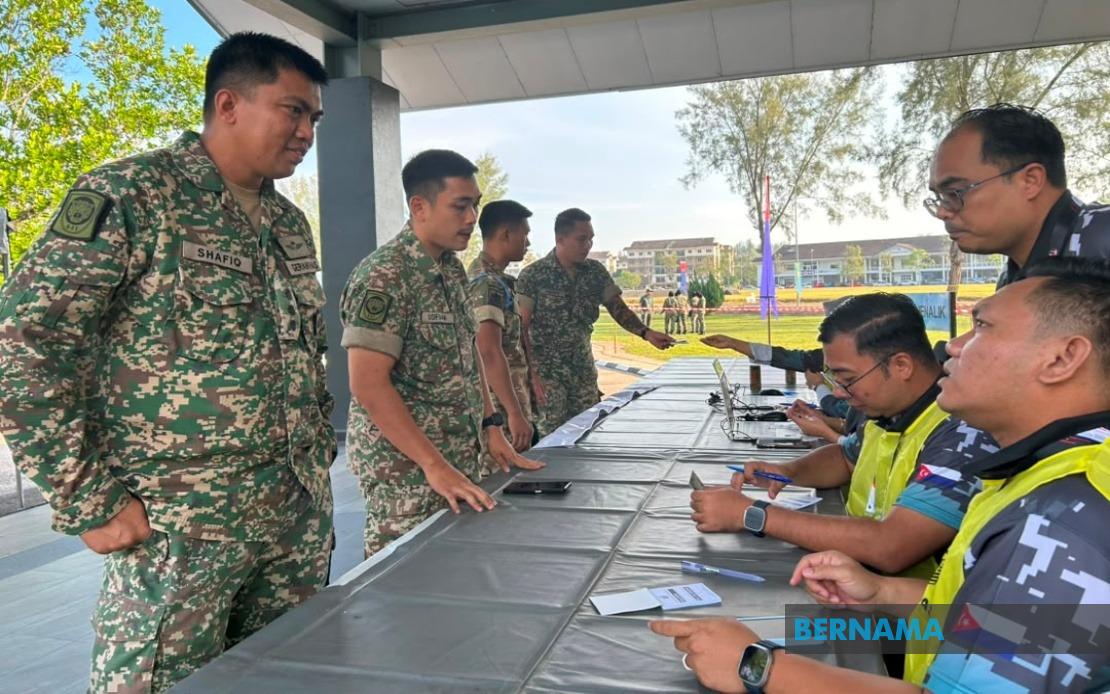
The Johor state election's early voting phase began on July 7 under favourable atmospheric conditions, with security forces and their families arriving at polling stations from dawn to exercise their franchise ahead of the broader electoral event scheduled for Saturday. Clear skies dominated the morning across the state capital and surrounding regions, creating optimal conditions for the smooth flow of personnel through the 64 dedicated early polling centres that opened their doors at 8 am, having prepared since 7.30 am for the anticipated influx of voters.
A total of 24,751 voters participated in the early polling exercise, comprising military and police personnel alongside their spouses who required alternative voting arrangements due to their operational duties during the main election day. The Malaysian Armed Forces contributed 12,041 eligible voters from their ranks and their families, while the Royal Malaysia Police and General Operations Force together mobilised 12,710 personnel and their dependents to participate in this preliminary phase. This substantial early voter cohort underscores the logistical complexity inherent in managing electoral participation among uniformed services across a geographically dispersed state.
Election Commission officials conducted meticulous preparation before the polls opened, undertaking final procedural checks across all designated venues to ensure voting could proceed without hindrance or administrative confusion. On-the-ground observations by electoral monitors at key locations including the 5th Battalion GOF Camp in Simpang Renggam, the Johor Contingent Police Headquarters, and Mahkota Kluang Camp confirmed that voting operations unfolded with requisite order and efficiency throughout the morning period. The Election Commission's investment in these preparatory measures evidently paid dividends, establishing a template of organisational competence for the main polling day ahead.
Meteorological forecasts, however, injected a note of caution into an otherwise unblemished operational landscape. The Malaysian Meteorological Department issued warnings of thunderstorms likely to develop across Johor during afternoon hours, potentially affecting visibility, voter movement, and logistical operations at some locations. This meteorological threat posed particular challenges given that early polling centres operated on staggered closing schedules, with different venues shutting down between noon and 6 pm based on their geographic position and individual voter registrations. Such variability meant that some centres would close before peak afternoon weather instability, while others remained vulnerable to storm disruptions during their final operational hours.
The electoral framework encompassing this contest extends substantially beyond the early voting phase. Across the entirety of Johor, 2,727,926 registered voters held voting rights in the 16th state election, with the Election Commission establishing 1,140 conventional polling stations to accommodate this electorate on the main voting day. The election itself represented a significant democratic exercise, with 172 candidates contesting across 56 state assembly seats distributed throughout the state's diverse constituencies. This candidate-to-seat ratio of approximately 3.07 reflected vigorous competition and genuine multi-party contestation at the state legislative level.
The geographic and demographic scope of the Johor election underscores the substantial logistical undertaking required to administer democratic processes across Malaysia's southern peninsula region. With nearly 2.73 million eligible voters spread across 56 constituencies and more than one thousand polling venues, the Election Commission faced considerable coordination challenges in ensuring simultaneous, fair, and administratively sound voting nationwide. The early voting phase represented the electoral authority's effort to accommodate those whose public service duties would preclude attendance during conventional polling hours, balancing operational requirements of state security apparatus against constitutional guarantees of electoral participation.
The scheduling of voting across multiple stages and locations reflects standard Malaysian electoral practice, wherein security personnel and certain government functionaries receive separate provision to discharge their civic duties while maintaining operational continuity in sensitive sectors. This accommodative approach acknowledges practical realities of governance—that police, military, and paramilitary forces must sustain full operational capacity throughout electoral periods—while preserving the democratic principle of universal suffrage among all eligible citizens. The Johor exercise thus exemplified how electoral authorities balance competing institutional requirements with democratic imperatives.
Weather conditions, while currently favourable, represented a variable that could influence turnout patterns and operational efficiency across both early and main polling phases. Thunderstorm warnings carried implications not merely for voter comfort but potentially for accessibility to polling centres in low-lying or flood-prone areas. Malaysian electoral history demonstrates that adverse weather occasionally constrains participation among rural and semi-rural constituencies, where transportation infrastructure may prove vulnerable to precipitation and flash flooding. The meteorological forecast therefore warranted close monitoring as state elections proceeded toward their climactic Saturday voting day.
From a broader Southeast Asian perspective, Johor's state electoral processes merit attention as Malaysia continues refining democratic institutions and electoral administration. Regional observers monitoring democratic health across the Association of Southeast Asian Nations context increasingly scrutinise how member states manage elections, particularly regarding transparency, inclusivity, and administrative efficiency. Malaysia's systematic approach to accommodating security personnel, its deployment of substantial polling infrastructure, and its engagement with meteorological services to anticipate operational challenges all reflect institutional maturity in democratic management. The early voting exercise, proceeding smoothly despite logistical complexity, demonstrated competent election administration at the state level.
As voters prepared for the main election on Saturday, the early polling phase had established operational baselines and procedural rhythms that would carry forward. The smooth administration of voting among security personnel, combined with fair weather conditions during morning hours, suggested that the broader electorate could expect similarly well-organised facilities when they exercised franchise in the main contest. Whether afternoon thunderstorms would materially affect Saturday's turnout rates remained uncertain, though the Election Commission's demonstrated capacity to manage complex voting logistics suggested reasonable confidence in their ability to mitigate weather-related disruptions should they materialise across multiple constituencies simultaneously.

