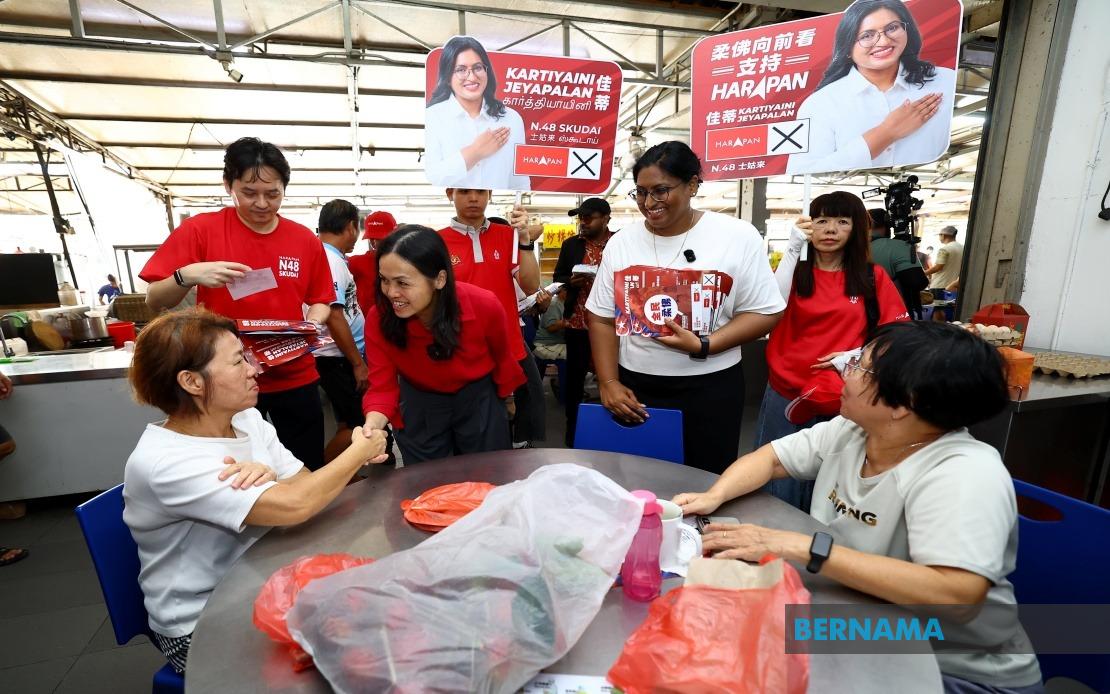
Johor's Democratic Action Party leadership has launched an impassioned appeal to the state's registered voters, urging them to recognise the privilege of democratic participation ahead of Saturday's 16th state election. The call came from Johor DAP chairman Teo Nie Ching, who also serves as Deputy Communications Minister, as she addressed voters particularly those working or living outside the state or internationally. Her message stressed that the right to cast a ballot represents a fundamental democratic freedom that should not be taken for granted, especially given the ease of voting compared to the challenges faced by Malaysians scattered across the globe.
Teo's advocacy was anchored in several poignant narratives that underscored the determination of overseas Malaysians to participate in their homeland's electoral process. One particularly striking account involved a Johor voter based in Queensland, Australia, who confronted logistical barriers when conventional courier services could not guarantee timely delivery of postal ballots before the July 11 deadline. Rather than accept defeat, this voter travelled to the airport hoping to find a sympathetic fellow Malaysian willing to carry the ballot home by hand. The Deputy Communications Minister drew explicit parallels between such resolute commitment and the responsibilities of domestic voters, questioning why those with geographic proximity to polling stations should display less enthusiasm than those separated by continental distances and substantial financial costs.
Another example that resonated throughout her remarks involved a postgraduate student pursuing a master's degree in China. Facing scheduling conflicts, this individual made the costly decision to alter their flight arrangements at personal expense exceeding RM1,000 simply to ensure their physical presence at the ballot box. Similarly, Teo highlighted the experience of a United States-based voter who invested considerable effort in locating an available Malaysian citizen to witness their postal voting procedure, a requirement that added another layer of complexity to their participatory effort. These narratives collectively illustrated that Malaysian diaspora communities, despite geographical separation and logistical hurdles, maintained strong commitment to electoral engagement.
The Deputy Communications Minister's remarks carried implicit messaging directed at voters in major Malaysian employment centres, particularly Kuala Lumpur and Singapore. She suggested that workers in these proximate urban centres should find it considerably less burdensome to travel home for polling day compared to their overseas counterparts who demonstrated such determination. The appeal represented a strategic recognition that significant voter populations commute across state and international borders for employment, and mobilising these voters could substantially influence electoral outcomes. Pakatan Harapan's machinery has identified cross-border workers, particularly those employed in Singapore, as a critical constituency requiring targeted encouragement to return home and participate in determining Johor's political direction.
Beyond voter mobilisation, Teo dedicated substantial attention to the challenge of misinformation circulating through digital channels during the election campaign period. She cautioned the public against the dangers posed by counterfeit social media accounts and deliberately fabricated narratives designed to confuse voters during this crucial democratic exercise. Her warning reflected growing concerns across Southeast Asia regarding the vulnerability of electoral processes to coordinated disinformation campaigns that exploit social media's rapid information diffusion mechanisms. The challenge intensifies when fraudulent accounts mimic legitimate political figures or organisations, creating confusion among voters who struggle to distinguish authentic communications from manipulated content.
Teo advocated for population-wide adoption of digital literacy practices, particularly emphasising a 'verify before you share' cultural norm that could substantially mitigate false information propagation. She articulated the paradox inherent in internet technology: while legitimate communication spreads efficiently through digital networks, malicious falsehoods disseminate even more rapidly, often outpacing fact-checking efforts. Her prescription essentially encouraged individual citizens to assume responsibility as custodians of information integrity by exercising scepticism before amplifying unverified claims through their social networks. This approach acknowledges that institutional fact-checking resources, while necessary, cannot match the speed and scale of voluntary peer verification systems operating across civil society.
The campaign activities described by Skudai state seat candidate Kartiyaini Jeyapalan revealed the systematic efforts Pakatan Harapan has deployed to contact geographically dispersed voters. Beyond conventional door-to-door canvassing, PH organisers positioned themselves at the Sultan Iskandar Building Customs, Immigration and Quarantine Complex beginning at 5:00 am to intercept cross-border commuters during their early morning departures toward Singapore. The strategy demonstrated recognition that workers bound for neighbouring Singapore represented a concentrated, accessible population segment that could be efficiently reached at transport hubs. Additionally, party members boarded cross-border worker buses to deliver their message directly to captive audiences during commutes, a tactic that generated reported positive responses from recipients.
Kartiyaini's messaging transcended simple voter encouragement by situating state elections within a broader framework of governance quality and developmental outcomes. She contended that voters frequently underestimate state elections' significance relative to federal elections, despite the reality that state governments exercise substantial authority over local development policies, infrastructure investment, and service provision. This framing attempted to elevate public consciousness regarding state-level electoral stakes, potentially combating the phenomenon whereby voters show lower enthusiasm for subnational elections. The assertion that capable state administrations can implement transformative policies reflected confidence in Johor's potential if Pakatan Harapan gained control of state government.
The 16th Johor state election will determine representation across 56 state assembly constituencies through votes cast by approximately 2.7 million registered voters. This substantial electorate represents significant political weight within Malaysia's federation, particularly given Johor's economic importance and geographic positioning adjacent to Singapore. The scale of participation implied by this voter population underscores the election's relevance to Malaysia's broader political trajectory. Historically, Johor has served as a political bellwether reflecting shifting electoral patterns across the country, making outcomes here potentially consequential for understanding Malaysian voter sentiment.
The simultaneous mobilisation of messaging around voter participation, misinformation vigilance, and the substantive importance of state governance reflected Pakatan Harapan's comprehensive campaign strategy. Rather than limiting outreach to traditional party supporters, the coalition's leadership recognised necessity of engaging undecided voters while simultaneously defending against alternative narratives circulating through digital channels. The emphasis on inspiring overseas Malaysians' commitment as a model for domestic voters represented a rhetorical strategy designed to reframe voting not merely as an obligation but as a valued democratic privilege. Whether such messaging successfully translates into enhanced turnout, particularly among the cross-border worker populations explicitly targeted, will become evident through Saturday's election results and comparative turnout figures.

