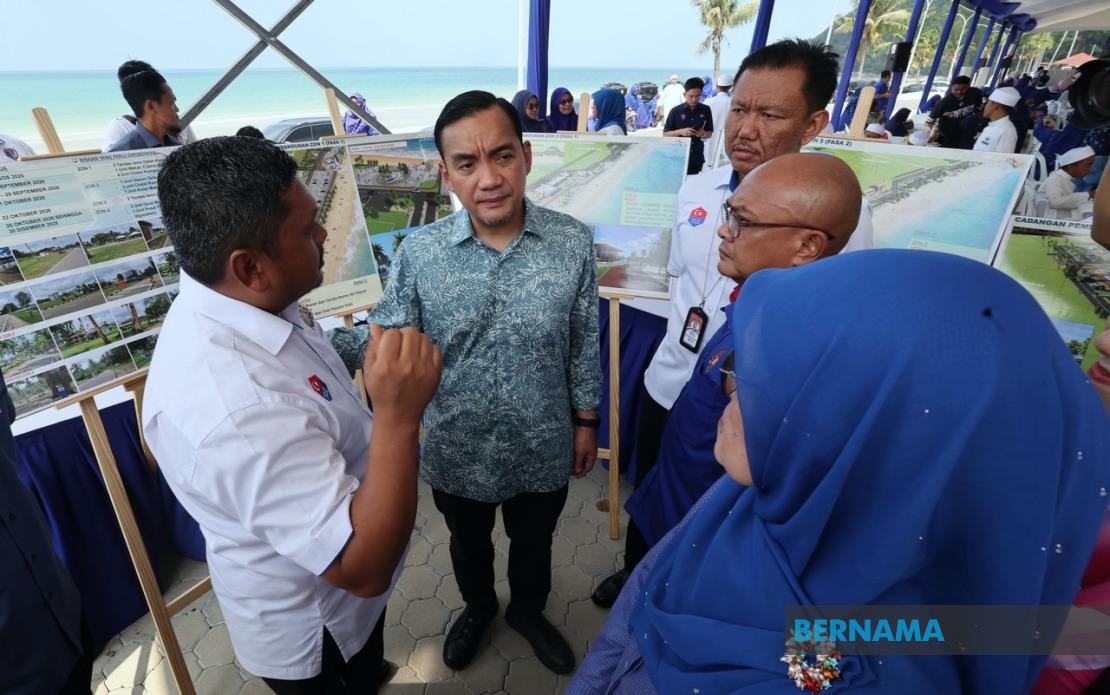
Johor's government has earmarked RM1.5 million to drive comprehensive development across Mersing, targeting infrastructure modernization, sports amenities, healthcare services, and utility improvements designed to extend economic benefits to the district's residents. Menteri Besar Datuk Onn Hafiz Ghazi outlined the allocation during a visit to the district, emphasizing the state's commitment to replicating the development success experienced in Johor Bahru across all of Johor's communities.
The initiative reflects a strategic pivot within the state administration to ensure prosperity is not concentrated in urban centers but distributed equitably throughout the state. Onn Hafiz underscored that tourism infrastructure and economic projects lose meaning if the approximately 80,000 inhabitants of Mersing cannot directly participate in or benefit from these developments. This concern speaks to a broader Malaysian challenge where coastal and rural districts sometimes remain peripheral to state-level economic narratives despite their tourism or resource potential.
The Johor Economic Transformation Plan, or JETP, underpins this approach, establishing targets across short, medium, and long-term horizons designed to strengthen the state economy while simultaneously improving household livelihoods. Youth employment emerges as a critical focal point within this framework, addressing a persistent concern across Malaysia where young people often face limited opportunities outside major metropolitan areas. By anchoring development initiatives to job creation and skill-building, Johor attempts to reverse migration patterns that typically see young talent flowing toward Kuala Lumpur and other larger cities.
Healthcare receives substantial investment, with RM500,000 allocated exclusively to upgrade the haemodialysis unit at Mersing Hospital. This investment recognizes that healthcare infrastructure in smaller towns often lags behind larger urban counterparts, and kidney dialysis services particularly serve populations with chronic conditions requiring reliable access to specialized facilities. The upgrade addresses not only medical needs but also quality-of-life considerations for patients and their families.
Sports and recreational infrastructure form another pillar of the allocation. RM200,000 will fund construction of a futsal court at Taman Sri Mersing, while a separate RM200,000 supports repairs at Felda Nitar's existing futsal court. An additional RM80,000 has been reserved for building a sepak takraw court in Felda Tenggaroh 6. These investments in grassroots sports facilities serve multiple functions—providing healthy recreational outlets for young people, fostering community cohesion, and potentially nurturing athletic talent that could represent the district and state at regional and national levels.
Religious and community facilities also feature prominently in the spending plan. The Kampung Sri Lalang Mosque will receive RM200,000 for carpet replacement, addressing maintenance needs in an important community gathering space. Simultaneously, the Kami Anak Felda Malaysia building in Felda Tenggaroh Timur will undergo upgrading with RM100,000, supporting programs that serve the descendants of Felda settlers—a demographic group that has historically faced distinct socioeconomic challenges within Malaysia's development framework.
Infrastructure improvements targeting underserved populations underline the administration's inclusivity approach. RM100,000 each will install solar-powered streetlighting in the Orang Asli villages of Kampung Peta and Kampung Tanjung Tuan, directly addressing energy access disparities affecting Malaysia's indigenous communities. Solar technology proves particularly suitable for rural areas where grid extension remains costly and unreliable, while offering long-term sustainability benefits aligned with Malaysia's renewable energy commitments.
Beyond immediate capital spending, the Menteri Besar articulated several longer-term strategic initiatives that extend Mersing's economic and institutional capacity. A proposal to establish a petrol station at Camp Iskandar specifically serving Special Forces Group personnel represents both a commercial opportunity and institutional investment, coordinated through the local assemblyman and district administration. Plans for a Religious Affairs Office would formalize Islamic administrative functions, reducing red tape for residents requiring religious services and documentation, while a Technical and Vocational Education and Training campus would provide crucial skills training locally, addressing workforce development needs without requiring youth to relocate for technical education.
These coordinated investments reflect recognition that development sustainability requires simultaneity across multiple sectors—healthcare, education, infrastructure, recreation, and commerce must advance together rather than in isolated silos. For Mersing specifically, a coastal district with tourism potential but historically limited economic diversification, this comprehensive approach addresses structural constraints that have prevented equitable prosperity distribution. The allocation represents neither transformative change nor a silver bullet, but rather a meaningful step toward recalibrating state-level attention toward districts that, while less visible in national discourse than Johor Bahru or major metropolitan zones, contain substantial populations and untapped economic potential requiring deliberate investment and governance attention.

