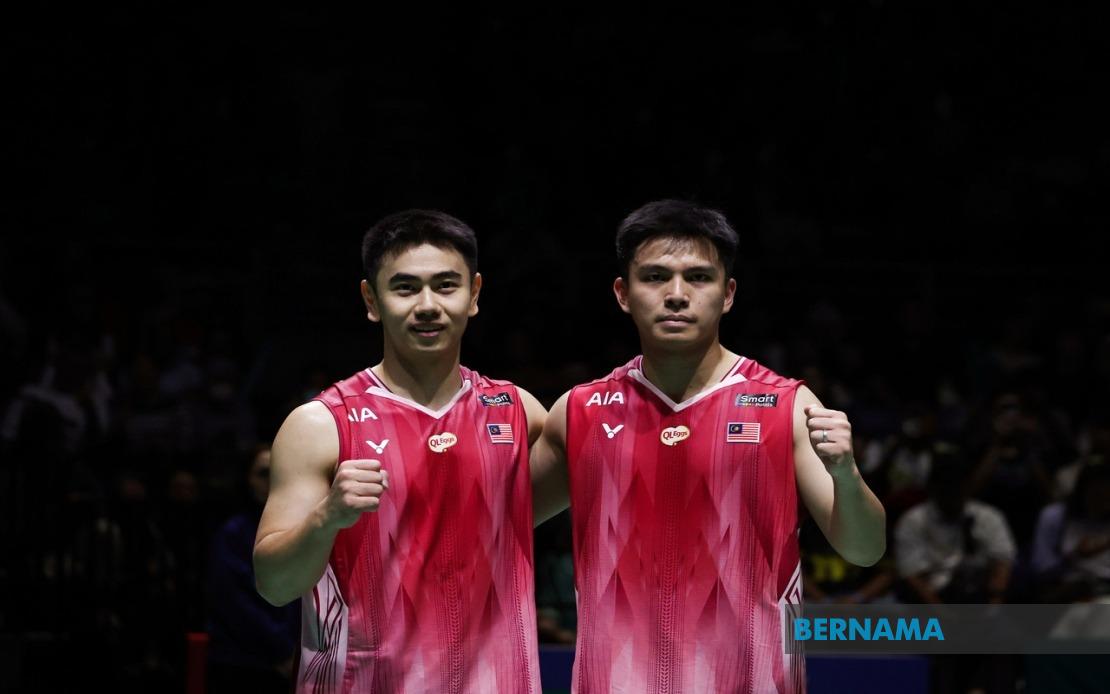
Malaysia's badminton contingent continued their impressive campaign at the Japan Open 2026 in Tokyo on July 17, with two pairs advancing to the semifinals and keeping the nation's medal hopes alive at the prestigious tournament. The strong showing underscores Malaysia's continued competitiveness in international mixed and men's doubles competition, a category where the country has traditionally performed well on the global stage.
The unseeded mixed doubles pairing of Jimmy Wong-Cheng Su Yin produced one of the day's standout performances by eliminating Denmark's third-seeded combination of Mathias Christiansen and Alexandra Boje. The Malaysian pair executed a controlled and disciplined display, securing a comfortable 21-17, 21-17 victory in just 39 minutes to complete a significant upset. This triumph was particularly notable given the ranking disparity and demonstrates the growing strength of Malaysia's mixed doubles pool. The result also brought the head-to-head record between the two pairs to an even 1-1, suggesting competitive parity between the Malaysian underdogs and the more established Danish pairing.
Jimmy and Su Yin's progression sets up an intriguing semifinal matchup against Hong Kong's seventh-seeded Tang Chun Man-Tse Ying Suet, a pairing they have never previously faced in competitive play. This fixture presents both an opportunity and a challenge, as the absence of prior head-to-head data means both teams will be entering relatively unfamiliar territory tactically. For Malaysian badminton enthusiasts, the encounter represents a crucial test against an emerging Hong Kong pair looking to establish itself on the international circuit.
In the men's doubles category, the fifth-seeded Malaysian duo of Goh Sze Fei and Nur Izzuddin Rumsani navigated a gruelling quarterfinal encounter against the United States' Chen Zhi Yi and Presley Smith. The match extended to a full three games, with the Malaysians ultimately prevailing 21-18, 15-21, 21-13 in a battle that consumed 50 minutes of intense competition. Their comeback victory after surrendering the second set illustrated their mental resilience and capacity to perform under pressure, qualities essential for success in knockout tournament formats.
The Malaysian men's doubles duo's triumph marked their fourth consecutive victory over the American pairing, establishing a dominant pattern in their rivalry. However, this winning streak carries less significance for their upcoming semifinal clash, where they will face a fundamentally different calibre of opposition. The second game loss to Chen and Smith suggests some vulnerability in their setup that more accomplished opponents may seek to exploit, a consideration that undoubtedly features in their preparation for the subsequent round.
Sze Fei and Nur Izzuddin must now contend with South Korea's top-seeded pairing of Kim Won Ho and Seo Seung Jae, widely regarded as the world's premier men's doubles team. The prospect of facing the tournament favourites presents one of the tournament's most challenging assignments for any Malaysian competitor. The head-to-head record between these pairs currently stands at 2-2, creating genuine balance in their rivalry despite the Koreans' elevated global ranking. Significantly, the Malaysians recently recorded a victory over the Korean pair at the Indonesia Open 2026, providing recent evidence that they possess the tactical blueprint and capability to compete at the highest level.
Earlier in the day, another Malaysian men's doubles pair experienced disappointment when Kang Khai Xing and Aaron Tai succumbed to Kim Won Ho and Seo Seung Jae in a thoroughly one-sided quarterfinal encounter. The Koreans' 21-13, 21-10 straight-sets victory was executed with clinical efficiency, allowing little room for the Malaysian challengers to impose their game. This decisive defeat highlighted the formidable quality of the Korean top seeds and reinforced their status as the tournament's clear favourites.
The contrasting fortunes of Malaysia's two men's doubles pairs at the Japan Open reveal the depth and variability within the national badminton programme. While Sze Fei-Nur Izzuddin have demonstrated sufficient consistency and tactical acumen to advance and compete against the world's best, Khai Xing-Aaron Tai struggled to match their opponents' intensity and execution. These disparities often reflect differences in international exposure, coaching support, and competitive experience at the highest levels of the sport.
Malaysia's progression of two pairs into the semifinals represents a solid achievement for the national badminton team at a tournament of Japan Open's prestige and competitive standard. The nation's mixed doubles success through Jimmy-Su Yin is particularly encouraging, as this category has been an area of relative inconsistency for Malaysian badminton in recent seasons. If the Malaysian pairs can maintain their momentum through the semifinals, the potential for multiple medal finishes remains within reach, which would represent a significant accomplishment at this elite level of international competition.

