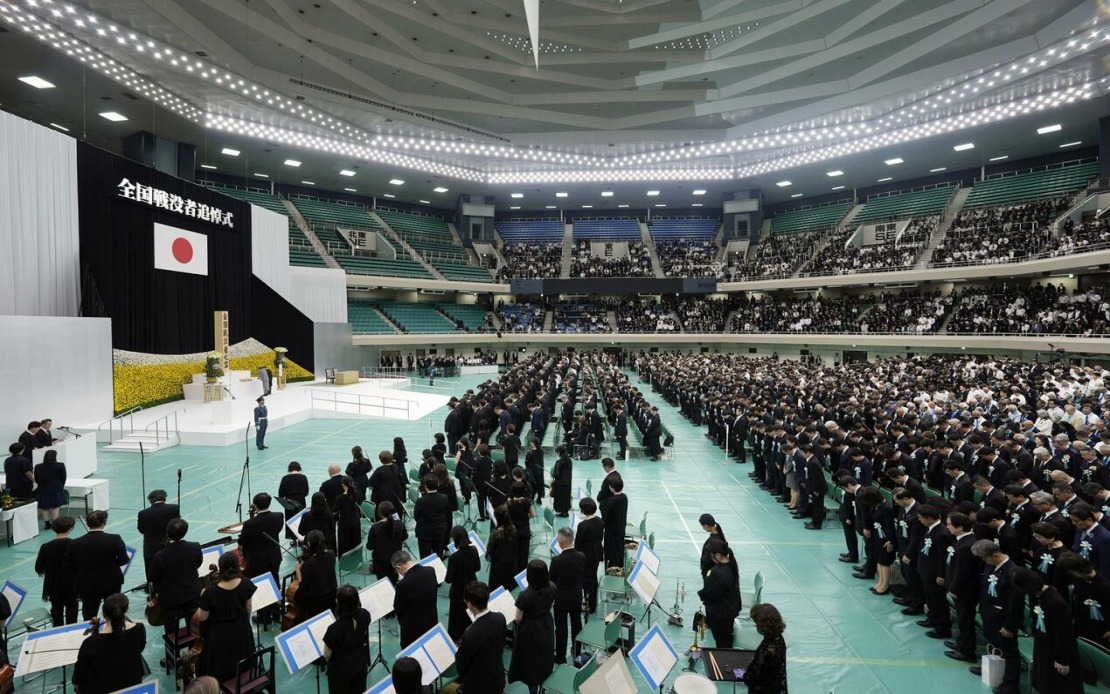
Japan observed the 81st anniversary of its World War II surrender on Saturday with a government ceremony in Tokyo honouring approximately 2.3 million military personnel and 800,000 civilians who perished in the conflict that concluded in 1945. However, Prime Minister Sanae Takaichi's remarks at the memorial—her first since assuming office in October—notably departed from the language employed by her immediate predecessor, signalling a potential recalibration in how Japan's postwar leadership acknowledges its wartime past.
Takaichi, recognised for her assertive stances on national defence, emphasised Japan's commitment to peace while deliberately sidestepping the explicit acknowledgment of national remorse that has characterised recent prime ministerial addresses at this solemn occasion. Her predecessor Shigeru Ishiba had pledged to bear in mind Japan's "remorse" over the war and reaffirmed the nation's "resolute pledge to renounce war"—language that marked a departure itself, being the first time in thirteen years that a sitting prime minister had invoked the concept of remorse at an August 15 ceremony. The contrast between Takaichi's formulation and Ishiba's represents more than semantic variation; it reflects deeper currents within Japan's conservative political establishment regarding how the nation should frame its historical relationship with the Pacific War.
In her address, Takaichi declared that Japan has "consistently walked the path of a nation that values peace and made all possible efforts for world peace and prosperity." While this formulation maintains the rhetorical commitment to peaceful principles, it conspicuously avoids naming the specific historical transgression that prompted the need for such a pledge. This carefully calibrated language suggests an intention to move forward from direct confrontation with wartime aggression, rather than to explicitly own and process it—a subtle but consequential distinction in how national memory is constructed and transmitted to younger generations.
The emperor's role in the ceremony provides instructive contrast. Emperor Naruhito, continuing an annual practice, expressed "deep remorse" during his remarks, maintaining the vocabulary of acknowledgment that has characterised imperial statements regardless of prime ministerial positioning. This division between the throne's consistent expression of remorse and the prime minister's avoidance underscores existing tensions within Japan's establishment regarding how forthrightly the nation should confront its historical record. The emperor's continuing emphasis on transmitting "memories of the suffering endured during and after the war" maintains a thread of accountability that the prime minister's framing does not explicitly advance.
The shift reflects broader patterns in Japan's political trajectory since the late Shinzo Abe returned to office in December 2012, marking a watershed moment in how successive governments approached wartime history. Before Abe's second premiership, Japanese leaders had consistently referenced national aggression in Asia, including specific acknowledgment of impacts on China and the Korean Peninsula. Takaichi, who serves as Abe's political protégé, appears to be consolidating and extending the precedent he established—one in which explicit historical accountability diminishes in favour of forward-looking rhetoric centred on security and national purpose.
This rhetorical recalibration carries significance beyond ceremonial propriety, particularly given Japan's current security environment and policy direction. The anniversary commemoration occurs amid mounting tensions throughout West Asia and a dramatic reorientation of Japan's defence posture, characterised by substantial increases in military spending and relaxation of longstanding restrictions on exporting defence equipment. For regional observers, particularly in Southeast Asia, these concurrent developments—linguistic distancing from historical remorse paired with military augmentation—raise questions about how Japan frames its strategic intentions and historical relationship with its neighbours. Malaysia and other ASEAN nations, some with direct experiences of Japanese military presence during the Pacific War, monitor these signals attentively.
The ceremony itself maintained established ritual elements, with participants observing a moment of silence at noon—the precise hour when then-Emperor Hirohito announced Japan's surrender via radio broadcast in 1945. This temporal anchoring to the specific moment of capitulation grounds the commemoration in historical fact, regardless of how contemporary political figures interpret or contextualise that history. The attendance of both the emperor and prime minister underscores the state's formal commitment to remembering the war's human costs, even as political disagreement persists regarding what form that remembrance should take.
For regional observers in Southeast Asia, Japan's evolving approach to war acknowledgment merits close attention, not from sentiment alone but from strategic clarity. The trajectory from explicit remorse through careful omission suggests a political choice to reframe national identity away from wartime liability and toward contemporary security positioning. This recalibration intersects with Japan's rearmament and its pivot toward more activist security roles within Indo-Pacific architecture. Understanding how Japan's leaders publicly account for their nation's history illuminates their implicit assumptions about international relations, historical responsibility, and the foundations upon which regional partnerships should rest.
Takaichi's inaugural address at this ceremony will likely become a reference point for analysing how Japan's prime ministerial class approaches historical consciousness going forward. Whether her avoidance of "remorse" represents a one-off rhetorical choice or signals entrenchment of a new standard will become apparent in subsequent annual commemorations. The tension between imperial consistency in acknowledging historical remorse and prime ministerial reluctance to articulate it explicitly suggests that Japan's political establishment has not reached settled consensus on how the nation should remember and frame its wartime past—a matter with implications extending well beyond Tokyo's borders into the regional consciousness and strategic calculations of neighbouring democracies.

