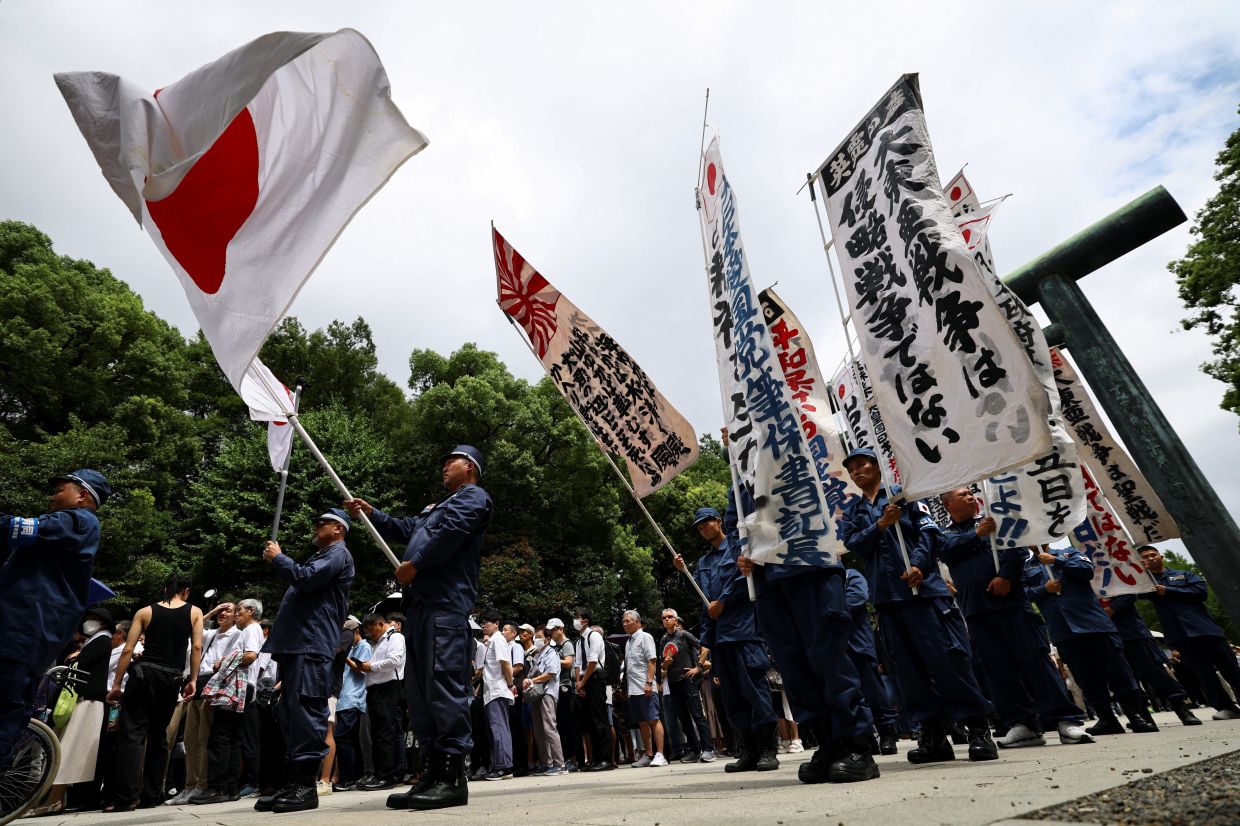
Japan's defence minister paid respects at the Yasukuni shrine on Saturday, marking the 81st anniversary of Japan's surrender in World War II, a visit that underscores Tokyo's delicate balancing act between honouring its war dead and managing fraught regional sensitivities. Shinjiro Koizumi's attendance at the controversial war memorial came as Prime Minister Sanae Takaichi notably refrained from joining the throng of visitors and senior political figures who traditionally descend on the site during this significant commemorative date. The decision by the prime minister to stay away signals an attempt to dampen diplomatic fallout, even as her defence minister's presence threatens to rekindle criticism from China, South Korea, and North Korea over Japan's relationship with its wartime past.
The Yasukuni shrine has remained a lightning rod in Japan's international relations for decades, enshrining approximately 2.5 million war dead, predominantly Japanese servicemen, alongside 14 individuals convicted as Class A war criminals who orchestrated Imperial Japan's aggressive expansion across Asia during the 1930s and 1940s. For neighbouring countries, particularly China and South Korea, the shrine embodies what they perceive as Japan's inadequate reckoning with the atrocities committed during the occupation and invasion of their territories. Koizumi's visit as defence chief marks a continuation of his established pattern as a regular pilgrim to the shrine, though his official capacity lends particular symbolic weight to the gesture at a moment when regional mistrust over Japan's military trajectory is already elevated.
Takaichi's avoidance of a direct shrine visit, despite her well-documented history as a frequent visitor before assuming office in October, suggests a pragmatic calculus aimed at minimising diplomatic damage. However, she has maintained a symbolic presence by sending an offering to the shrine, following precedent set by earlier prime ministers. This measured approach differs notably from that of her predecessor and mentor, Shinzo Abe, whose December 2013 visit to Yasukuni provoked severe backlash from Beijing and Seoul and even elicited rare criticism from the United States, Japan's most important security ally. Her father, Junichiro Koizumi, remains the last sitting prime minister to have visited on the August 15 anniversary itself, doing so in 2006, a distinction that underscores the political risk involved in such gestures.
The broader context of Takaichi's tenure reveals a prime minister navigating an increasingly complex geopolitical landscape. Before assuming office, she cultivated a reputation as a hawk on China policy, and her tenure has only reinforced this perception. In November, she sparked particular controversy by suggesting Japan would intervene militarily should conflict erupt over Taiwan, a statement that prompted Beijing to issue stern warnings and impose trade restrictions. These remarks have unsettled relations precisely when China views Japan's overall military posture with deep suspicion, particularly as Tokyo accelerates defence spending and gradually abandons the pacifist constitutional stance that has defined the post-war era.
China's response has been measured yet pointed. Senior Colonel Chen Xi, speaking for China's defence ministry, warned explicitly against Japanese "neo-militarism" on the eve of the anniversary, urging Tokyo to "earnestly reflect on itself, recognise and atone for its crimes, adhere to the post-war international order, and stop its dangerous acts of remilitarisation." The statement reflects Beijing's view that Japan's military expansion, coupled with visits to Yasukuni and its conservative political leadership, represents a worrying pattern that threatens regional stability. Russia has joined this chorus, with President Vladimir Putin's recent visit to the disputed Kuril Islands drawing Japanese protest while China and Russia's ambassadors issued a coordinated joint statement emphasising their World War II sacrifices.
Interestingly, the diplomatic landscape shows some positive currents that Takaichi appears keen not to jeopardise. Japanese-South Korean relations have warmed considerably in recent months, with the prime minister and Seoul's President Lee Jae Myung engaging in informal cultural exchanges in January, including a memorable drum jam session. Such people-to-people diplomacy represents the kind of soft power that could be undone by perceived provocations at Yasukuni, making Takaichi's cautious approach strategically sound from a broader relationship-management perspective. This warming, however fragile, underscores why senior Japanese figures must carefully calibrate their actions.
Koizumi's visit as defence minister represents the latest in a series of military officials paying respects at the shrine. Minoru Kihara, his immediate predecessor in the defence portfolio, visited in 2024, establishing recent precedent for such attendance. The role of defence minister carries particular weight in such matters, as it directly embodies Japan's military apparatus and can therefore be read by neighbours as an institutional endorsement of particular narratives about the war. The distinction between a prime ministerial visit and a defence ministry visit is not merely semantic; it signals different levels of political commitment and governmental priority.
The shrine itself, recognising the contentious nature of military-attired visitors, appealed this week for guests to refrain from wearing military-style uniforms, seeking to maintain an atmosphere conducive to "peace and quiet" worship. This preventative measure, while framed politely as guidance rather than prohibition, reveals underlying concerns about the shrine's public image and the symbolism that uniformed visitors evoke, particularly for China and South Korea. An AFP reporter counted approximately 20 to 30 individuals in military or military-style clothing despite this request, indicating incomplete compliance with the shrine's appeal.
Takaichi's broader military agenda has accelerated Japan's defence modernisation significantly. She has championed increased military spending and overseen policy shifts that represent the most substantial revision of Japan's post-war security posture in generations. These moves align with Tokyo's strategic concerns about China's military growth, North Korean weapons development, and Russia's regional assertiveness, particularly in light of the Ukraine invasion's demonstration of how quickly security assumptions can shift. However, this defence expansion, when coupled with visits to Yasukuni and rhetoric about Taiwan intervention, creates a package that regional powers perceive as threatening.
The timing of these regional tensions adds another layer of complexity. Putin's visit to the Kuril Islands, which Japan also claims, occurred just days before the Yasukuni anniversary, demonstrating how quickly multiple disputes can cluster and create cumulative diplomatic pressure. Tokyo finds itself simultaneously managing disputes with Russia over island territories, tensions with China over Taiwan and the East China Sea, and the need to preserve hard-won improvements in relations with South Korea. In such circumstances, even symbolic gestures at a shrine become consequential diplomatic statements.
Looking forward, the question of how often and at what level Japanese officials will visit Yasukuni will likely remain contested. The shrine serves as a proxy for larger debates about how Japan frames its national identity and wartime legacy—whether as a victim of nuclear weapons and military defeat, as a perpetrator of imperial aggression, or as some complex combination thereof. For neighbouring countries and international observers, these symbolic choices matter because they signal whether Japan's leadership genuinely accepts the post-war international order or merely tolerates it. Takaichi's careful hedging—avoiding the shrine herself while permitting her defence minister to attend—represents a compromise position that satisfies neither camp entirely but minimises immediate diplomatic fallout.

