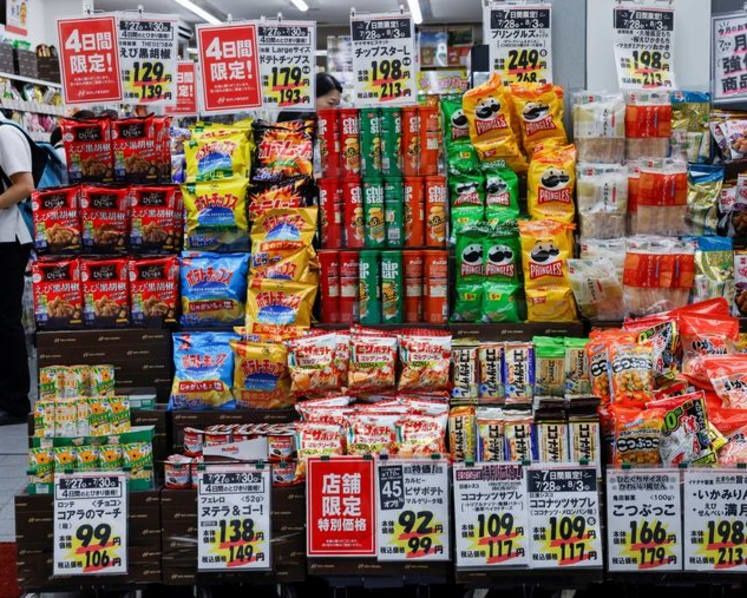
Japan's newly appointed Prime Minister Sanae Takaichi has unveiled an aggressive fiscal intervention to combat the nation's persistent inflation crisis, announcing a dramatic reduction in the consumption tax applied to food and beverages. Beginning next April, shoppers will pay just one per cent tax on food items—down from the current eight per cent rate—in what represents a historic departure from three decades of tax policy. The temporary two-year programme marks the first reduction in consumption tax since its introduction in 1989, reflecting the government's determination to prioritise household financial relief over fiscal conservatism.
Takaichi's announcement responds to mounting cost-of-living pressures that have squeezed Japanese consumers as inflation persists across multiple economic fronts. The world's fourth-largest economy has faced particular vulnerability to global supply chain disruptions and currency fluctuations, with the weak yen amplifying the cost of imported goods whilst ongoing instability in the Middle East continues to drive energy prices higher. For ordinary Japanese households already contending with elevated grocery bills and transportation costs, the proposed tax cut represents meaningful relief on everyday purchases that constitute a substantial portion of household budgets, particularly for elderly and fixed-income earners.
The decision carries significant political weight, as Takaichi had pledged during her successful election campaign to eliminate sales tax on food entirely—a manifesto commitment that resonated strongly with voters and contributed to her lower house election victory. By implementing the one per cent rate, the government delivers a substantial concession to that electoral mandate whilst avoiding the full revenue loss that would accompany complete tax elimination. This calibrated approach allows Takaichi to claim a decisive policy victory whilst maintaining some fiscal flexibility for future adjustments or policy refinements.
Financial implications of the initiative are substantial, with independent media analysis estimating that the two-year programme will result in approximately 10 trillion yen in foregone tax revenue—equivalent to roughly 61 billion US dollars. For context, this represents a significant hit to government coffers at a moment when Japan's fiscal position remains precarious. The nation carries debt obligations exceeding twice its gross domestic product, the highest ratio among wealthy economies, creating an unusually constrained fiscal environment for implementing major new spending or revenue-reduction programmes.
The reinstatement of the standard eight per cent rate is scheduled for 2029, deliberately timed to coincide with the introduction of enhanced targeted subsidy mechanisms designed specifically to support lower-income households struggling with rising social insurance premiums. This sequencing suggests the government intends the food tax cut as a temporary bridge measure rather than a permanent shift in tax architecture, with longer-term support mechanisms planned to address underlying affordability challenges facing vulnerable populations. The coordination between tax policy and subsidy programmes reflects a more nuanced approach to tackling inequality than simple across-the-board tax reductions.
Addressing legitimate concerns about Japan's already-strained public finances, Takaichi indicated that her administration would pursue offsetting revenue measures rather than expanding government debt through special bonds. The government plans to examine existing tax relief arrangements and subsidy programmes with an eye toward efficiency improvements and potential reallocation of resources. This commitment to revenue-neutral implementation distinguishes the approach from purely stimulus-oriented fiscal expansion, though the technical feasibility of achieving true neutrality through existing programme adjustments remains to be demonstrated.
For Malaysian observers, Japan's inflation-fighting strategy offers relevant insights into how advanced economies balance immediate cost-of-living relief against long-term fiscal sustainability. Like Malaysia, Japan confronts the challenge of managing inflation whilst maintaining investor confidence and market stability. However, Japan's ability to implement such dramatic tax reductions reflects its status as the world's largest creditor nation and the international demand for yen-denominated assets, circumstances quite different from Malaysia's fiscal position. Nevertheless, the emphasis on targeted rather than universal relief, and the determination to avoid special bond issuance, represents a policy discipline that remains instructive regardless of national context.
Regionally, Japan's food tax reduction may influence neighbouring economies grappling with similar inflation pressures. South Korea, Taiwan, and other Northeast Asian countries monitoring Japanese policy responses may face domestic political pressure to implement comparable measures. The successful packaging of a temporary tax cut as both crisis response and electoral mandate fulfilment demonstrates how skilfully fiscal policy can serve dual political and economic objectives. Takaichi's framing—positioning the measure as temporary and deficit-neutral—may become a template other governments adapt when responding to inflation demands whilst attempting to preserve longer-term fiscal credibility.
The broader economic context remains important for understanding the urgency driving this initiative. Japan's deflationary bias over multiple decades created political space for expansionary policies that would prove unsustainable in other contexts. However, the recent experience of persistent inflation has shifted public expectations and government priorities markedly. The food tax cut represents an attempt to deliver tangible relief whilst preserving the monetary policy space that the Bank of Japan requires for future adjustments. Whether this combination proves sufficient to restore consumer confidence in the economic outlook will shape not only Japan's growth trajectory but also global perceptions regarding the effectiveness of fiscal policy in contemporary inflation management.

