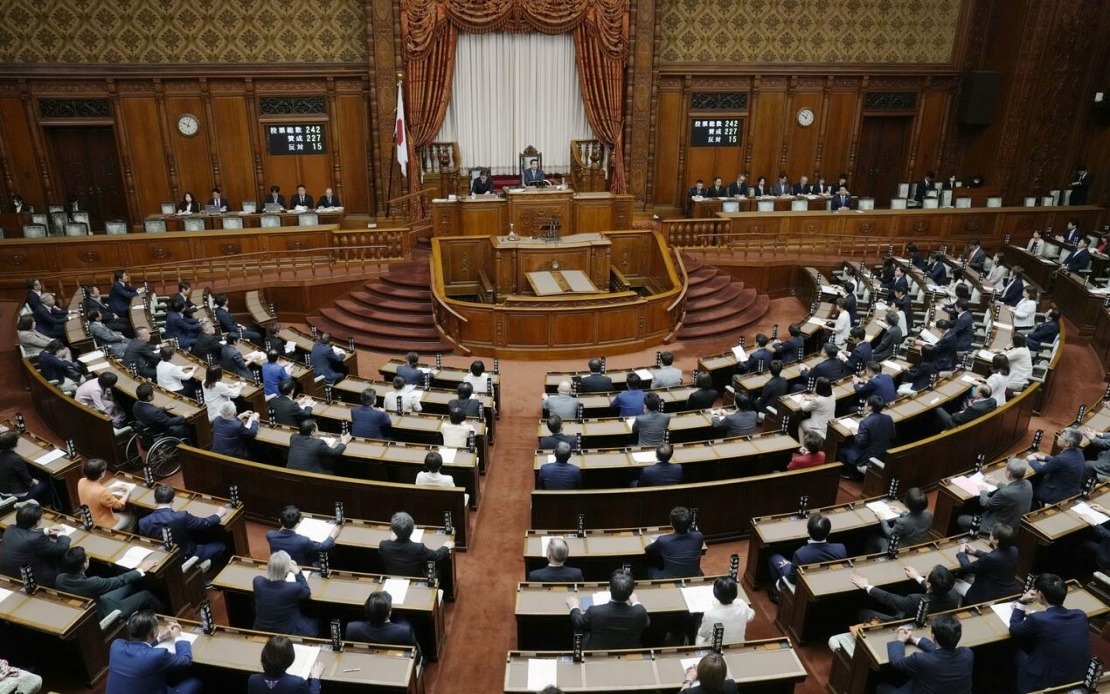
Japan's legislature has formally approved sweeping military reforms that will fundamentally reshape how the country's armed forces approach space security. The legislation, which passed the House of Councillors on Friday, represents a significant institutional overhaul designed to address emerging threats in an era when satellites have become indispensable to modern warfare and civilian infrastructure alike. The restructured Air Self-Defence Force will incorporate a new designation reflecting space responsibilities, with implementation scheduled for the fiscal year concluding in March 2027. This timeline underscores Tokyo's methodical approach to integrating space operations into its defence posture rather than pursuing hasty improvisation.
At the heart of the reorganisation lies the establishment of a dedicated space operations group, overseen by a lieutenant general-ranked commander. This unit will concentrate specifically on enhancing Japan's surveillance and awareness capabilities across orbital domains, addressing what military strategists identify as a critical vulnerability in contemporary defence architectures. The space operations group will leverage advances in satellite technology to monitor activities in the region with greater precision and responsiveness, capabilities that prove particularly relevant given the intensifying competition among regional powers for dominance in outer space. By formalising these functions within a dedicated command structure, Japan signals its recognition that space operations demand the same institutional attention and resource allocation traditionally reserved for air, sea, and land forces.
Defence Minister Shinjiro Koizumi emphasised during a press conference that space infrastructure now permeates virtually every aspect of civilian and military life. Modern societies depend upon continuous satellite connectivity for navigation systems, mapping applications accessible through smartphones, and weather forecasting services that extend into emergency management and agricultural planning. Koizumi's remarks suggest that Japan's space defence strategy encompasses not merely military applications but the broader ecosystem of critical infrastructure protection. This holistic perspective distinguishes Tokyo's approach from narrower military-centric models, acknowledging that threats to space assets represent threats to essential services affecting millions of ordinary citizens.
The legislation simultaneously authorises the appointment of a second senior vice defence minister, a managerial innovation intended to distribute decision-making responsibilities more effectively during crises and natural disasters. Japan's experience with major seismic events and typhoons has underscored the necessity for robust institutional capacity when emergency response demands compete with routine defence administration. An additional senior leadership position allows for parallel management of concurrent priorities without sacrificing coordination or strategic oversight. This bureaucratic expansion also facilitates deeper engagement with security partners, particularly the United States, where equivalent-level ministerial discussions strengthen bilateral ties and facilitate intelligence sharing.
Recruiting and retaining qualified military personnel represents an escalating challenge throughout developed democracies, and Japan confronts demographic headwinds that intensify this pressure. The legislation addresses these pressures by enhancing retirement benefits for Self-Defence Forces members, whose mandatory retirement ages typically arrive considerably earlier than comparable civil service positions. By improving compensation packages and pension arrangements, the government seeks to make military service more attractive to prospective recruits and encourage experienced personnel to extend their tenure. This financial commitment reflects official recognition that technological sophistication in space operations demands highly trained specialists who require years of development and mentoring.
The southwestern region of Japan assumes particular strategic importance in contemporary geopolitics, positioned along major shipping lanes and proximate to territories claimed by multiple regional actors. The legislation upgrades the Ground Self-Defence Force's 15th Brigade, headquartered in Naha, Okinawa Prefecture, from brigade to full divisional status, substantially increasing its personnel ceiling and operational independence. This elevation responds directly to China's increasingly assertive maritime posture and the proliferation of military facilities across the disputed South China Sea region. The upgraded Okinawa division will reinforce Japan's capacity to defend the nation's remote southwestern islands, which occupy exposed positions yet remain strategically vital to regional security architecture.
For Malaysian observers and policymakers, Japan's defence reorganisation carries significant implications for Southeast Asian security dynamics. Japan remains a crucial strategic partner for nations throughout the region concerned about maintaining open sea lanes and protecting against unilateral territorial assertions. Tokyo's strengthened space capabilities will enhance its ability to contribute to regional maritime domain awareness, information Japan routinely shares with allied nations including Malaysia through intelligence partnerships and military cooperation frameworks. As space technologies become increasingly central to military operations and civilian infrastructure protection, Japan's institutional innovations provide a model that other democracies in the region might examine when evaluating their own defence modernisation priorities.
The integration of space operations into Japan's Self-Defence Force structure reflects broader global trends toward treating space as a distinct operational domain requiring dedicated strategic attention. The United States, France, and other technologically advanced nations have similarly reorganised military forces to elevate space considerations from subordinate status to equivalent standing with traditional domains. Japan's approach demonstrates that middle powers can develop sophisticated space defence strategies without necessarily matching the resource expenditures of superpowers, instead focusing institutional reforms on surveillance, coordination, and regional partnership. This pathway proves instructive for Southeast Asian nations evaluating how to strengthen space security with limited defence budgets.
The legislative package also signals Japan's determination to modernise its defence institutions comprehensively rather than pursuing piecemeal adjustments. By combining space force restructuring, expanded ministerial capacity, enhanced personnel benefits, and regional force upgrades within a single legislative effort, Tokyo demonstrates strategic coherence and parliamentary alignment around defence priorities. This integrated approach contrasts with nations where defence modernisation struggles against fragmented political support or budgetary constraints that force sequential rather than simultaneous implementation of capability improvements. Japan's success in bundling multiple initiatives suggests that effective defence transformation requires political consensus at the highest levels and sustained institutional commitment.
Looking forward, the space operations group's establishment will unfold across the next two fiscal years as Japan builds the necessary training infrastructure, acquires specialised equipment, and develops operational doctrines governing space domain operations. The lieutenant general commanding this unit will assume responsibility for defining how space capabilities integrate with existing air, sea, and ground operations, a coordination challenge that demands both technical expertise and strategic vision. As regional tensions persist and space technology proliferates throughout the Asia-Pacific, Japan's enhanced space defence capabilities will shape not only bilateral relationships with allies like the United States but also the broader security environment affecting all Southeast Asian nations dependent upon stable, secure space infrastructure for economic prosperity and disaster response.

