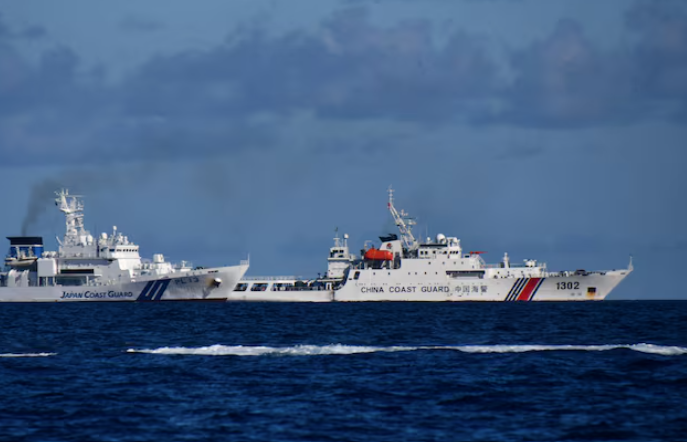
Tokyo reported on Tuesday that its coast guard had successfully forced two Chinese coast guard vessels to withdraw from waters that Japan claims as its own, located in the vicinity of the contested Senkaku Islands. The operation took place in the early morning hours, with Japanese authorities issuing formal departure orders that were obeyed by approximately 9:20am local time. The incident underscores the fragile state of maritime relations between the two regional powers and demonstrates Japan's determination to maintain its territorial claims despite mounting pressure from Beijing.
The Senkaku Islands, referred to as the Diaoyu by China, sit strategically positioned between Taiwan and Japan's Okinawa prefecture, making them a focal point of geopolitical competition in the East China Sea. Both nations maintain historical claims to the archipelago, and control of these waters carries implications far beyond the islands themselves, as the region is believed to contain significant energy reserves and lies along critical shipping lanes. For Southeast Asia and the broader Indo-Pacific region, the stability of this maritime boundary remains consequential, as any major escalation could disrupt regional commerce and security arrangements.
What rendered this particular incident noteworthy was the nature of the Chinese operation. Rather than simply maintaining a patrol presence, the two Chinese coast guard ships were actively approaching a Japanese fishing vessel that operated lawfully in the disputed waters. This targeting of civilian fishing activities marks a shift in tactics from routine patrols and represents a more aggressive posture that could have endangered the Japanese crew. The coast guard's protective response, positioning vessels around the fishing boat to ensure its safety, highlights the volatile environment in which ordinary maritime commerce now occurs in this contested zone.
According to Japan's coast guard statement, four Chinese vessels had been present in the broader area before the two incursions into what Tokyo considers its territorial waters. This pattern of larger formations probing Japanese claims is consistent with Beijing's incrementalist approach to asserting dominion over disputed territories. While Chinese coast guard activity near the islands is relatively frequent, direct confrontations with Japanese fishing boats remain comparatively uncommon, making this instance noteworthy as an intensification of pressure tactics.
The Japanese authorities formally characterised the Chinese conduct as a breach of international law, reflecting Tokyo's commitment to the rules-based maritime order enshrined in conventions such as the United Nations Convention on the Law of the Sea. Japan's coast guard pledged to maintain a measured but resolute stance, continuing to enforce what it views as rightful territorial authority while adhering strictly to international and domestic legal frameworks. This careful balancing act reflects Japan's broader strategic posture of not escalating beyond proportional responses while firmly defending its claimed sovereignty.
The current tensions cannot be separated from the diplomatic firestorm ignited by Prime Minister Sanae Takaichi's statements regarding Taiwan last November. Takaichi's remarks, in which she suggested that Japan might consider military intervention should Taiwan face attack, drew sharp condemnation from Beijing, which views such statements as interference in its internal affairs. Taiwan's status remains among the most sensitive geopolitical issues in Asia, and any suggestion of Japanese military commitment to its defence crosses what China considers a crucial red line in bilateral relations.
China's response to Takaichi's Taiwan comments has extended well beyond diplomatic protest. Beijing has discouraged its citizens from travelling to Japan, effectively dampening tourism revenues, and has implemented targeted trade restrictions against selected Japanese companies. These economic countermeasures reflect the broader competition between Tokyo and Beijing for regional influence and demonstrate how security disputes can quickly metastasise into economic friction affecting ordinary businesses and citizens across both nations.
The East China Sea remains an area of acute strategic competition not merely because of the Senkaku Islands themselves but because of the deeper rivalry between China and Japan for maritime supremacy in waters that feed several nations' economies. China has consistently deployed its coast guard assets across various disputed maritime zones in the East China Sea, consistently provoking formal objections from Japan. These repeated intrusions suggest that China views coast guard deployments as a low-risk mechanism for gradually normalising its presence and contestation of Japanese claims, incrementally shifting perceptions of where effective control exists.
For Malaysia and other Southeast Asian nations, the implications of escalating Sino-Japanese tensions warrant careful attention. The region depends heavily on the freedom of navigation through these waters, and any serious military clash could disrupt the commercial arteries upon which economic growth depends. Furthermore, the pattern of Chinese coast guard assertiveness in the East China Sea mirrors similar tactics employed in the South China Sea, where Malaysia has its own maritime interests and disputes with Beijing. The techniques that China employs against Japan may presage how it will handle disagreements with other claimant states.
The international legal framework governing maritime disputes, while clear in its principles, has proven inadequate at preventing these recurring confrontations. Japan's invocation of international law, though juristically sound, cannot alone deter Chinese actions when Beijing operates under a different interpretation of territorial claims and calculates that gradual pressure yields diplomatic and economic concessions. This mismatch between legal clarity and practical enforcement remains a central challenge in the Indo-Pacific security environment.
Looking ahead, Japan faces the difficult task of maintaining its territorial position without allowing incidents to spiral into conflicts it does not seek. The coast guard's measured response—forcing withdrawal without opening fire or creating inflammatory scenes—reflects this calibration. However, as Chinese operations become more aggressive and frequent, questions inevitably arise about how long Japan can sustain this restraint before domestic political pressure demands a firmer stance. The fundamental tension remains unresolved: both nations claim the same territory, neither shows signs of backing down, and the international system offers limited mechanisms for peaceful resolution when vital interests collide.

