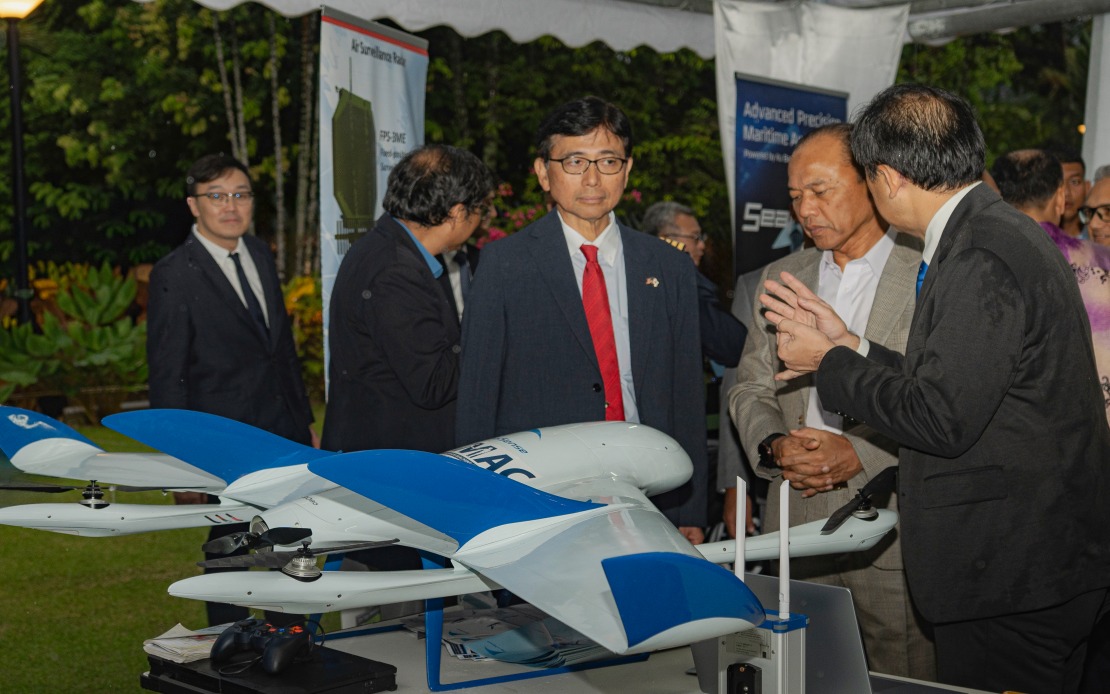
Japan has signalled a significant expansion of its defence and security collaboration with Malaysia, with Ambassador Noriyuki Shikata declaring that Tokyo stands ready to deepen partnership at a moment of mounting regional complexity. Speaking at the 72nd Japan Self-Defence Forces Day Reception in Kuala Lumpur on Wednesday, Shikata underscored Japan's determination to translate strategic declarations into concrete operational cooperation, particularly in maintaining maritime security and regional stability across Southeast Asia's vital waterways.
The ambassador's statement builds on a recent high-level diplomatic engagement between Prime Minister Sanae Takaichi and Malaysian Prime Minister Datuk Seri Anwar Ibrahim during the latter's visit to Japan earlier this month. Both leaders reaffirmed their commitment to broadening strategic cooperation, positioning defence and security as central pillars of their bilateral relationship. This renewed emphasis reflects broader geopolitical calculations in both capitals as they navigate an increasingly multipolar Indo-Pacific where traditional security frameworks are being tested by competing regional interests and power dynamics.
A cornerstone of the deepening ties is Japan's alignment of its Free and Open Indo-Pacific vision with ASEAN's Outlook on the Indo-Pacific—two strategic frameworks that, while originating from different perspectives, share common objectives around rules-based maritime order and economic openness. By synchronising these visions, Japan and Malaysia position themselves as custodians of a regional architecture that resists hegemonic practices and emphasises collective security through institutional cooperation. This ideational convergence provides the intellectual foundation for practical defence initiatives.
The bilateral relationship itself achieved a milestone in 2023 when it was elevated to Comprehensive Strategic Partnership status, a designation that formally recognises the breadth and depth of ties spanning trade, culture, technology, and security. As the nations approach the 70th anniversary of their diplomatic relationship next year, Ambassador Shikata signalled Japan's intention to leverage this celebratory moment to accelerate cooperation across all domains. For Malaysia, this represents an opportunity to strengthen ties with a major regional power that shares concerns about maintaining open sea lanes and upholding international law in an era when such principles face mounting pressure.
On the operational front, the MALPAN bilateral naval exercise has become the practical manifestation of Japan-Malaysia defence cooperation. Conducted regularly in the South China Sea and Strait of Malacca—two of the world's most strategically important waterways—MALPAN serves multiple purposes beyond symbolic cooperation. These exercises build institutional familiarity between the Japan Maritime Self-Defence Force and Royal Malaysian Navy, establish protocols for coordinated maritime responses, and demonstrate to other regional actors that Japan and Malaysia maintain robust mechanisms for coordinated operations. The April expansion to include the Royal Malaysian Air Force marked a significant evolution, introducing three-dimensional coordination across maritime and aerial domains and signalling the maturation of bilateral military interoperability.
Japan's Official Security Assistance programme, launched in 2023, provides another avenue for deepening technological and operational linkages. Malaysia's early inclusion among OSA recipients reflects both the strategic importance Tokyo assigns to the bilateral relationship and the practical value Malaysia offers as a maritime hub. The equipment transfers—ranging from unmanned aerial vehicles and rescue boats to diving support vessels—address genuine operational requirements while embedding Japanese military technology and training protocols into Malaysian defence structures. Under the 2025 iteration, Japan's provision of ceasefire monitoring equipment to the ASEAN Observer Team demonstrates how bilateral assistance mechanisms can serve broader regional stabilisation goals.
The establishment of a bilateral defence industry dialogue, formalised through a Terms of Reference signed during Defence Services Asia 2026 in Kuala Lumpur, opens a new dimension to the security relationship. With ten Japanese companies participating in the defence exhibition, the initiative signals that defence cooperation is no longer confined to government-to-government interactions but is expanding into commercial partnerships and technology transfer arrangements. For Malaysian policymakers, this represents an opportunity to access advanced defence technologies and manufacturing capabilities while potentially developing a domestic defence industrial base through collaboration with established Japanese firms.
The timing of these initiatives carries particular significance given regional developments that make Malaysia's geographical position increasingly valuable from a security perspective. The Strait of Malacca, through which roughly one-third of global maritime trade transits, remains a critical chokepoint vulnerable to disruption. Malaysia's role as a Southeast Asian anchor in ensuring freedom of navigation and maritime security has garnered attention from multiple great powers, making Japanese partnership both strategically aligned and mutually beneficial. Japan views Malaysia as a key node in its security architecture for the Indo-Pacific, while Malaysia benefits from Japanese technological sophistication and commitment to rules-based regional order.
General Tan Sri Malek Razak Sulaiman's presence at the reception—representing Malaysia's armed forces establishment—underscored institutional support for the deepening defence relationship across the military command structure. This inter-service engagement suggests that security cooperation extends beyond diplomatic gestures to encompass serious military planning and operational coordination. The backing of Malaysia's top military brass indicates that these initiatives have secured endorsement at the highest levels of the defence establishment, creating conditions for sustained implementation and regular engagement.
For Southeast Asia more broadly, the Japan-Malaysia partnership represents a model of security cooperation that emphasises transparency, rule of law, and inclusive regional frameworks rather than exclusive alignments. By anchoring their relationship within ASEAN mechanisms and emphasising contribution to regional stability, Japan and Malaysia demonstrate that bilateral partnerships need not be perceived as destabilising or exclusionary. This approach carries implications for Malaysia's diplomatic positioning, allowing it to deepen ties with a major external power while maintaining its foundational commitment to ASEAN centrality and non-alignment principles that have traditionally guided Malaysian foreign policy.
Looking forward, the intensity of Japan-Malaysia defence engagement suggests the relationship will continue evolving along an upward trajectory. The explicit commitment to reaching new levels of cooperation by 2025 indicates that both governments view current initiatives not as endpoints but as foundations for more ambitious projects. For Malaysia, this presents opportunities to strengthen its maritime capabilities, modernise defence systems, and position itself as a reliable partner in regional security architecture. For Japan, deepening ties with Malaysia reinforces its strategic presence in a region where its interests—from trade security to regional stability—remain paramount in an increasingly contested geopolitical environment.

