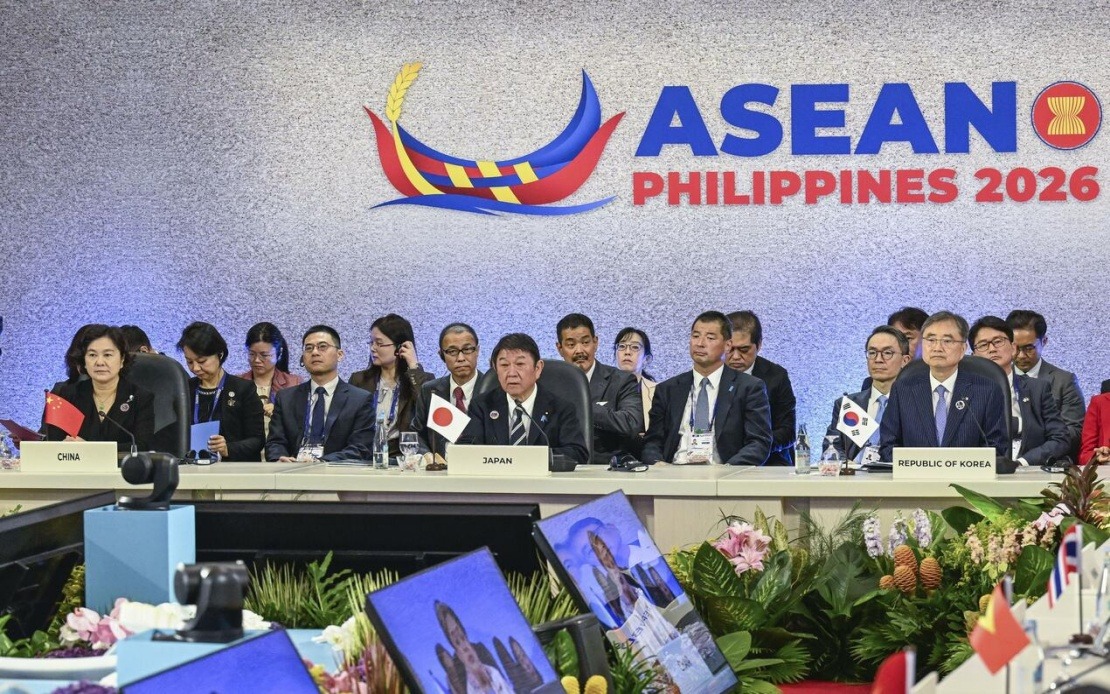
Japan has committed itself to deepening collaboration with ASEAN member states, China, and South Korea across critical domains including energy security and the fight against online scams, marking a significant diplomatic push in Manila this week. Foreign Minister Toshimitsu Motegi articulated Japan's intentions at a gathering of regional foreign ministers, emphasising Tokyo's readiness to contribute meaningfully to multilateral initiatives that strengthen the broader Indo-Pacific framework.
The multilateral forum brought together diplomatic heavyweights from across the region, with Motegi representing Japanese interests alongside his counterparts from Southeast Asia and South Korea's Foreign Minister Cho Hyun. China's participation was secured through Vice Foreign Minister Hua Chunying, who stepped in for Foreign Minister Wang Yi, underscoring the importance Beijing places on maintaining engagement within this institutionalised dialogue mechanism despite broader geopolitical tensions.
In his opening remarks, Motegi highlighted the economic significance of the ASEAN-plus-three grouping, noting that its combined Gross Domestic Product represents more than a quarter of global economic output. This figure carries substantial weight for regional observers, as it demonstrates the collective leverage these nations possess in shaping international economic policy and standards. The assertion effectively positions the grouping as indispensable to maintaining both regional equilibrium and broader global economic health, a message particularly resonant given volatile international market conditions.
Japan's backing for ASEAN Centrality—a principle that positions Southeast Asia as the geographic and strategic anchor for regional architecture—reflects Tokyo's careful calibration of its Indo-Pacific strategy. By endorsing ASEAN's own vision for the region, Japan avoids appearing to impose external frameworks whilst simultaneously advancing principles aligned with its own free and open Indo-Pacific concept. This diplomatic manoeuvre allows Japan to maintain leadership on regional vision-setting without appearing to challenge ASEAN prerogatives or Beijing's influence.
The explicit mention of the ASEAN Outlook on the Indo-Pacific initiative underscores how regional powers are attempting to construct a multilateral consensus on governance principles. Motegi's suggestion that Tokyo will coordinate with Beijing and Seoul to champion this ASEAN-led initiative through ASEAN-plus-three mechanisms demonstrates Japan's interest in building broader coalitions around shared strategic interests rather than pursuing unilateral approaches.
Energy security emerged as a central concern at the gathering, with participants collectively acknowledging the necessity to strengthen regional supply networks in light of escalating tensions in West Asia. For Malaysia and other Southeast Asian economies heavily dependent on stable energy supplies and maritime trade corridors, this discussion carries immediate practical implications. Disruptions to energy markets or shipping lanes directly threaten manufacturing competitiveness and broader economic growth, making collaborative approaches to energy resilience a matter of national interest.
The decision to address online scam proliferation at a high-level diplomatic forum reflects how digital threats have graduated from technical concerns to matters requiring coordinated government action. Southeast Asia has emerged as a significant hub for online fraud operations, with criminal networks exploiting regulatory gaps and operational costs differential to target victims across the region and globally. Japan's commitment to collaborate on this front suggests Tokyo recognises that technological challenges require transnational solutions that transcend traditional bilateral relationships.
The ASEAN-plus-three framework itself carries historical significance, having been established following the 1997 Asian financial crisis as an institutional mechanism for practical cooperation among its members. Its longevity—spanning over two decades—demonstrates the enduring utility of this grouping for addressing shared regional challenges. The structure provides a forum less formal than ASEAN itself yet more focused than broader Asia-Pacific mechanisms, allowing for candid discussion of bilateral tensions whilst maintaining multilateral cooperation.
That leaders from these groupings last convened at a summit in Malaysia during October signals the regularity with which high-level engagement occurs, though months between summits also indicate the glacial pace at which some regional initiatives advance. For Malaysian observers, the frequency of such gatherings affects how quickly regional positions can shift and how effectively consensus can be mobilised around emerging challenges.
Motegi's subsequent bilateral engagement with British Foreign Secretary Ed Miliband, conducted following the multilateral sessions, illuminates how Japan simultaneously manages relationships across multiple strategic partnerships. His expression of hope that Tokyo and London would persist in collaborative efforts under Prime Minister Andy Burnham's administration demonstrates Japan's interest in maintaining robust ties with extra-regional actors. This parallel diplomacy suggests Japanese strategy encompasses not merely regional Asia-Pacific architecture but also strengthening partnerships with like-minded democracies globally.
The convergence of energy security, digital crime prevention, and regional institutional frameworks in a single diplomatic gathering reflects the complexity of contemporary multilateral engagement. Regional powers increasingly recognise that traditional security concepts must be complemented by attention to non-traditional threats and economic resilience mechanisms. Japan's articulation of these interconnected challenges through established regional forums indicates how established diplomatic structures are adapting to address twenty-first century security requirements.
For Southeast Asia broadly and Malaysia specifically, Japan's reinforced commitment to regional cooperation carries both economic and strategic dimensions. Enhanced energy network coordination could stabilise supply chains and reduce vulnerability to external disruptions, whilst collaborative approaches to online fraud might protect regional economies from illicit financial flows. The emphasis on ASEAN centrality simultaneously respects Southeast Asian agency whilst creating space for Japanese influence within frameworks designed to preserve regional independence and balance among competing powers.

