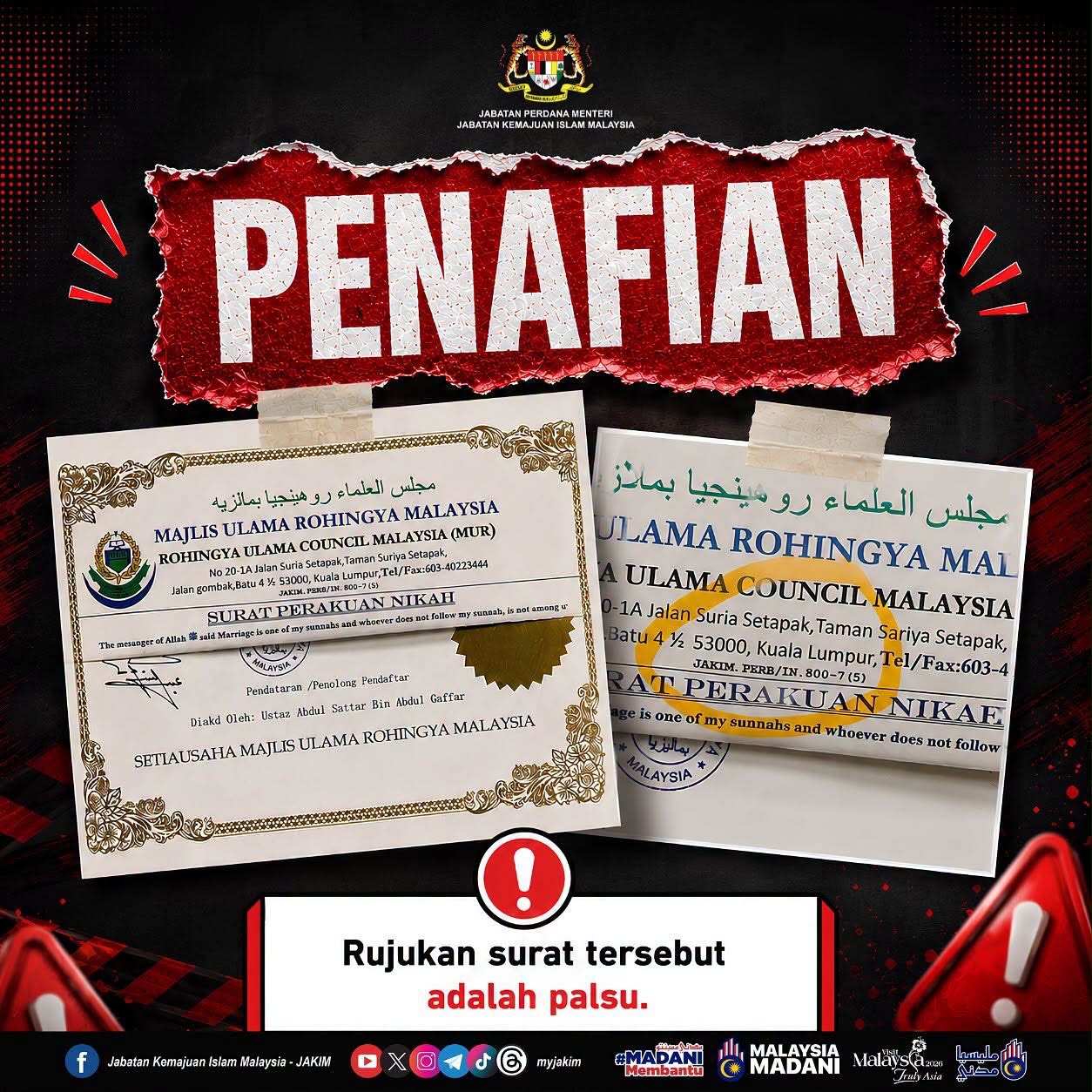
The Department of Islamic Development Malaysia (JAKIM) has moved to extinguish confusion surrounding a fraudulent document that recently circulated across social media platforms, explicitly stating that neither the reference number nor the issuing organisation bears any official endorsement from Malaysian Islamic authorities. The declaration came through JAKIM's official Facebook statement on July 15, following widespread public alarm over the authenticity of a marriage letter attributed to the Malaysia Rohingya Ulama Council and bearing what appeared to be an official departmental reference code.
Investigations undertaken by JAKIM confirmed that the document in question does not originate from the department itself, nor has it been recognised or produced by any legitimate Islamic religious body operating within Malaysia's regulatory framework. The specific reference number displayed on the circulating letter—"JAKIM.PERH/LN.800-7(5)"—was identified as entirely fabricated, raising serious concerns about the proliferation of forged official documents in the digital sphere. JAKIM's statement emphasised that no state Islamic religious council or department had authorised the organisation mentioned in the letter to manage, certify, or otherwise handle marriage-related administrative functions.
The emergence of this counterfeit document underscores a growing challenge facing Malaysia's regulatory institutions in the digital age, where the ease of document duplication and social media dissemination enables rapid spread of misinformation before verification mechanisms can intervene. The letter's sophistication—including what appeared to be an authentic government reference format—likely contributed to its initial credibility among users who encountered it online. Such incidents demonstrate how fraudulent paperwork can exploit public familiarity with official numbering systems and bureaucratic conventions to establish false legitimacy.
Minister in the Prime Minister's Department (Religious Affairs) Dr Zulkifli Hasan acknowledged the seriousness of the matter, indicating that authorities would conduct a comprehensive investigation once complete information had been gathered. This commitment to formal scrutiny signals the government's recognition that the circulation of forged official documents carries implications beyond mere misinformation, potentially affecting individuals who might act upon such fraudulent materials in matters as consequential as marriage registration and legal standing.
The Malaysia Rohingya Ulama Council, referenced in the fraudulent letter, has not been officially appointed by JAKIM or any state Islamic authority to undertake certification or management responsibilities regarding marriage matters. This distinction is crucial, as it prevents any ambiguity about whether the organisation holds legitimate delegated authority. The fake reference number deliberately mimics JAKIM's actual administrative coding structure, suggesting the document's creator possessed sufficient familiarity with official formats to construct a convincing forgery.
For Malaysian citizens and residents, this incident carries practical implications for verifying the authenticity of religious documents before relying upon them for official purposes. JAKIM's public advisory encourages individuals to contact the department directly or reach out to their respective state Islamic religious authorities whenever uncertainty arises concerning the legitimacy of marriage-related paperwork or other religious documentation. This verification step, while potentially time-consuming, represents the most reliable safeguard against being misled by counterfeit materials.
The vulnerability exposed by this case reflects broader challenges facing government agencies across Southeast Asia as digital technologies enable increasingly sophisticated document forgery. Unlike earlier eras when physical authentication features provided some protection, modern scanning and design software allow criminals to replicate official aesthetics with minimal specialist knowledge. The proliferation of such documents through social media platforms—where content spreads rapidly across networks before institutional fact-checking mechanisms engage—creates windows of vulnerability that authorities must actively monitor and counter.
State-level Islamic religious councils and departments across Malaysia have similarly been implicated in this incident, as they too bear responsibility for maintaining awareness of forged documents circulating within their jurisdictions. Coordination between JAKIM and state authorities becomes essential for identifying emerging fraud patterns and issuing timely public warnings. The departmental statement serves as an early alert mechanism, enabling citizens and officials alike to recognise similar fraudulent materials if they encounter additional variants of this particular scam.
The incident also raises questions about how individuals came to possess the Malaysia Rohingya Ulama Council's name and how they determined the format for JAKIM's reference numbering system. These details suggest either insider knowledge of official procedures or systematic reverse-engineering of legitimate documents. Understanding the document's origins would assist authorities in identifying whether this represents an isolated incident or part of a broader pattern of organised fraud targeting Malaysia's Islamic administrative structures.
Moving forward, public institutions must consider enhanced digital verification mechanisms that allow citizens to validate official documents in real time without requiring in-person visits or phone calls to government offices. Some jurisdictions have implemented online verification portals where official reference numbers can be cross-checked against registered documents. Such systems would reduce the time between fraudulent document circulation and public awareness of their illegitimacy, limiting potential harm to individuals who might otherwise act upon false information.
The warning issued by JAKIM reflects an institutional acknowledgement that the burden of verification cannot rest solely upon individual citizens navigating an increasingly complex information landscape. Rather, government agencies must proactively communicate the existence of fraudulent materials, describe their identifying characteristics, and provide accessible pathways for public verification. This collaborative approach between authorities and citizens represents the most effective defence against document fraud in the digital age.

