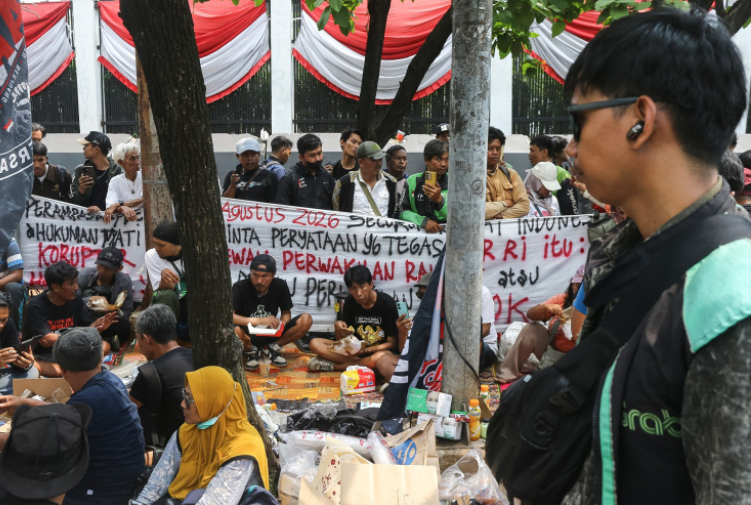
Thousands of activists and citizens descended on the Senayan Legislative Complex in Central Java on Thursday morning, wielding a diverse set of demands that reflected widespread frustration with Indonesia's entrenched corruption problem. The protests, which drew support from the United Pati People's Alliance and numerous affiliated groups, called for capital punishment of graft-tainted officials, expedited passage of a controversial asset forfeiture bill, and government action to reduce the cost of living for ordinary Indonesians. The demonstrations marked an escalation in public pressure on the House of Representatives to deliver concrete anti-corruption measures at a moment when public trust in institutions remains fragile.
Organisers had mobilised supporters from Pati, Central Java, and surrounding regions with remarkable efficiency, dispatching dozens of buses toward the capital throughout the week. The scale of commitment demonstrated by protesters—some travelling hundreds of kilometres—underscored the depth of public anger over corruption and the perceived slowness of legislative reform. Coordinator Supriyono revealed that the movement had swelled beyond initial expectations, with five additional buses arriving in Jakarta funded through public donations, a grassroots fundraising effort that highlighted how anti-corruption sentiment transcends regional and socioeconomic boundaries.
Government authorities responded with visible unease, deploying security cordons around the legislative quarter and implementing traffic diversions across multiple central Jakarta thoroughfares. Both lanes of Jalan Gatot Subroto from Senayan Park to the parliament building remained sealed, while dozens of uniformed personnel maintained stations throughout the zone. Jakarta Police spokesperson Sr. Comr. Budi Hermanto anticipated at least 500 participants, though actual numbers appeared to exceed initial projections as groups from outside Pati joined the demonstrations, reflecting broader coalescence around anti-corruption demands.
Significantly, attempts by authorities to disrupt the protest movement proved counterproductive. Police stopped several buses en route to Jakarta, while Bank Mandiri, a state-owned institution, temporarily froze a bank account belonging to AMPB coordinator Supriyono. These blocking measures triggered public backlash rather than compliance, generating widespread condemnation and spurring calls for boycotts of the state lender. The heavy-handed approach illustrated how security responses to legitimate protest can backfire, delegitimising authorities and amplifying activist messaging far beyond what the original demonstrations might have achieved.
The asset forfeiture bill sits at the crux of Thursday's mobilisation, representing a legislative battleground that divides anti-corruption advocates, legal experts, and political interests. First introduced in 2008 but languishing in parliamentary limbo for more than a decade, the legislation would empower the state to seize assets suspected of deriving from criminal activity prior to any conviction. Proponents argue this mechanism would strip corrupt officials and organised crime networks of ill-gotten wealth, dismantling financial ecosystems built on theft. Yet legal scholars have cautioned that the bill contains dangerous provisions that could enable authoritarian misuse—specifically, weaponisation against political opponents or deployment for extortionate shakedowns by compromised officials.
The House of Representatives, which commenced deliberations on the bill in January, signalled accelerated progress following Monday's reception of Pati delegations at the legislative complex. Gerindra Party lawmaker Habiburokhman, who chairs Commission III supervising legal affairs, declared that passage would occur by December at the latest, with roughly eight additional weeks required for deliberations. This timeline represents a significant compression compared to the fourteen-year delay that preceded it, suggesting parliament recognises both the political potency of the issue and pressure from security agencies and administration officials.
President Prabowo Subianto's newly installed government has positioned itself as champion of the anti-corruption agenda, with Government Communications Agency head Muhammad Qodari articulating executive branch enthusiasm for swift passage. The administration's rhetorical framing—that the responsibility now rests with parliament—attempts to capitalise on anti-corruption sentiment whilst deflecting to legislators should implementation prove problematic. This positioning carries particular weight given Prabowo's historical relationship with corruption allegations and his administration's broader law-and-order messaging, which resonates with public constituencies simultaneously angered by graft and economically squeezed by inflation.
The protest dynamics reflect a complex political moment across Indonesia and Southeast Asia more broadly, where anti-corruption demands intersect with populist economic grievances. Demonstrators coupled calls for legislative reform with demands that government address soaring prices for essential commodities, signalling that ordinary Indonesians perceive graft and economic hardship as interconnected phenomena. Corruption siphons resources that might otherwise fund public services or infrastructure, whilst corrupt officials operate with impunity amid systems that prioritise wealth accumulation over governance effectiveness.
Police messaging emphasised commitment to facilitating peaceful protest whilst maintaining public order, with spokesperson Budi urging activists to avoid property damage and respect ongoing commercial and educational activities. This rhetorical accommodation masked underlying tensions, however—the pre-positioned security perimeter, traffic restrictions, and initial bus interdictions all signalled state anxiety about mass mobilisation. For Malaysian observers, the Jakarta protests offer instructive parallels, as both nations wrestle with entrenched corruption networks, public impatience with incremental reform, and the challenge of deploying anti-graft legislation without enabling authoritarian abuse.
The coming eight weeks will determine whether parliamentary consensus solidifies around the asset forfeiture bill or whether competing interests among legislators, law enforcement, and private sector figures produce further delays. The external pressure from street-level activism provides unusual leverage for reform advocates within parliament, yet the same mechanism that amplifies reform prospects also creates space for those opposed to asset forfeiture to mobilise counter-pressure. Thursday's demonstrations thus represent not a resolution of Indonesia's corruption crisis but rather an intensification of the political contest over what genuine reform should entail and who should control the mechanisms through which it operates.

