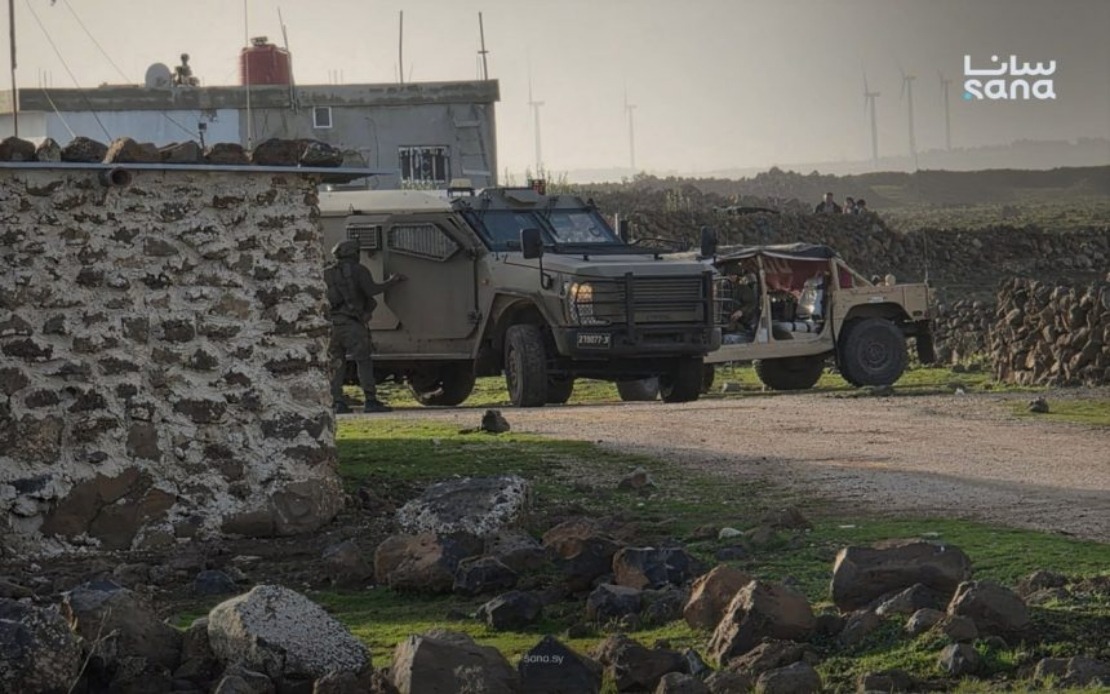
Israeli forces comprising six military vehicles crossed into Syria's southwestern Quneitra province on Saturday, according to reports from the Syrian Arab News Agency (SANA), underscoring the deepening security vacuum that has emerged across southern Syria since the dramatic collapse of Bashar al-Assad's government late last year. The convoy proceeded toward the Kudna Dam in central Quneitra while unmanned aerial systems maintained surveillance operations overhead, a pattern that reflects the shifting tactical approach Israel has adopted in the region.
The Quneitra incursion represents one of the most visible manifestations of a broader strategic reassessment by Israel following al-Assad's fall in December 2024. For decades, the 1974 disengagement agreement had created a fragile but functional buffer zone between Israeli and Syrian forces in the region, managed under United Nations observation. Israel's formal announcement that this agreement no longer applies signalled a fundamental rupture in the arrangement, removing the diplomatic framework that had largely contained direct military confrontation along this frontier.
Southern Syria has become a focal point of Israeli military activity over the past several months, with incursions occurring with increasing frequency and scope. Beyond vehicle movements across the border, Israeli operations have included armed raids, facility searches, detention operations, and the establishment of military checkpoints that extend Israeli control deeper into Syrian territory. These activities had already begun accumulating before al-Assad's ouster but have accelerated dramatically since the regime's collapse, as the absence of a functioning central authority in Damascus has eliminated the institutional capacity to resist or formally protest such actions.
The timing of Saturday's incursion reflects broader geopolitical turbulence in the Levant. The fall of al-Assad's regime left Syria without a government capable of projecting authority throughout its territory, creating security vacuums that neighbouring states have begun to exploit. For Israel, this transformation presents both opportunities and concerns—opportunity to reshape the security environment along its border, but also the uncertainty of dealing with an increasingly fragmented Syrian landscape where various armed groups and foreign powers compete for influence.
The involvement of unmanned systems in the Quneitra operation illustrates Israel's preference for maintaining operational capacity while minimizing personnel exposure. The use of drones for reconnaissance and surveillance has become standard procedure during such incursions, allowing Israeli commanders to gather intelligence on Syrian positions, military infrastructure, and the capabilities of whatever armed groups may be present in the area. This technological advantage represents a significant asymmetry that groups operating in southern Syria lack the means to counter effectively.
For Malaysian observers and policymakers monitoring Middle Eastern developments, the Quneitra incident carries implications beyond the immediate Syrian-Israeli context. The unraveling of existing security agreements and the assertion of unilateral military control over buffer zones represents a destabilization of regional norms that could encourage similar actions elsewhere. The principle that a collapsed state permits neighbouring powers to unilaterally redefine borders and security arrangements challenges the interstate system that developing nations like Malaysia depend upon for stability.
The repeated violations of Syrian sovereignty documented by SANA reflect a pattern rather than isolated incidents. The frequency and scale of Israeli operations suggest a systematic effort to establish facts on the ground—military presence, checkpoint networks, and demonstrated capacity to operate freely across the border. Such accumulation of small incursions can gradually redraw effective control without the visibility of major military operations, though the current Syrian weakness makes even overt operations feasible.
The collapse of the 1974 disengagement agreement removes a critical institutional constraint on Israeli military operations in Syria. That agreement, monitored by United Nations personnel, had created a tripwire mechanism where dramatic violations would trigger international attention and diplomatic pressure. Its dissolution eliminates that mechanism precisely when Syria's government lacks the ability to invoke international support or resistance. Israeli officials have explicitly justified this move by noting that al-Assad's regime no longer exists to honour the agreement, a technically accurate but strategically significant assertion that formalizes the new reality.
Southern Syria's instability extends beyond the Israeli-Syrian frontier. The broader collapse of state authority has created a space where multiple actors—Turkish forces, Iranian-backed groups, various rebel factions, and now increasingly visible Israeli operations—compete for influence. Quneitra province, positioned at the convergence of Israeli, Jordanian, and Turkish spheres of interest, has become a particular flashpoint where these competing interests intersect with minimal institutional resistance.
The international response to Israeli operations in post-Assad Syria remains constrained by several factors. The Syrian government's absence eliminates the traditional counterparty for diplomatic protests. Neighbouring countries like Jordan and Lebanon, while affected by the instability, lack the military capacity to challenge Israeli actions. International organisations have struggled to respond coherently to Syria's state collapse, and major powers have competing interests in the Syrian outcome that complicate unified diplomatic responses.
For Malaysia and other Southeast Asian nations concerned with regional stability and respect for sovereignty, the Syrian situation presents a cautionary case study. The complete breakdown of state institutions, combined with the unilateral assertion of control by more powerful neighbours, illustrates the security dangers posed by state collapse in strategically significant locations. The precedent established in Quneitra—that a sufficiently weakened state cannot prevent military incursions or maintain border integrity—carries broader implications for international law and the protection of smaller states.
Moving forward, the trajectory of Israeli-Syrian military interactions will depend heavily on whether any functional Syrian government emerges capable of asserting control over its territory. In the interim, southern Syria appears set to remain a zone of fluid and intensifying Israeli military operations, with Quneitra province serving as a visible indicator of how far Israel is willing to extend its direct military presence. The Saturday incursion, therefore, should be understood not as an isolated event but as a symptom of the broader transformation of Syrian geopolitics since al-Assad's regime's dramatic collapse.

