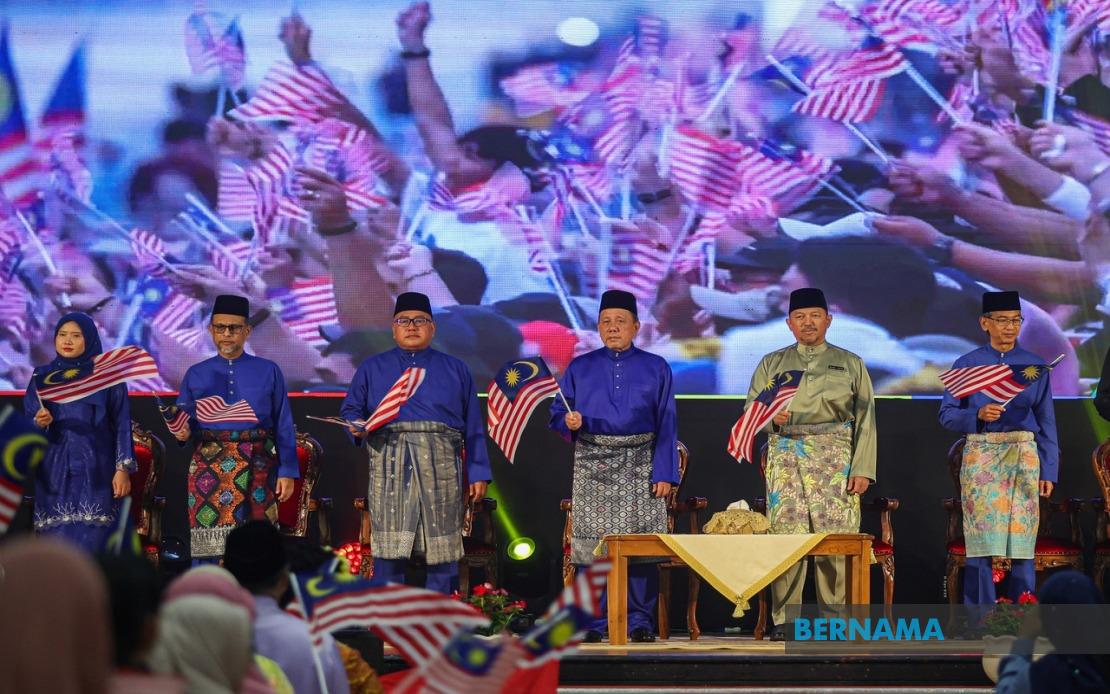
Negeri Sembilan Menteri Besar Datuk Ismail Lasim has unveiled an ambitious governance blueprint anchored on three foundational pillars—stability, progress, and prosperity—intended to reshape how the state administration delivers public services and addresses citizen concerns. Speaking at the state-level assembly of public servants and the launch of the Kibar Jalur Gemilang campaign in Seremban, Ismail articulated a vision that extends beyond electoral mathematics to encompass institutional integrity and constitutional safeguards as essential prerequisites for effective governance.
The Juasseh assemblyman distinguished his administration's approach from conventional understandings of political success by emphasizing that stability transcends parliamentary arithmetic. Rather than viewing government legitimacy primarily through majority support in the State Legislative Assembly, Ismail positioned institutional and administrative steadiness as the true measure of a functional state. This reframing carries particular significance in Malaysian politics, where coalition dynamics and shifting allegiances frequently reshape the political landscape. By prioritizing the integrity of constitutional institutions and customary frameworks, Ismail seeks to project an administration grounded in predictability and institutional confidence—assets that prove especially attractive to investors evaluating regulatory environments and long-term business viability.
The second pillar of progress encompasses a broader conception than conventional economic indicators alone. Ismail articulated that meaningful advancement must encompass job creation, the attraction of quality foreign and domestic investment, and equitable geographic distribution of development benefits. This inclusive framing addresses persistent tensions in Malaysian regional development, where urban centers have historically captured disproportionate shares of infrastructure spending and economic opportunity. By committing to synchronized advancement across rural areas and Felda settlements alongside major towns, Ismail acknowledged the political salience of rural constituencies and the socioeconomic challenges facing agricultural communities during periods of sectoral transformation.
Negeri Sembilan's economic trajectory provides context for these ambitions. The state's gross domestic product expanded to RM55.8 billion in the preceding year, climbing from RM54.3 billion and representing 2.6 percent growth driven substantially by services and manufacturing sectors. These figures position Negeri Sembilan as a mid-tier economic performer within the Malaysian federation, with sufficient diversification to cushion against commodity price fluctuations that devastate more resource-dependent states. The administration's projection that state revenue will reach RM1 billion by 2030—building from RM522.4 million currently—reflects confidence in sustained economic expansion, though achieving this target will require deliberate policy interventions supporting both sectors.
The third pillar—prosperity—carries explicit emphasis on inclusivity and wealth distribution. Rather than concentrating benefits among already-advantaged segments, Ismail signaled commitment to mechanisms ensuring that economic growth translates into improved living standards across demographic and geographic constituencies. This formulation responds to mounting concerns about inequality within Malaysia, where aggregate growth figures often obscure stagnant or declining real incomes for substantial population segments. For Negeri Sembilan's 1.2 million residents, prosperity measured through broad-based income improvements and service accessibility represents a meaningful departure from trickle-down assumptions that have historically dominated development discourse.
Ismail's invocation of the newly constituted State Executive Council's composition warrants careful observation. The emphasis on diverse experience, fresh expertise, and renewed energy suggests a deliberate recalibration of the administrative team, potentially reflecting confidence-building measures aimed at both the public service apparatus and external stakeholders. The explicitly stated cooperation between Exco members and the civil service signals recognition that effective governance requires functional partnerships between political leadership and career officials—a relationship sometimes strained in Malaysian state administrations where political turnover creates institutional disruption.
The administration's focus on agricultural and rural economic strengthening carries particular importance for Southeast Asian readers monitoring Malaysian policy trajectories. Agriculture has experienced persistent challenges globally as younger demographics migrate toward urban centers and mechanization reduces labor requirements. Negeri Sembilan's Felda settlements, established decades ago as pioneering land development schemes, now face demographic aging and generational transition questions. By positioning agricultural revitalization and rural economic diversification as explicit administration priorities, Ismail addressed constituencies vulnerable to marginalization amid broader economic transformation.
Investment competitiveness receives prominent framing within the governance blueprint. Ismail directly linked institutional stability and cooperative public-service engagement to Malaysia's positioning within regional and global investment hierarchies. This reflects Malaysia's ongoing competition with neighboring economies for manufacturing, technology, and services investments. Negeri Sembilan's geographic proximity to Kuala Lumpur and the Klang Valley, combined with relatively developed infrastructure, positions the state as a potential beneficiary of firms seeking to establish operations outside the capital's congested corridors while maintaining logistical advantages.
The concurrent call for widespread display of the Jalur Gemilang across government departments, local authorities, schools, businesses, and residential areas during National Day celebrations operates on multiple registers. Superficially, it represents routine administrative directives supporting national symbolism. More substantively, it reflects broader governance messaging attempting to align state identity with constitutional nationalism and institutional patrimonialism. This positioning proves particularly relevant during periods of political transition, when new administrations seek to stabilize public perception through repeated invocation of shared national symbols and civic obligations.
For Malaysian political observers and Southeast Asian policymakers, Ismail's articulation of three-pillar governance demonstrates emerging efforts to move beyond conventional campaign rhetoric toward articulated policy frameworks emphasizing institutional maturity. Whether implementation delivers substantive outcomes remains to be determined, particularly given the ambitious revenue and prosperity targets outlined. The framework's success will depend upon disciplined execution across multiple policy domains, coherent coordination among Exco members and career administrators, and demonstrated commitment to rural constituencies and agricultural transformation. The coming years will reveal whether this blueprint translates into measurable improvements in public service delivery and inclusive economic growth, or represents aspirational rhetoric outpacing administrative capacity.

