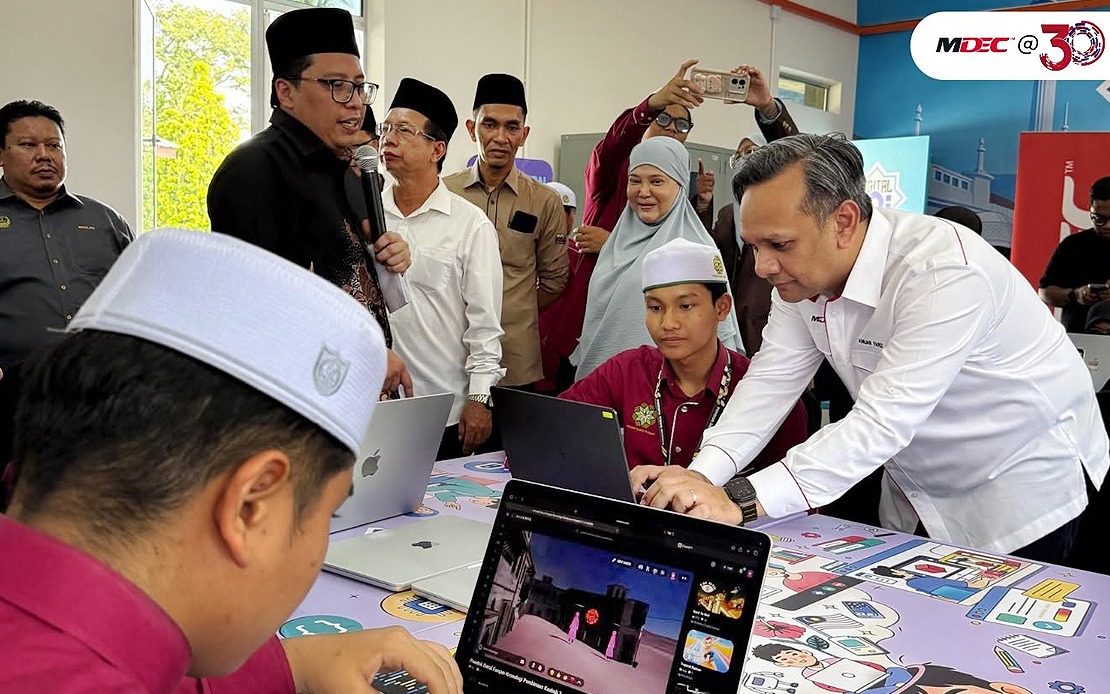
Pondok Darul Furqan in Ipoh's Tambun district has become the latest Islamic education institution to receive a Digital Maker Hub from the Malaysia Digital Economy Corporation, marking a significant step in the government's effort to democratise access to digital learning technologies among religiously-affiliated schools. The facility, officially handed over on July 13, represents a deliberate attempt to blend traditional religious instruction with contemporary technological literacy, recognising that modern Islamic institutions must equip their students with skills relevant to a rapidly evolving digital economy.
The Digital Maker Hub functions as an interactive learning environment stocked with essential technological infrastructure, including computers, high-speed internet access, interactive smartboards, robotics equipment and microcontroller systems. These tools are designed to move beyond theoretical understanding of technology towards hands-on experimentation and creative problem-solving. Rather than passively consuming digital content, students and teachers at Pondok Darul Furqan can now actively build projects, test ideas and develop practical competency in emerging technologies that increasingly dominate Malaysia's economic landscape.
MDEC chief executive officer Anuar Fariz Fadzil framed the initiative within Malaysia's broader strategic ambition to position itself as an artificial intelligence leader by 2030. The underlying logic is straightforward yet compelling: if Malaysia aspires to compete globally in AI development and digital innovation, it cannot afford to leave any segment of its population—including students in Islamic education settings—behind in the technological revolution. This represents a philosophical shift acknowledging that digital capability is no longer a luxury but a fundamental requirement for meaningful participation in the modern economy.
The Digital Maker Hub deployment occurs under the Islamic Education Institution Digital Transformation Programme, known as Digital IPI, a collaborative framework involving MDEC and the Department of Islamic Development Malaysia (JAKIM). This partnership structure is noteworthy because it demonstrates government commitment to meeting Islamic institutions on their own terms rather than imposing external solutions. By working through JAKIM, the programme gains institutional credibility and cultural legitimacy within the Islamic education sector, increasing the likelihood of genuine adoption and integration.
At Pondok Darul Furqan, the initiative has already taken tangible form. Thirty students and five teachers engaged in a two-day immersive experience called the MetaSkool Metaverse Programme, which introduced participants to virtual reality and metaverse technologies through experiential learning exercises. These were not abstract lectures but interactive activities designed to stimulate creativity and encourage exploration of innovative applications. For many participants in the Perak region, this likely represented their first meaningful exposure to metaverse concepts, suggesting how significant the knowledge transfer can be.
The Ipoh facility serves as a pilot installation within a broader rollout strategy. Four additional Islamic education institutions located in Kedah, Kelantan, Negeri Sembilan, Pahang and Penang have also been selected to receive identical Digital Maker Hubs during this initial phase. This geographical distribution across diverse states suggests a deliberate effort to reach different regions and create a network of digitally-equipped institutions rather than concentrating resources in urban centres. The strategy implies longer-term ambitions to expand the programme nationally.
Prime Minister Datuk Seri Anwar Ibrahim launched Digital IPI in March, setting an ambitious scope for the initiative. The programme anticipates reaching over 3,000 students and 50 teachers through structured training modules spanning multiple domains: digital literacy fundamentals and artificial intelligence concepts, creative applications of digital tools, immersive learning technologies, metaverse platforms and practical digital content creation. This curriculum breadth indicates recognition that technology education must span both technical foundations and creative expression.
For Malaysian policymakers and educators, the Digital IPI programme addresses a critical gap in the national educational ecosystem. Islamic education institutions, which serve significant student populations across the country, have historically received less investment in technological infrastructure compared to government schools. By specifically targeting these institutions, the programme acknowledges an equity imperative: students in Islamic boarding schools deserve equal access to the digital tools and knowledge that their counterparts in mainstream schools increasingly take for granted. This targeted approach could help prevent the emergence of a digital divide along religious institutional lines.
The integration of religious values with technological training represents another dimension worth examining. Rather than treating religious education and technology as separate domains, Digital IPI attempts a holistic approach that respects Islamic education's foundational purpose while equipping students for contemporary contexts. Values such as trustworthiness, which the programme seeks to emphasise, can theoretically be reinforced through technology projects that require teamwork, ethical decision-making and responsible innovation. This fusion reflects understanding that effective education in the digital age cannot ignore the moral and values-based components that give learning deeper meaning.
For the broader Southeast Asian context, Malaysia's approach offers a noteworthy model. Other nations in the region also operate extensive Islamic education systems yet may lack comparable digital transformation initiatives. Malaysia's willingness to invest government resources through MDEC and coordinate with religious authorities through JAKIM demonstrates that technological modernisation and religious education need not be in tension. This experience could inform policy discussions in other Muslim-majority countries wrestling with similar questions about how to prepare students in Islamic institutions for digital futures.
The implications extend to Malaysia's competitive positioning in the regional digital economy. As countries compete for talent and innovation capacity, ensuring that all population segments—regardless of their educational background—develop digital competency becomes strategically important. Students emerging from Islamic institutions equipped with AI literacy, coding fundamentals and metaverse familiarity expand the potential talent pool available to Malaysia's technology sector. Over time, this could contribute meaningfully to the supply of skilled workers in high-value digital industries.
Looking forward, the success of Digital IPI will depend on sustained implementation beyond the initial hub installations. Teachers require ongoing professional development to confidently facilitate technology-based learning. Students need continued access to equipment and mentorship. The programme's ambitious targets of reaching thousands of students and dozens of teachers will demand significant resource commitment and coordination across multiple government agencies. Whether the political will and budgetary allocation remain stable through inevitable transitions will ultimately determine whether Digital IPI becomes a transformative initiative or a laudable but limited pilot project.

