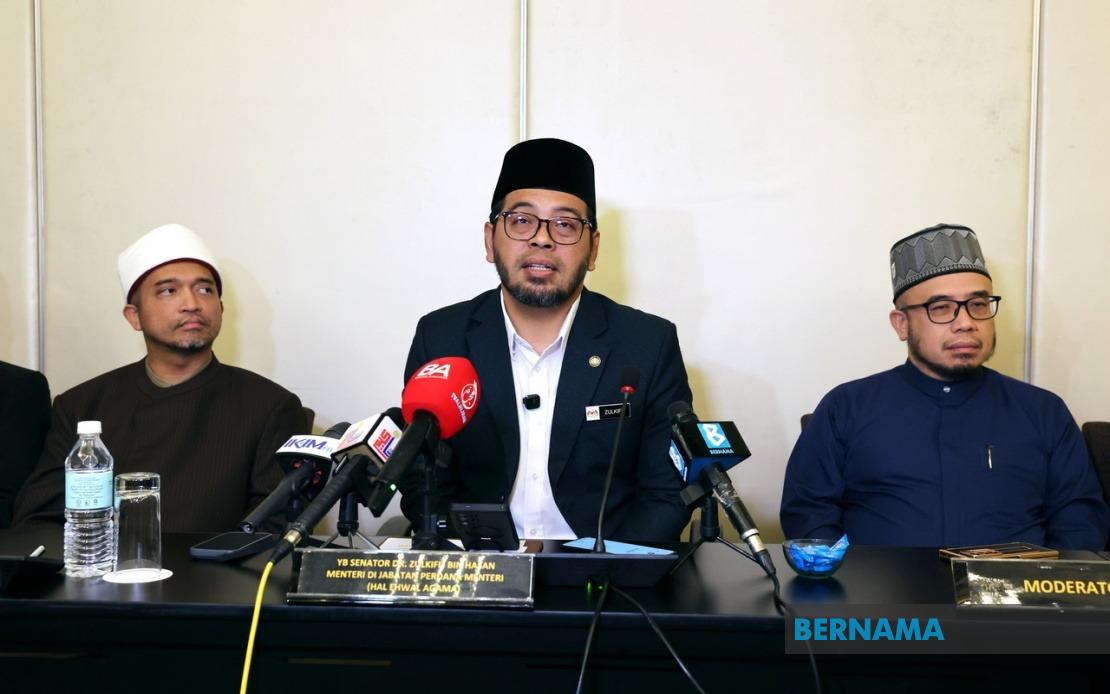
Malaysia's Minister in the Prime Minister's Department (Religious Affairs) Dr Zulkifli Hasan has formally rejected the application of the term "kafir harbi" to Malaysian citizens, marking an official stance on a sensitive theological and political matter that has periodically surfaced in public discourse. Speaking in Putrajaya on August 10, Zulkifli stated that the designation is fundamentally incompatible with Malaysia's constitutional framework and the nation's multi-ethnic, multi-religious character. The declaration followed a structured roundtable discussion convened specifically to examine the term's relevance and appropriateness within the Malaysian context.
The concept of "kafir harbi" refers in Islamic jurisprudence to non-Muslims in territories considered hostile to Islam—a classification historically applied in contexts of religious conflict or non-Muslim dominance. Its invocation in contemporary Malaysia carries particularly fraught implications, potentially delegitimizing non-Muslim fellow citizens and undermining the constitutional compact that binds the nation together. By explicitly ruling out its use, Zulkifli positioned the government as guardian of a unifying national narrative that transcends religious categorical divisions.
During his remarks, Zulkifli articulated the core principle underpinning the decision: all Malaysian citizens derive their legal status and mutual obligations from the Federal Constitution, not from their religious identity. This constitutional grounding supersedes any theological framework that might otherwise classify citizens according to faith-based hierarchies. The minister emphasized that Malaysia represents a single national community in which citizens of all religions share both rights and responsibilities, rendering divisive religious classifications both analytically flawed and politically counterproductive.
The roundtable discussion brought together stakeholders from multiple domains to examine the issue comprehensively. Through presentations, deliberations, and structured dialogue, participants reached consensus that employing such terminology threatened social cohesion and contradicted Malaysia's foundational commitment to national unity. This collaborative forum approach reflected an official desire to ground the decision in broad-based agreement rather than unilateral ministerial pronouncement, lending greater legitimacy to the outcome.
Zulkifli articulated a vision of national solidarity grounded in shared custodianship of Malaysia's future. He framed the rejection of divisive religious language as integral to strengthening the bonds that hold the nation together across demographic and faith-based lines. This reframing transforms what might appear as merely a theological debate into a matter of fundamental national interest and constitutional principle. The emphasis on unity and mutual respect across religious boundaries reflects official anxiety about language and rhetoric that could fracture Malaysia's carefully maintained plural society.
The Department of Islamic Development Malaysia (JAKIM) has been tasked with leading a coordinated public education campaign to clarify the government's position and build awareness among both Muslim and non-Muslim communities. This initiative underscores recognition that terminology and theological concepts, however arcane they may appear to secular observers, carry real consequences for inter-communal relations in a diverse society. JAKIM's involvement signals that the religious establishment itself will champion the government's integrationist message.
Zulkifli stressed that the information and clarification efforts must transcend the religious sector alone, requiring participation from multiple government agencies and ministries. This multi-sectoral approach acknowledges that national integration cannot be pursued through religious channels exclusively but demands coordinated messaging across education, information, security, and other domains. The inclusive framework suggests official recognition that building and maintaining plural societies requires sustained institutional commitment across numerous policy areas.
The minister's appeal to all Malaysians to strengthen unity and foster intercommunal understanding carries particular resonance given periodic tensions around religious expression and minority rights in Malaysian public life. By explicitly calling for mutual respect and cultural understanding, Zulkifli positioned the government as actively intervening to promote tolerant attitudes and inclusive national consciousness. The appeal implicitly acknowledges that such attitudes require deliberate cultivation and cannot be assumed to develop spontaneously.
For non-Muslim Malaysians, the formal rejection of "kafir harbi" terminology provides reassurance that the state apparatus recognizes their full citizenship status and rejects theological frameworks that might otherwise marginalize them. The declaration affirms constitutional protection against discriminatory classification based on religious identity, reinforcing principles of equal citizenship. This carries particular significance in a polity where religious establishment seats hold considerable institutional influence and where constitutional provisions grant Islam special recognition.
The decision also reflects evolving interpretations of Islamic jurisprudence within Malaysia's official Islamic establishment. By rejecting the applicability of "kafir harbi" to Malaysian citizens, authorities implicitly assert that classical Islamic legal categories require contextual reinterpretation when applied to modern plural nation-states. This theological pragmatism enables Malaysia to maintain Islamic institutional prominence while still accommodating non-Muslim populations as full constitutional citizens—a delicate balance essential to Malaysia's political stability.
For Southeast Asia more broadly, Malaysia's explicit repositioning carries potential implications for how other Muslim-majority nations navigate religious pluralism and national integration. The formal rejection of divisive theological terminology, coupled with affirmation of constitutional unity, offers a model for reconciling Islamic institutional roles with inclusive citizenship frameworks. The approach prioritizes shared constitutional membership over religious categorical boundaries, potentially influencing regional approaches to managing religious diversity.
Looking forward, the success of JAKIM's public education initiative will determine whether this governmental clarification translates into changed attitudes and reduced invocation of the contested term in public discourse. The challenge extends beyond elite-level pronouncements to shifting grassroots understandings and informal usage patterns. Sustained institutional commitment and coordinated messaging across government will be essential to embedding the new official position within broader Malaysian society and preventing reemergence of divisive terminology.

