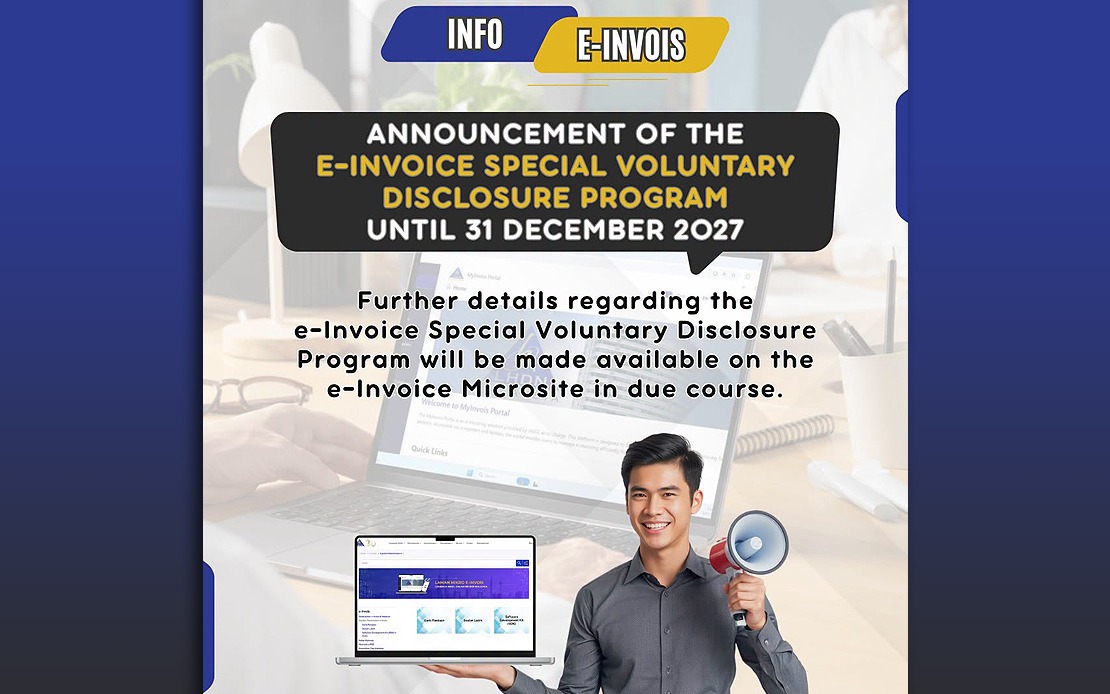
The Inland Revenue Board (IRB) has activated a comprehensive amnesty scheme designed to encourage businesses to voluntarily correct deficiencies in their electronic invoicing submissions. Running through December 31, 2027, the e-Invoice Special Voluntary Disclosure Programme (PKPS) represents a significant shift in Malaysia's approach to digital tax compliance, offering a grace period for enterprises struggling with the transition to mandatory e-invoicing requirements.
Three distinct groups of taxpayers may benefit from this initiative. The first encompasses businesses that failed entirely to submit e-Invoices for transactions that should have been documented digitally. The second category includes those who submitted e-Invoices containing errors or falling short of regulatory specifications. The third group covers entities that never submitted e-Invoices for any period since the government mandated digital invoicing implementation. This tiered structure acknowledges the varied compliance challenges facing Malaysia's diverse business ecosystem.
Prime Minister Datuk Seri Anwar Ibrahim, speaking in his capacity as Finance Minister, framed the programme as a cost-reduction measure aimed particularly at micro, small, and medium enterprises (MSMEs). His announcement reflects the government's recognition that the transition to fully digital tax administration has created administrative burdens for smaller operators who may lack dedicated compliance teams or sophisticated accounting infrastructure. By extending this amnesty, the administration seeks to bring more businesses into the formal e-invoicing system without triggering the financial penalties that typically accompany non-compliance.
The programme's most attractive feature is its penalty waiver. During the disclosure period, the IRB will not impose financial sanctions on any updates, revisions, or corrections that taxpayers submit voluntarily. This represents a meaningful departure from standard enforcement practices and signals the government's prioritisation of compliance expansion over revenue collection through penalties. For businesses managing cash flow constraints, the absence of retrospective penalties may prove decisive in their decision to regularise their tax position.
The IRB has emphasised that all voluntary disclosures must meet stipulated accuracy and quality standards. Submissions must align with both General and Specific e-Invoice Guidelines, meaning the amnesty is not a free pass for sloppy record-keeping but rather a structured opportunity to correct documentation systematically. This requirement ensures that the digital tax system maintains integrity while accommodating legitimate compliance difficulties.
Beyond the amnesty itself, the government has announced accelerated tax incentives for businesses demonstrating full compliance with e-invoicing mandates. Specifically, taxpayers may now claim capital allowances for information and communication technology equipment purchases and software development costs related to e-invoicing systems within a single financial year, rather than spreading deductions across multiple years. This measure addresses a critical barrier to digital adoption, particularly for smaller enterprises for whom upfront system investment represents a significant expense relative to turnover.
The timing of this initiative reflects broader regional patterns in Southeast Asia, where governments are grappling with digital tax system implementation while managing business sector resistance. Malaysia's approach—combining amnesty provisions with positive incentives—differs from purely enforcement-focused strategies and may offer lessons for neighbouring countries still rolling out electronic invoicing requirements. For Malaysian businesses operating regionally, understanding this framework becomes important for cross-border compliance planning.
Access to assistance is crucial for programme success. The IRB has established multiple support channels, including the dedicated e-Invoice helpdesk at 03-8682 8000, MyInvois Live Chat facilities, and direct support through IRB offices nationwide. The existence of these channels recognises that many compliance failures stem not from deliberate evasion but from genuine confusion about technical requirements or system navigation. Enhanced advisory capacity potentially converts the amnesty from a mere penalty deferral into a genuine compliance support mechanism.
For MSMEs particularly, the programme addresses a critical vulnerability point. Many smaller operators have struggled with e-invoicing implementation due to limited IT resources, unfamiliarity with digital platforms, and competing operational priorities. The combination of penalty amnesty, technical support, and accelerated tax deductions creates a more forgiving compliance environment that may accelerate genuine system adoption rather than merely driving underground the informal economy segments currently avoiding digital compliance.
The extended timeline until end-2027 provides businesses with almost three years to regularise their positions, suggesting the government's confidence that this timeframe suffices for systematic correction of historical deficiencies. However, the fixed deadline also creates urgency, potentially motivating procrastinating businesses to engage with the e-invoicing system before the amnesty window closes. This balance between leniency and deadlines reflects sophisticated understanding of behavioural compliance dynamics.
Regional implications merit consideration as well. As Malaysia deepens digital tax infrastructure, it creates template and precedent for other ASEAN economies contemplating similar transitions. The balance the IRB has struck between supporting business digitisation and maintaining tax system integrity could influence how neighbouring governments structure their own electronic tax administration programmes. For multinational enterprises operating across Southeast Asia, Malaysia's approach becomes a relevant case study in managing large-scale system migration.

