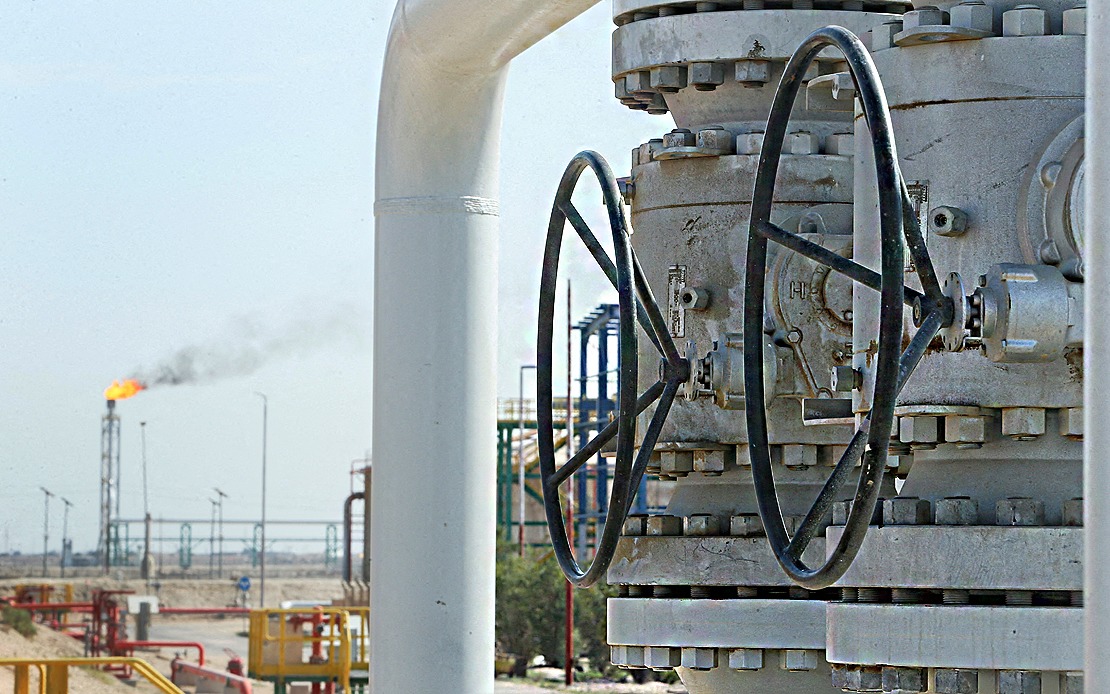
Iraq is pressing ahead with ambitious plans to construct a major oil pipeline terminating at Mediterranean ports in Turkiye and Syria, marking a strategic shift driven by the persistent disruptions affecting the Strait of Hormuz. Oil Minister Bassim Khudair confirmed the acceleration of these plans, signalling Baghdad's determination to establish viable alternatives to traditional shipping routes that have been compromised by regional tensions. The initiative reflects mounting anxiety among Iraqi policymakers about the vulnerability of conventional export channels and their capacity to handle the nation's petroleum shipments reliably.
A comprehensive feasibility study is currently underway to evaluate a pipeline corridor that would unite Iraq's two principal hydrocarbon hubs: the prolific southern fields centring on Basra and the northern reserves in the Kirkuk region. This unified infrastructure would transport crude oil westward across Iraqi and Syrian territory to reach the Turkish port of Ceyhan on the Mediterranean, with an alternative terminus at Baniyas in Syria. The design demonstrates flexibility in its eventual routing, as officials have indicated that extensions could potentially reach the Jordanian Red Sea port of Aqaba, creating multiple maritime export points and further diversifying Iraq's market access.
The urgency driving this project cannot be overstated when considering Iraq's economic circumstances. The nation relies overwhelmingly on petroleum revenues, which in stable periods contribute more than 90 per cent of state income. This dependence is not merely a macroeconomic concern but a social imperative affecting millions of ordinary Iraqis who depend on government disbursements. Over 10 million citizens—encompassing civil service employees, retirees, and social welfare beneficiaries—receive monthly payments funded almost entirely by oil export receipts. Any disruption to revenue generation cascades through the economy and threatens the government's capacity to meet basic public obligations.
The Strait of Hormuz, one of the world's most critical maritime chokepoints, has effectively remained blocked for extended periods as hostilities between Iran and the United States have escalated. This strategic waterway normally handles a substantial share of global oil shipments, and its compromise creates a bottleneck effect that penalises exporters dependent on this passage. Iraq, which lacks secure alternative maritime access, faces particular vulnerability. Production itself has contracted during the conflict period, compounding the export problem and further undermining state revenues.
However, Iraqi planners are not oblivious to the considerable drawbacks inherent in overland pipeline transportation. Moving crude oil through terrestrial routes proves substantially more costly and operationally less efficient compared to maritime shipping, which benefits from economies of scale. The expense differential could prove significant over the lifespan of such infrastructure, affecting the competitiveness of Iraqi oil in international markets and potentially reducing the financial advantage of circumventing Hormuz entirely.
Moreover, Iraqi officials privately acknowledge a sobering reality: pipelines and associated energy infrastructure lying outside the Hormuz zone remain theoretically susceptible to interdiction and attack, particularly from Iranian forces seeking to expand their leverage over regional energy flows. The political and security dimension of this dilemma complicates what appears initially to be a straightforward technical problem. Alternative infrastructure represents a target, and the calculus of regional power competition suggests that any new corridor could become a flashpoint rather than a definitive solution.
Baghdad has not begun from scratch in pursuing export diversification. Iraq currently operates an existing pipeline to Turkiye that traverses the semi-autonomous Kurdish region, providing a functional albeit capacity-limited conduit for petroleum exports. A second pipeline designed to bypass Kurdish territory entirely—thereby avoiding the political complications of routing through regions with their own resource governance—has reached final testing phases. According to Khudair, this second corridor could commence operations within days, providing immediate though partial relief to Iraq's export constraints.
For Malaysian readers and Southeast Asian observers, Iraq's predicament illuminates the precarious position of energy exporters whose fortune depends on contested waterways and fragile regional stability. The broader implications extend beyond Iraq itself, as global energy security and regional commerce depend on maintaining reliable transit corridors. The Strait of Hormuz remains essential for Asian economies, and any prolonged disruption threatens fuel supplies and inflation dynamics across East and Southeast Asia. Iraq's pipeline initiative, whatever its immediate prospects, underscores how Middle Eastern instability propagates economic consequences far beyond the region.
The articulated "clear vision and strategy" that Khudair claims Baghdad possesses must be tested against reality. The pipeline project represents a long-term commitment requiring substantial capital investment, security guarantees across transit territories, and political cooperation among governments whose relationships remain complex and sometimes adversarial. Even if successfully constructed, such infrastructure would require years to achieve operational capability, leaving Iraq exposed to Hormuz-related disruptions in the intervening period. The initiative therefore occupies an intermediate position between strategic necessity and practical feasibility, reflecting how energy-dependent nations navigate the intersection of geopolitical constraint and economic survival.

