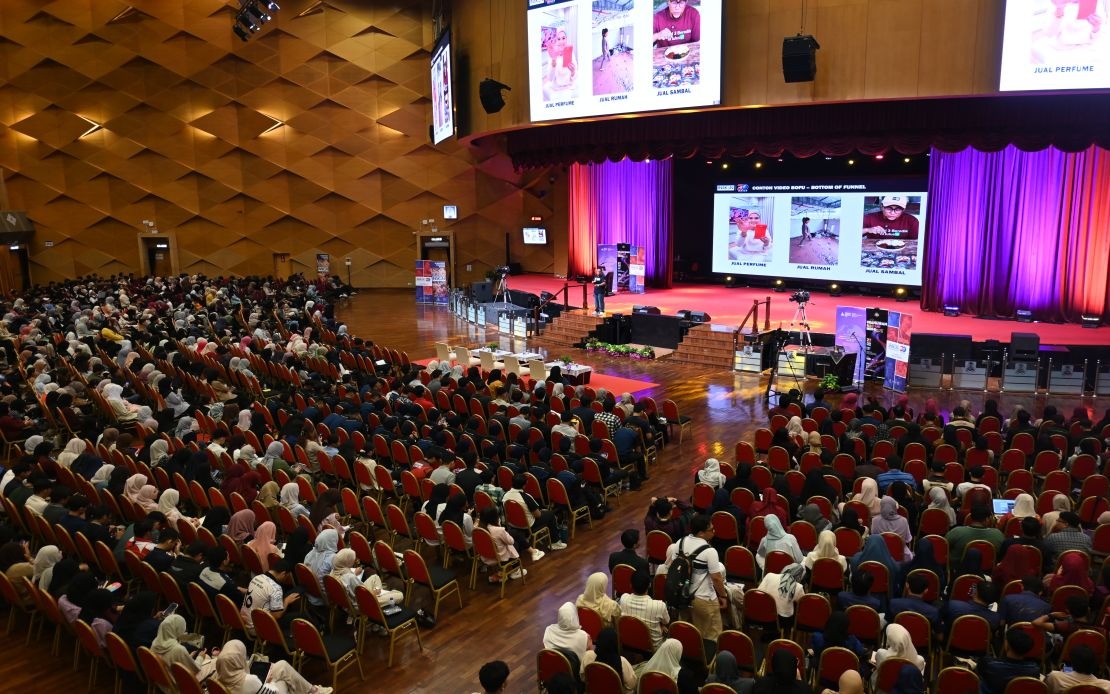
A major entrepreneurship seminar held at Universiti Teknologi MARA's Shah Alam campus has set a national participation record, drawing 6,877 students both in-person and virtually to engage with industry leaders and policy makers on business fundamentals. The Usahawan MADANI Mega (SUM MEGA) 2026 event, organised by the National Entrepreneurship Institute (INSKEN) alongside the Malaysian Academy of SME and Entrepreneurship Development (MASMED), has secured recognition from the Malaysia Book of Records for hosting the largest student participation in a single entrepreneurship seminar. The achievement underscores a significant cultural shift among Malaysian youth, who are increasingly viewing self-employment and business creation as credible career trajectories rather than fallback options.
The seminar represents a crucial convergence of academic institutions, government support structures, and entrepreneurial ecosystems designed to nurture the next generation of business leaders. UiTM students from across the nation participated in knowledge-sharing sessions and networking opportunities aimed at translating entrepreneurial interest into practical business competence. The scale of attendance signals that Malaysia's young people are responding positively to messages around economic opportunity and self-reliance, particularly as traditional employment pathways become more competitive and uncertain. For policymakers and educators, the turnout validates continued investment in capacity-building programmes targeting tertiary students.
Deputy Minister for Entrepreneur and Cooperatives Development Datuk Mohamad Alamin framed entrepreneurship as fundamental to Malaysia's economic future, moving beyond the stereotype of business ownership as merely an alternative livelihood. He stressed that as global competition intensifies and economic structures evolve, homegrown entrepreneurs become essential drivers of job creation, supply chain resilience, and sectoral innovation. This perspective aligns with broader Southeast Asian trends, where smaller economies increasingly rely on diverse entrepreneurial bases to sustain competitive advantage. Malaysia's emphasis on fostering entrepreneurial culture among students reflects recognition that early exposure to business concepts, networks, and mentorship can significantly influence career decisions and regional economic outcomes.
The Ministry of Entrepreneur and Cooperatives Development (KUSKOP) under the MADANI government has committed to supporting entrepreneurial ecosystems through multiple policy channels. Mohamad Alamin outlined the government's multi-pronged approach encompassing capacity-building workshops, financing mechanisms to reduce startup capital barriers, market access programmes that connect young businesses with procurement opportunities, digital transformation support, and tailored business development assistance. Such comprehensive support architecture acknowledges that entrepreneurial intent alone is insufficient; aspiring business owners require access to capital, market information, technical skills, and mentorship networks. For Malaysian entrepreneurs, particularly those from less privileged backgrounds, government-facilitated access to these resources can mean the difference between viable ventures and failed experiments.
INSKEN Board of Trustees chairman Datuk Mustaffa Kamil Ayub stressed that entrepreneurship should be reframed as a cultural movement and mindset rather than merely a career option. This ideological shift carries implications beyond economics; when entrepreneurship becomes embedded in educational curricula and societal values, it cultivates resilience, creative problem-solving, and self-reliance traits beneficial across all professional domains. The emphasis on shifting entrepreneurship from occupational categorisation to cultural identity reflects global best practices, where countries with stronger entrepreneurial cultures typically generate higher innovation rates and more dynamic small business sectors. For Southeast Asia, where many economies depend on SME contributions to GDP and employment, cultivating entrepreneurial mindsets in younger cohorts strengthens long-term economic foundations.
The seminar employed a structured pedagogical approach centred on the MOFA framework, which dissects entrepreneurial success into four operational pillars: marketing, operations, finance, and business administration. This decomposition helps participants understand that successful enterprises require competence across multiple functional areas, not merely product innovation or market enthusiasm. By exposing students to these business fundamentals through practical case studies and interactive sessions, organisers ensure that entrepreneurial aspirations translate into informed decision-making. The framework proves particularly valuable in developing markets where formal business education remains concentrated in urban centres and expensive institutions; events like SUM MEGA democratise access to entrepreneurial knowledge and mentorship that students might otherwise access only through paid programmes or family connections.
INSKEN's broader portfolio of developmental programmes—including the INSKEN Masterclass, BANGKIT initiative, and PROTÉGÉ mentorship scheme—creates a comprehensive pipeline nurturing entrepreneurs from initial interest through scaling stages. This tiered approach recognises that entrepreneurial development is iterative; students exposed to foundational concepts at seminars like SUM MEGA may progress to intensive masterclasses, peer-learning communities, and one-on-one mentoring depending on commitment levels and business viability. Such progression pathways increase the probability that talented but under-resourced individuals can advance entrepreneurial ambitions without depending entirely on family capital or serendipitous connections. The multiplicity of entry points also accommodates diverse learning styles and time constraints, essential for inclusion of students juggling academic responsibilities with business experiments.
The collaboration anchoring SUM MEGA 2026 demonstrates how Malaysia's entrepreneurship support ecosystem has matured into an interconnected network spanning government agencies, universities, financial institutions, and business associations. Rather than siloed efforts, this coordinated approach creates reinforcing effects where student interest stimulates institutional innovation, successful entrepreneurs mentor newcomers, and policymakers design support mechanisms informed by practitioner feedback. Such ecosystem coherence particularly benefits students from first-generation entrepreneurial backgrounds who lack inherited networks; the collaborative structure ensures multiple touchpoints for guidance, capital access, and market entry. Regionally, Malaysia's institutional infrastructure for entrepreneurship support surpasses many neighbours, positioning it competitively for attracting talent and venture investment.
The alignment between SUM MEGA 2026 and Malaysia's National Entrepreneurship Policy 2030 signals strategic continuity, with individual initiatives reinforcing policy objectives rather than operating independently. The national policy framework establishes entrepreneurship as essential to sustained economic growth, employment creation, and inclusive development across regions and demographics. By embedding entrepreneurship development into higher education and government support systems, Malaysia operationalises policy commitments, transforming aspirational targets into measurable institutional outcomes. For observers tracking Southeast Asian economic development, Malaysia's deliberate construction of entrepreneurship infrastructure demonstrates policy sophistication beyond rhetoric, though implementation quality and equitable access remain areas requiring ongoing evaluation and adjustment.