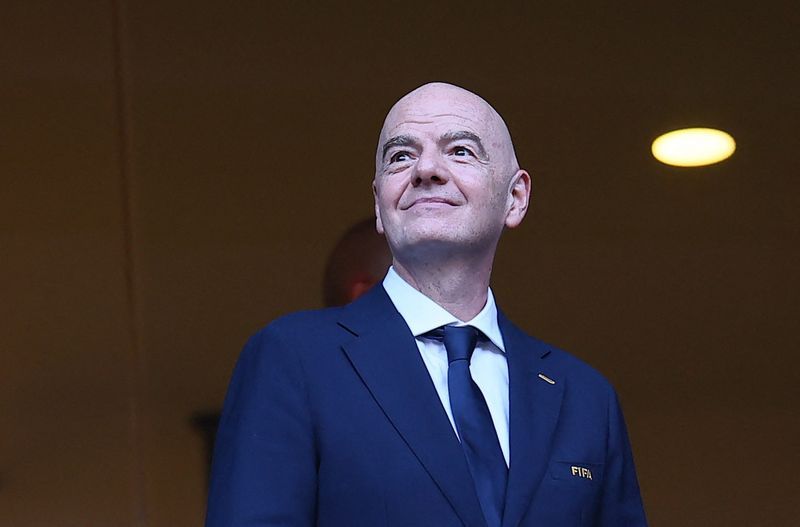
FIFA President Gianni Infantino's once-dominant control over world football's governing body has cracked visibly following the dramatic collapse of his attempt to raise $4.2 billion through a controversial stake sale in World Cup commercial rights. What began as an audacious plan to introduce private investment into the sport's flagship tournament for the first time has instead triggered an unprecedented crisis, with powerful regional confederations now openly coordinating to remove the 56-year-old Swiss-Italian administrator from his position before the FIFA Congress reconvenes in Morocco next March.
Infantino's retreat from the proposal came late on Friday after three days of turbulent internal conflict that exposed deep fractures within FIFA's administrative structure. The president subsequently apologised for the divisiveness the scheme had created, acknowledging that his handling of the matter had fractured relationships forged over nearly a decade of consolidating power. Yet this mea culpa appears insufficient to restore confidence among continental blocs whose leaders felt blindsided and marginalised by a proposal that would fundamentally reshape how the World Cup generates revenue.
The political arithmetic facing Infantino has shifted dramatically. Five European national associations, prominently including England's Football Association, have formally revoked their electoral support for his reelection campaign, while Denmark made clear it never intended to back him regardless of recent events. In contrast, the federations of Morocco, Qatar, Kuwait, Lebanon and Sri Lanka have publicly reaffirmed their backing for a leader who has controlled FIFA since taking office in 2016 and seeks to extend his tenure until 2031. However, these declared positions represent only a fraction of the 211 national federations that will cast votes at the Congress, leaving hundreds of federations' positions unknown or undeclared.
The withdrawal of backing from European associations carries considerable symbolic weight, but the far more consequential development involves the coordinated criticism from three continental confederations. UEFA, which oversees European club and national football, and CONCACAF, the governing body for North and Central American and Caribbean football, issued sharply worded statements withdrawing confidence in Infantino's leadership. The AFC, Asia's continental confederation, stopped short of such dramatic language but nevertheless declared the lack of consultation on the proposal "totally unacceptable" and called for fundamental institutional reforms at FIFA.
According to reporting from the Times of London, the three confederations are reportedly engaged in deliberate coordination aimed at forcing Infantino's departure through mechanisms that would paralyse FIFA's operations and potentially create rival competitions. This alleged strategy reveals the extraordinary gravity with which football's regional powerhouses view the crisis. CONCACAF, the AFC, and FIFA declined to comment on these reports, while UEFA similarly offered no substantive response, a calculated silence that neither confirms nor denies the coordination allegations but maintains maximum political flexibility.
Infantino's immediate strategic priority centres on preventing an Extraordinary Congress, a special session that would be triggered if 43 or more FIFA member associations formally request one in writing. Such a congress could rapidly escalate into a motion of no confidence or force an early presidential election. Avoiding this threshold over the coming weeks represents his most acute vulnerability, requiring him to either shore up wavering support or persuade potential organisers of such a request to stand down. Beyond this immediate hurdle, he possesses seven months to rehabilitate relationships and consolidate his position against potential challengers.
The structure of Infantino's power base contains both his greatest historical strength and his current greatest vulnerability. Like his two immediate predecessors, Joao Havelange and Sepp Blatter, Infantino deliberately constructed his political foundation outside Europe's wealthy football federations. Instead, he cultivated relationships with less prosperous associations that depend heavily on FIFA's financial distributions and development grants to maintain their operations. It was precisely at these federations that his World Cup commercialisation plan was pitched, accompanied by promises of annual dividends ranging from $20 million to $40 million beginning in 2025 for each federation endorsing the scheme.
This financial inducement strategy worked for years in consolidating Infantino's authority, yet it ultimately backfired catastrophically. By attempting to implement such a transformative scheme without consulting the powerful European and continental confederations that exercise enormous practical influence over global football governance, he misjudged the political moment. The absence of consultation transformed a potentially negotiable proposal into an act of unilateral overreach that violated the unwritten norms of FIFA governance and triggered the rare spectacle of continental confederations abandoning their traditional neutrality to mount unified opposition.
Infantino's opponents, energised by his apparent weakness and organisational failure, now face the significant challenge of identifying a viable alternative before the 18 November deadline for presidential nominations. Any credible challenger must possess sufficient credibility within the less wealthy federations—whose combined votes remain essential to winning the presidency—whilst simultaneously addressing the governance reform demands articulated by UEFA, CONCACAF, and AFC. The candidate must therefore navigate an exceptionally complex political landscape, offering both substantive institutional changes and financial arrangements persuasive enough to retain the support of developing federations that Infantino cultivated so assiduously.
For Southeast Asian football federations, this internal FIFA crisis presents both uncertainty and potential opportunity. Many Asian nations rely considerably on FIFA revenue distributions and development programmes, meaning any transition in FIFA leadership could affect funding flows and administrative priorities. The AFC's comparatively mild criticism suggests Asian confederations may occupy a pivotal swing position in any election contest, potentially giving them enhanced negotiating leverage in securing commitments regarding governance, transparency, and development investment from whatever leadership ultimately prevails.
The next seven months will determine whether Infantino can rebuild sufficient political capital to survive the March Congress or whether the coalition arrayed against him proves insurmountable. What remains certain is that the era of his unchallenged dominance has definitively ended, and the power structures within FIFA governance have undergone a potentially permanent realignment that transcends this single leadership contest.

