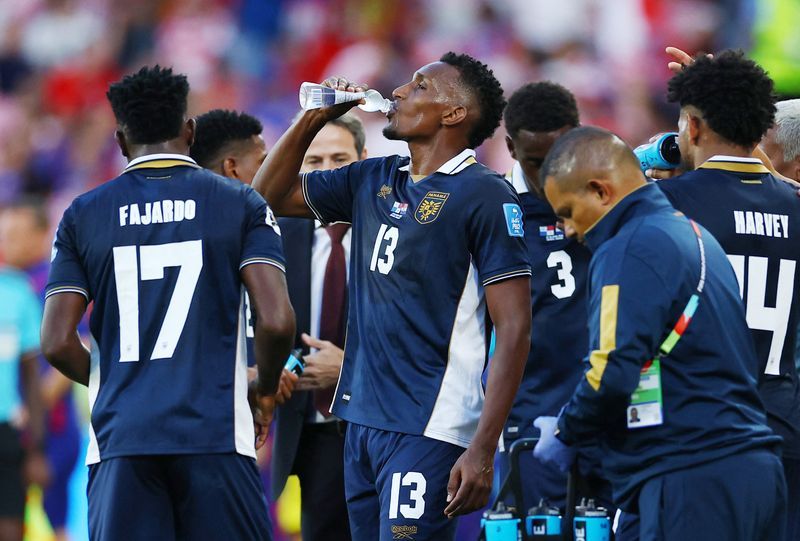
FIFA president Gianni Infantino has moved to quell mounting controversy surrounding mandatory hydration breaks introduced at the World Cup, asserting that the governing body's decision stems entirely from athletic considerations rather than revenue-generation schemes. The three-minute stoppages, inserted automatically at the 22nd and 67th minutes of every match, have provoked substantial pushback from multiple quarters since matches began, with critics questioning whether the innovation genuinely serves player welfare or merely creates extra commercial windows for broadcasters to capitalize upon.
The hydration breaks were implemented in response to extreme heat conditions affecting competitions held across North America, prompting FIFA to prioritize competitor safety and physical endurance. Yet their introduction has inadvertently created additional advertising opportunities throughout matches, sparking viewer complaints and wider debate about whether commercial interests may have influenced the decision despite official assertions to the contrary. Broadcasters have prominently utilized these pauses to insert promotional content, leading skeptics to suggest that financial motivations may have played a role in the rule's adoption or at least its enthusiastic promotion.
Infantino directly addressed these accusations on Wednesday, stating unequivocally that FIFA receives no supplementary income from the breaks since all broadcasting contracts were negotiated and finalized prior to their introduction. This assertion effectively separates the financial architecture from the timing of the rule change, though it does not necessarily eliminate questions about whether the additional advertising space benefited networks commercially even without direct FIFA compensation. The distinction between generating new revenue and creating marketing opportunities for commercial partners represents an important nuance in understanding the economic dimensions of modern sport governance.
Meanwhile, tactical implications have emerged as a secondary but significant concern among football professionals. The stoppages grant coaching staff opportunities to issue in-game instructions during these structured breaks, fundamentally altering how matches develop strategically. Veteran manager Thomas Tuchel of England has characterized the breaks as fundamentally disruptive, suggesting they undermine the continuous narrative and tactical flow that historically defines association football. Similarly, Uruguay's Marcelo Bielsa expressed concern that fragmenting matches into shorter segments erodes the sport's essential character by permitting artificial reset moments that would not naturally occur during conventional play.
Not all voices in the sport have opposed the measure outright. Spain manager Luis de la Fuente and Netherlands captain Virgil van Dijk have acknowledged the legitimate health rationale for breaks during genuinely oppressive heat conditions, yet both have questioned the blanket application across all venues and temperature scenarios. Their measured stance recognizes the real physiological threats posed by extreme temperatures while questioning whether the rule requires recalibration to account for varying environmental circumstances and indoor facilities with climate control.
Infantino countered the criticism by emphasizing the grueling nature of modern World Cup tournaments, which now span 39 days with teams potentially competing in eight matches across that extended period. From this perspective, scheduled moments for rest and recovery become strategically important elements of tournament structure rather than mere conveniences. The FIFA chief argued that providing these breaks acknowledges the physical demands imposed by compressed competition schedules that have become standard in contemporary international football.
Furthermore, Infantino highlighted a compelling argument centered on competitive fairness and standardization. He contended that allowing tactical interventions through breaks during matches played in extreme heat while denying identical opportunities in cooler conditions would create an uneven competitive environment. Under this logic, the uniform application of the rule across all matches preserves the principle that every team faces equivalent circumstances regardless of meteorological factors, preventing weather from becoming an unpredictable variable affecting which coaches gain additional strategic opportunities.
The FIFA president also maintained that introducing hydration breaks has not diminished match intensity or player performance levels throughout contests. This claim directly challenges assertions from critics who contend that the stoppages interrupt momentum and reduce the physical demands of the 90-minute encounter. If accurate, the contention suggests that modern athletes can sustain competitive intensity across fragmented timeframes without suffering the performance degradation that traditional football theory might predict.
For Malaysian and Southeast Asian sporting audiences, these debates hold particular relevance as tropical and subtropical climates increasingly impact tournament scheduling and player welfare across the region. The precedent established by FIFA's approach to environmental challenges may influence how regional football bodies address similar situations during domestic competitions held under intense heat conditions. Understanding the balance between commercial interests, athlete protection, and competitive integrity becomes increasingly important as global sports governance evolves in response to climate and economic pressures.
The hydration break controversy ultimately reflects broader tensions within modern professional sports between tradition and innovation, commercial imperatives and player safety, and centralized governance and stakeholder input. As FIFA seeks to modernize the game while preserving its essential character, the persistent criticism from respected figures like Tuchel and Bielsa suggests that further refinement of the policy may prove necessary. The coming months will reveal whether the breaks become accepted fixtures or whether mounting pressure compels FIFA to reconsider their implementation in future tournaments.