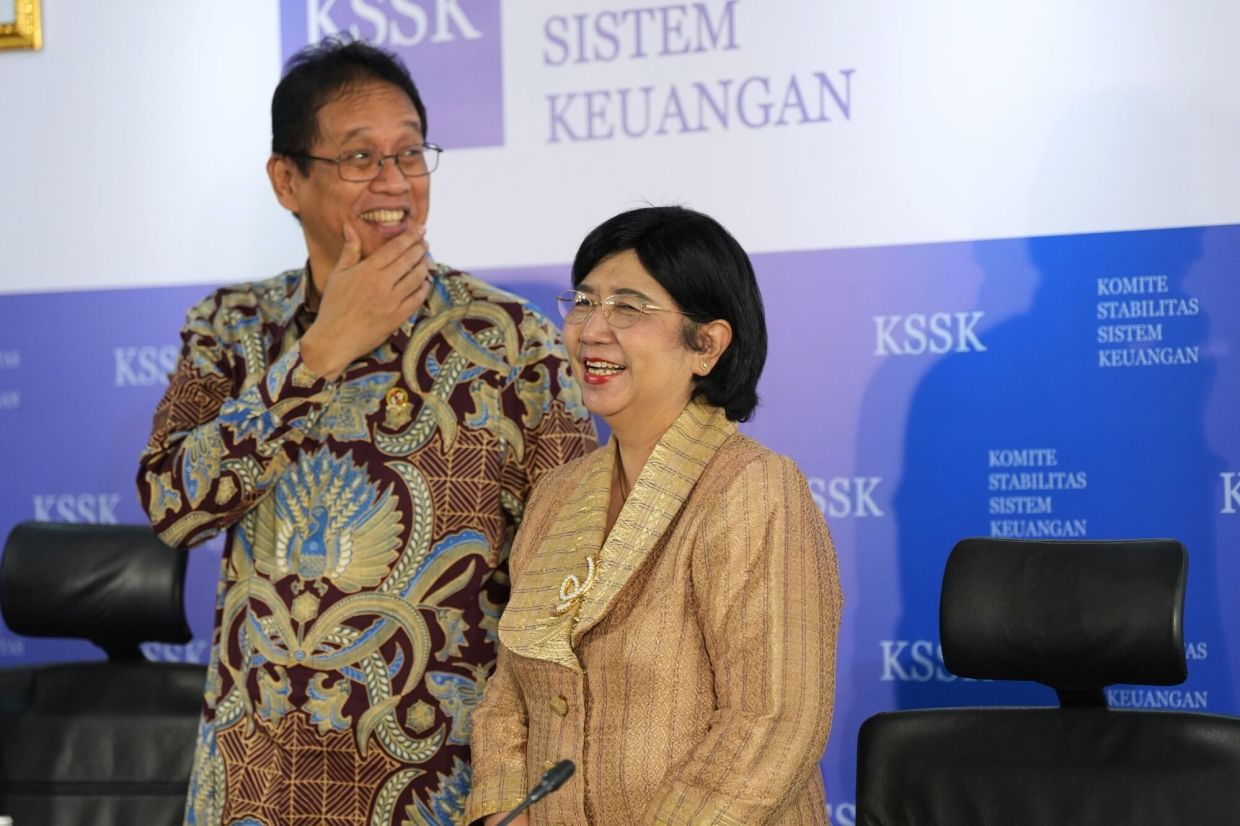
Destry Damayanti's elevation to acting governor of Bank Indonesia just over a fortnight ago immediately signalled a shift in the institution's relationship with government. Her strategic choice to visit Finance Minister Purbaya Yudhi Sadewa's office before meeting President Prabowo Subianto at the presidential palace underscored her intent to strengthen coordination between monetary and fiscal authorities. The subsequent joint press appearance, complete with handshakes and public displays of harmony, presented a markedly different dynamic from her predecessor Perry Warjiyo, whose engagements with the finance ministry typically occurred through formal channels at the president's residence or regulatory forums. This carefully orchestrated choreography of collaboration raises both opportunities and red flags for market participants watching the institution's trajectory.
Prabowo's nomination of Destry as the sole candidate for the permanent governorship reflects his administration's deliberate attempt to install a figure who embodies technocratic credibility whilst remaining receptive to the president's development agenda. Having served as Warjiyo's deputy since 2019, Destry brings continuity to monetary policy at a time when Indonesia's economic management faces intense scrutiny from both domestic stakeholders and international investors. Her appointment represents a calculated gamble: the president seeks faster growth whilst the financial markets demand the institutional independence and policy discipline that shored up the rupiah and inflation expectations during the previous regime. Whether Destry can credibly straddle this fault line will determine her effectiveness and Bank Indonesia's trajectory over the coming years.
Economic observers have greeted her appointment with cautious optimism, primarily because her credentials and experience suggest policy continuity rather than radical shifts. Her educational pedigree—a bachelor's degree in economics from the University of Indonesia and a master's from Cornell University—provides the intellectual foundation expected of a central bank governor. Her prior role as chief economist at PT Bank Mandiri and her tenure as a commissioner at the Indonesia Deposit Insurance Corporation, an agency once led by Purbaya himself, demonstrate deep engagement with financial-sector governance and regulatory frameworks. These professional networks and experiences position her as someone capable of managing the intricate relationships between monetary authorities, commercial banking, and government financial agencies.
The rupiah's immediate market response to Destry's announcement provided a glimpse of investor sentiment. The currency extended gains against the dollar to reach its strongest level in a month, outperforming most Asian peers on the news. This performance stood in sharp contrast to the rupiah's overall year-to-date depreciation of approximately six percent against the dollar, rendering it the worst performer across the Asian region. The currency weakness reflects sustained anxiety about Prabowo's policy direction, particularly his populist initiatives including spending on free school meals and expanded state control over commodity sectors. These interventions have eroded investor confidence in the predictability of policy frameworks, prompting both Fitch Ratings and Moody's Ratings to place Indonesia's sovereign credit ratings on negative watch. Only S&P Global Ratings has maintained a stable outlook, suggesting divergence among the major rating agencies about Indonesia's trajectory.
Destry's challenge extends beyond the rupiah to encompass the broader question of monetary policy independence in an environment where the political leadership has articulated explicit growth objectives. Prabowo has signalled his ambition to lift economic growth toward eight percent by 2029, a target that would require both accommodative fiscal spending and potentially supportive monetary conditions. Yet the global financial environment increasingly constrains such flexibility. Rising interest rates in developed markets and a strengthening US dollar continue to exert downward pressure on emerging-market currencies including the rupiah, even as domestic inflation in Indonesia remains relatively contained. This external headwind creates a genuine dilemma: pursuing growth through easier monetary conditions risks weakening the currency further, whilst maintaining or tightening policy to defend the rupiah could slow economic expansion below the president's targets.
Under Warjiyo's leadership, Bank Indonesia deployed a sophisticated array of policy instruments to address these competing objectives simultaneously. Since May, the central bank has raised its policy interest rate on three occasions whilst maintaining interventions in foreign-exchange markets to support the rupiah's value. Alongside these conventional tools, BI has relied increasingly on non-rate mechanisms to sustain credit provision and economic activity. This nuanced approach reflected a determination to preserve monetary credibility whilst accommodating reasonable credit demands from the productive sectors of the economy. The question now is whether Destry will continue this calibrated framework or gradually shift toward greater policy accommodation under political pressure.
Market participants are particularly focused on several litmus tests for Destry's independence. Observers want assurance that she will maintain or increase interest rates whenever economic conditions—particularly inflation or currency depreciation—warrant such moves, regardless of political preferences for lower rates. Similarly, investors expect liquidity policy to remain guided by sound monetary principles and financial-stability considerations rather than becoming a tool for promoting specific presidential economic outcomes. Irman Faiz, chief economist at PT Bank Danamon, articulated this tension succinctly: coordination between the central bank and government is not merely desirable but necessary, yet monetary policy subordination to political objectives would fundamentally undermine institutional credibility. This distinction between cooperation and subordination will likely define perceptions of Destry's tenure.
Destry's familiarity with the investor community and analyst ecosystem provides another dimension to her positioning. Her regular engagement with market participants on central bank policy matters means she enters the role with established relationships and demonstrated accessibility. This standing could facilitate more transparent communication about policy rationale and forward guidance, potentially reducing uncertainty and market volatility. However, accessibility also carries risks; excessive transparency about political conversations or pressure could undermine public confidence in the bank's independence, whilst insufficient communication could be interpreted as secretive subordination to government preferences.
The structural environment demands that Destry quickly establish her policy framework and demonstrate that Bank Indonesia's decisions remain grounded in economic fundamentals rather than political calculation. Helmi Arman at Citigroup notes that improved communication between the central bank and government is achievable, yet the broader institutional context for credibility remains dynamic and uncertain. This assessment captures the essential challenge: Destry must signal willingness to work constructively with the Prabowo administration whilst simultaneously demonstrating that such cooperation does not compromise monetary independence or institutional integrity.
Beyond the immediate question of interest rates and currency management, Fakhrul Fulvian, chief economist at PT Trimegah Sekuritas Indonesia, argues that Bank Indonesia faces a broader mandate under Destry's leadership. Merely preserving the stability achieved in recent years represents a minimum threshold, but the institution should aspire to translate that stability into more fundamental improvements: normalising yield curves that have become distorted by recent volatility, strengthening monetary transmission mechanisms that have grown sluggish, and rebuilding private-sector confidence in economic management. These longer-term objectives require both external credibility and internal institutional capacity.
For Southeast Asian observers and investors with exposure to Indonesia, Destry's tenure will signal whether a major regional economy can maintain institutional guardrails against political pressure or whether authoritarian leadership ultimately subsumes independent institutions into broader executive agendas. The coming months will prove decisive as parliamentary approval processes proceed and as economic data begins to reveal whether Destry's policies diverge from or mirror Warjiyo's approach. Indonesia's development trajectory and regional economic stability may well hinge on how successfully she navigates this intersection of technical expertise, political relationship management, and institutional defence.

