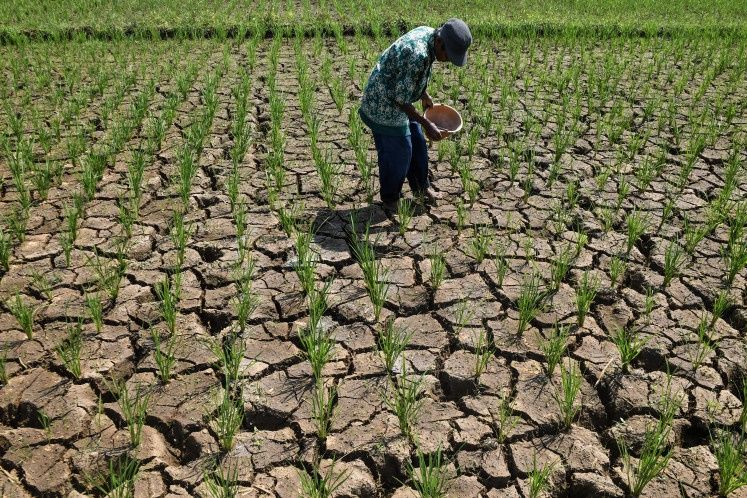
The drought strangling Indonesia is tightening its grip with alarming speed. As El Niño pushes warmer Pacific waters and suppresses rainfall patterns across the archipelago, regions from Java to the outer islands are facing critical water shortages that threaten both daily survival and the nation's agricultural output. The National Disaster Mitigation Agency (BNPB) has sounded an escalating alarm, urging all regional administrations and citizens to prepare for what meteorologists now describe as a potentially "extreme" dry season that could persist through September.
The geographical spread of the crisis is accelerating beyond initial expectations. In a single update on Friday, BNPB added three new regions to its growing list of drought-affected areas: Gunungkidul in Yogyakarta, Semarang in Central Java, and Jember in East Java, each facing immediate water distribution needs for around 700 combined households. This expansion reflects how rapidly El Niño conditions are moving beyond traditionally vulnerable zones. The additions bring the total number of affected households to more than 7,800 across multiple provinces, with tanker trucks now the lifeline for communities in Cilacap, Klaten, and Jepara in Central Java; Bantul in Yogyakarta; Karawang, Tasikmalaya, and Sukabumi in West Java; Seram in Maluku; and West Lombok in Nusa Tenggara Barat.
Several regional governments have already declared formal 90-day drought alert statuses, a procedural step designed to expedite emergency response mechanisms and unlock rapid resource allocation. Gunungkidul initiated its alert in June, while West Java implemented province-wide measures this month. West Lombok moved even faster, declaring a full drought emergency on June 15 after 3,600 households lost reliable access to clean water. Banten province was still assessing its situation as of Friday, holding back from a province-wide declaration pending completion of impact surveys. These declarations represent more than administrative formalities—they signal that local governments have exhausted routine capacity and require central intervention.
The meteorological outlook offers little comfort. Indonesia's Meteorology, Climatology and Geophysics Agency (BMKG) projects that El Niño will push the dry season to peak intensity between July and September, with below-normal rainfall expected across more than 80 per cent of the archipelago. By mid-June, 37 per cent of Indonesia's climate zones had already transitioned into official dry season conditions, while nearly half the country was simultaneously recording rainfall well below historical averages. This simultaneous occurrence of early transition and below-normal precipitation suggests the current situation represents a worst-case scenario rather than a typical seasonal fluctuation.
Beyond immediate water stress, the drought poses a profound threat to national food security. Agricultural experts and government officials openly acknowledge that prolonged water scarcity could trigger cascading crop failures, potentially driving rice prices to unprecedented levels. BMKG's deputy for climatology, Ardhasena Sopaheluwakan, has called for immediate implementation of adaptive agricultural strategies, including schedule adjustments for planting cycles, prioritisation of drought-tolerant crop varieties with shorter maturation periods, and diversification of food crop cultivation beyond rice dependency. These measures represent damage mitigation rather than prevention—acknowledgment that some degree of agricultural disruption is now inevitable.
The government has attempted to project confidence about food supply resilience, with Agriculture Minister Amran Sulaiman repeatedly asserting that national rice reserves remain at "historically high levels" and should suffice to meet domestic demand through the next calendar year. Yet such assurances ring somewhat hollow given the ministry's simultaneous acknowledgment that drought mitigation measures must be accelerated. The government has expanded deployment of irrigation pumps to maintain water availability and preserve production momentum, a costly and energy-intensive response that addresses symptoms rather than root causes. The House of Representatives' Commission IV, which provides legislative oversight of agriculture, has pushed beyond government messaging to demand concrete acceleration of assistance in vulnerable regions, specifically calling for rapid distribution of seeds, fertilisers, farming equipment, and livestock feed.
However, most current government intervention remains tactically focused on emergency response rather than strategic prevention. Water distribution by tanker truck, while essential for immediate survival, constitutes a temporary palliative that consumes fiscal resources and fuel without addressing underlying vulnerabilities. Bagas Yusuf Kausan, a researcher at water policy think tank Yayasan Amerta Air Indonesia, argues that Indonesia requires fundamental infrastructure investment, particularly the expansion of piped water systems managed through regional water utilities (PDAM) in drought-prone areas. He advocates for government subsidisation of these services as a political commitment to vulnerable communities, recognising that drought preparedness cannot rely indefinitely on emergency logistics.
The deeper issue lies in environmental degradation that El Niño merely exposes rather than creates. Land conversion for development and agriculture has systematically degraded water catchment areas, while unsustainable groundwater extraction has depleted aquifer reserves that once provided resilience during dry periods. These human-driven ecological changes have rendered many regions increasingly fragile and susceptible to climate variability. A single severe dry season now produces humanitarian crises in areas that would have weathered equivalent conditions two decades ago through natural water retention capacity. This trajectory suggests that even if current El Niño conditions ease in coming months, Indonesia will face recurring drought emergencies unless environmental management patterns fundamentally shift.
Kausan specifically recommends that the government leverage the current crisis as a political opportunity to tighten restrictions on land conversion, particularly in water catchment areas critical to regional water supply. This proposal directly challenges development interests and land speculation that have historically enjoyed regulatory latitude, making implementation politically difficult despite its logical necessity. The government's current positioning emphasises emergency management and reassurance rather than structural reform, suggesting institutional reluctance to confront the development patterns that have exacerbated climate vulnerability.
For Malaysia and other Southeast Asian nations, Indonesia's crisis carries significant implications. Regional water resources remain interconnected through shared river systems and aquifers, and agricultural disruptions in Indonesia inevitably affect regional food markets and commodity prices. Malaysian consumers could face elevated rice and agricultural commodity costs if Indonesian production declines substantially, while Malaysian agricultural regions dependent on transboundary water flows may themselves face unexpected scarcity. The crisis also demonstrates how inadequate water infrastructure investment creates humanitarian vulnerability disproportionately affecting lower-income populations, a pattern replicated across the region.
The situation underscores a broader Southeast Asian policy challenge: the region's development trajectory has prioritised rapid agricultural expansion and urban growth without systematically investing in climate-resilient water infrastructure. Indonesia's current emergency represents a preview of stress that may become routine as climate variability intensifies, unless governments shift from reactive emergency management to proactive long-term investment in water systems, environmental protection, and sustainable agricultural practices that reduce climate sensitivity. The window for such repositioning before the next crisis emerges remains uncomfortably narrow.

