A dramatic overnight operation across Indonesia's capital has exposed one of the most significant corruption cases involving the nation's law-enforcement hierarchy in recent years, with authorities recovering approximately US$26.3 million in gold bullion and cash from multiple locations tied to a senior judicial official. The sweeping raids, which began Wednesday afternoon and extended into Thursday morning, targeted properties and businesses throughout Jakarta and its surroundings, ultimately implicating Febrie Adriansyah, who had served as deputy attorney general overseeing special crimes prosecutions for more than four years before his sudden resignation following the operations.
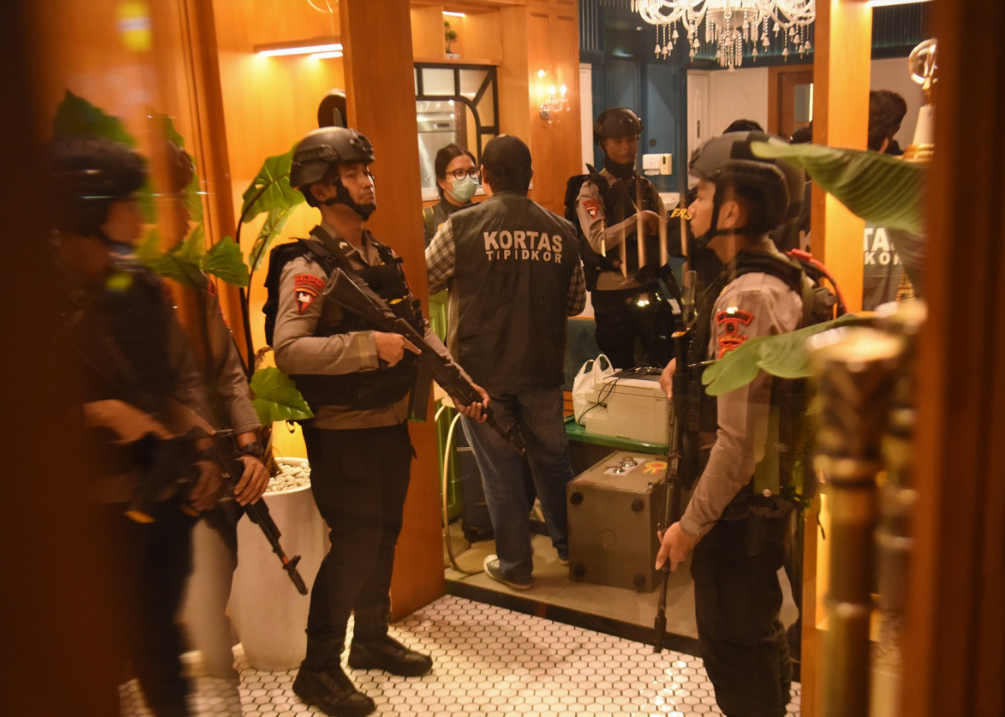
The investigation unfolded in full public view, with the initial target being de'Clan Signature, an upscale restaurant situated in the relatively modest Cipete neighborhood of South Jakarta. Officers from the Jakarta metropolitan police and the National Police's anti-corruption division, supported by heavily armed Mobile Brigade units equipped with tactical gear and assault weapons, methodically searched the premises and discovered a substantial safe concealed behind cabinetry. The safe contained millions of dollars in mixed-currency cash along with financial documents, creating immediate suspicion among diners and restaurant staff about the operation's scope. The authorities did not stop there, proceeding immediately to Koin Money Changer, the adjacent establishment, where they opened another secure container revealing additional rupiah-denominated banknotes worth hundreds of thousands of dollars.
These findings, however, paled in comparison to what awaited investigators at a luxury residence in Sentul, an affluent hilltop community approximately one hour's drive south of the capital. Inside the upscale property, police discovered seven large suitcases packed with 74 kilograms of gold bars alongside substantial amounts of cash denominated in multiple currencies. This single location accounted for the overwhelming majority of the operation's total asset recovery, establishing it as the centerpiece of what authorities characterize as a coordinated money-laundering and corruption investigation. The visual impact of the gold and currency being displayed to media representatives created powerful imagery that has dominated Indonesian news cycles and raised serious questions about the integrity of institutions tasked with combating financial crimes.
Febrie Adriansyah has acknowledged ownership of the Sentul residence but has publicly disputed claims that the discovered assets belong to him personally. His statement suggests that the origin and rightful ownership of the seized materials will become apparent through legal proceedings, a position that legal observers and anti-corruption advocates view with considerable skepticism given the location of the assets within his own property. Despite being formally designated a suspect in both corruption and money-laundering investigations, Febrie has not been placed in detention, a distinction that has itself become a subject of public controversy and speculation about potential preferential treatment afforded to high-ranking officials.
The investigation expanded dramatically beyond the initial Cipete and Sentul locations, with police executing searches at more than ten additional addresses throughout greater Jakarta during the multi-day operation. Officers examined residential units within the prestigious Pacific Place apartment complex located near the Jakarta Stock Exchange, searched corporate offices scattered across various business districts, and raided properties in the upscale Gandaria suburb of South Jakarta. The breadth of the operation suggests that investigators believe the suspected corruption scheme involved multiple participants and extended across residential, commercial, and financial infrastructure throughout the metropolitan region.
Another individual implicated in the investigation is Don Ritto, a lawyer whose residential property was among those searched and who has been formally named as a suspect. Unlike Febrie, Ritto has been placed in police custody pending further investigation, according to local reporting. Subsequent examination of corporate records by Indonesian media outlets has established that Ritto maintains business interests in entities connected to both de'Clan Signature and Koin Money Changer, suggesting potential coordination in the suspected financial improprieties. This corporate connection provides additional evidentiary threads that investigators are likely pursuing to establish the operational mechanics of the alleged scheme.
The discovery has immediately sparked considerable debate within Indonesian legal and policy circles regarding the efficacy of existing anti-corruption mechanisms and whether such findings demonstrate that institutional safeguards are functioning as designed. Some observers have interpreted the successful recovery of substantial assets as evidence that anti-corruption institutions are performing their mandated role, while others view the case as yet another entry in a lengthy catalog of scandals suggesting systemic and deepening corruption within judicial and law-enforcement establishments. The sheer magnitude of the seized assets—particularly the quantity of physical gold and foreign currency—has intensified questions about how such wealth could accumulate within the orbit of a government official without triggering earlier investigation or discovery.
Prominently, constitutional law scholar Mahfud MD, whose background includes service as chief justice of Indonesia's Constitutional Court and as coordinating minister for political, legal and security affairs, has publicly questioned procedural legitimacy of the investigation's handling. Speaking through his YouTube platform, Mahfud argued that the transfer of the investigation from police authorities to the Attorney General's Office—the institution Febrie served in a senior capacity—lacks statutory foundation within Indonesia's criminal procedure code. His assessment suggests the procedural irregularity could provide grounds for defense challenges at preliminary hearings and potentially jeopardize prosecution of the case. Mahfud specifically recommended that the Corruption Eradication Commission, a constitutionally independent state body operating outside the hierarchical structure of traditional law-enforcement agencies, should assume investigative leadership to preserve case integrity.
This constitutional concern carries substantial weight within Indonesian governance discourse, as procedural defects have historically been exploited to derail high-profile corruption cases before reaching substantive trial phases. The independence of the Corruption Eradication Commission from both police and prosecutorial structures theoretically provides greater insulation from political interference or institutional self-protection that might otherwise compromise investigations involving senior government officials. The commission's involvement would signal to international observers and domestic anti-corruption constituencies that Indonesia intends to pursue the matter with genuine institutional impartiality rather than allowing the Attorney General's Office to investigate one of its own former senior officials.
From a regional perspective, the case illuminates vulnerabilities within Southeast Asia's larger governance architecture, where middle-income countries often struggle to prevent institutional capture by elite actors. Indonesia, as the region's largest economy and putatively one of its more robust democracies, faces credibility challenges when senior law-enforcement officials become subjects of corruption investigations. The incident occurs against a backdrop of regional concerns about the durability of democratic institutions and anti-corruption commitments in Southeast Asian states. Malaysia and other regional governments monitoring Indonesia's handling of this matter will assess whether Indonesia's response demonstrates institutional resilience or reveals continued vulnerability to corruption among the senior judiciary and prosecution establishment.
The case also raises questions about asset concealment methodologies employed by sophisticated actors seeking to hide wealth offshore or in alternative forms. The volume of physical gold and multiple currencies recovered suggests deliberate diversification of assets to complicate detection and tracing. For Malaysia and other developing economies in Southeast Asia, the operational details of how investigators identified and located these assets may offer instructive precedent for strengthening domestic financial intelligence capacity and property registration systems designed to detect anomalous wealth accumulation among government officials.

