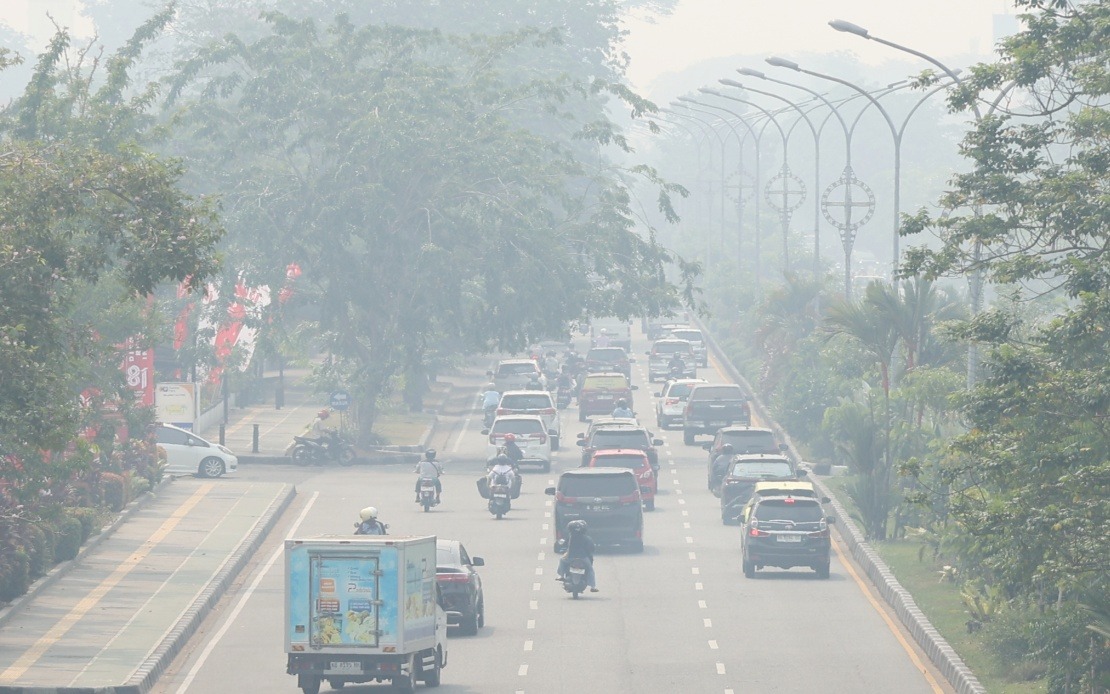
Indonesia faces an escalating environmental crisis as forest and land fires continue to rage across multiple provinces, triggering hazardous air quality readings that threaten the health and livelihoods of millions. The Air Pollutant Index in parts of Central Kalimantan has climbed to an alarming 573, marking conditions that pose immediate risks to public health. The reading was recorded in Jekan Raya, a subdistrict within Palangka Raya, based on data collected from 17 air-quality monitoring stations as of early Wednesday morning. Health Ministry Environmental Health Director Then Suyanti disclosed these figures during an online briefing, underscoring the severity of Indonesia's seasonal haze crisis, a phenomenon that has periodically blighted Southeast Asia for decades.
The geographic scope of the pollution extends far beyond a single region, with hazardous conditions documented across multiple hotspots in the affected provinces. Muaro Jambi Regency in Jambi province has also reached hazardous pollution levels, recording an API of 302. Beyond these critically polluted areas, a broader swathe of territory stretching across Sumatra and Kalimantan experiences what officials classify as very unhealthy air quality, with index readings between 201 and 300. These zones encompass Pelalawan in Riau; Penukal Abab Lematang Ilir and Ogan Ilir in South Sumatra; Southeast Pontianak in West Kalimantan; and Gunung Mas and Katingan in Central Kalimantan. The distribution of pollution across multiple provinces reflects the scale and interconnected nature of the fires, which spread smoke across vast distances through prevailing atmospheric patterns.
Public health authorities are implementing increasingly stringent recommendations to mitigate immediate health consequences. For areas where the API has reached hazardous levels, the Health Ministry is advising all residents to cease outdoor activities, recognising that direct exposure to such severely polluted air carries significant health risks. For regions experiencing very unhealthy air quality, officials recommend the public minimise time spent outdoors, particularly given vulnerability among sensitive populations including children, elderly people, and those with pre-existing respiratory conditions. Then Suyanti indicated that the ministry is preparing comprehensive measures to protect public welfare, with a circular instruction expected to be issued within two days by the ministry's secretary-general. These protective measures include authorising schools in severely affected areas to transition to distance learning programmes when air quality deteriorates beyond safe thresholds, ensuring educational continuity while minimising health exposure for students and educators.
The humanitarian toll of the fires is already becoming visible, though thankfully without fatalities recorded to date. The Health Crisis Centre Head Agus Jamaludin reported that the fires have directly impacted approximately 3.4 million people distributed across seven provinces: Riau, Jambi, and South Sumatra on the island of Sumatra, alongside West Kalimantan, Central Kalimantan, East Kalimantan, and South Kalimantan on Borneo. All affected provinces have activated emergency alert status rather than the more severe emergency response status, indicating that while conditions are serious, authorities believe the situation remains manageable through coordinated firefighting efforts. Casualty figures remain relatively low at present, with 42 people suffering minor injuries. However, two individuals in South Kalimantan sustained severe burn injuries and require hospitalisation, suggesting that direct contact with active fire sources continues to pose localised dangers. To respond to health emergencies across this expansive region, the ministry has deployed 321 health personnel to the affected provinces, establishing medical capacity to address acute health crises arising from both fire-related injuries and smoke inhalation complications.
The underlying challenge driving this crisis is the sheer number of active fire sources scattered across the landscape. Satellite monitoring conducted by the Forestry Ministry revealed widespread fire activity across Indonesia as of late Tuesday evening, with 805 hotspots classified as high-confidence and 11,313 hotspots classified as medium-confidence. This distinction reflects varying degrees of certainty in satellite detection, with high-confidence hotspots representing areas where thermal signatures are most clearly indicative of active fire. The distribution of these hotspots illustrates which provinces are experiencing the most severe fire activity. Among the six priority provinces, South Sumatra leads with 239 high-confidence hotspots, followed by Central Kalimantan with 113, South Kalimantan with 89, and West Kalimantan with 86. Jambi and Riau contribute smaller numbers, with seven and one high-confidence hotspots respectively. This regional variation suggests that firefighting resources and prevention efforts should be strategically concentrated in the most active zones.
Medium-confidence hotspot data reveals an even more extensive fire problem when accounting for less certain thermal detections. West Kalimantan dominates this category with 2,447 medium-confidence hotspots, followed by Central Kalimantan with 2,168. South Sumatra reports 1,161, South Kalimantan 710, Riau 199, and Jambi 197. The preponderance of medium-confidence hotspots in West Kalimantan and Central Kalimantan suggests that these regions have particularly challenging fire conditions, with numerous smaller fires or fires obscured by smoke making definitive detection difficult. The total fire situation across the nation—over 12,000 hotspots when combining both confidence categories—underscores the magnitude of Indonesia's firefighting challenge and the complexity of preventing smoke pollution from affecting downwind regions.
For Malaysian readers and policymakers, this Indonesian crisis carries direct relevance to regional air quality and public health. Malaysia has historically experienced significant transboundary haze pollution during Indonesian fire seasons, with major episodes in 1997-1998 and 2015 causing severe air quality deterioration across Malaysia, Singapore, and Brunei. The current situation in Central Kalimantan and South Sumatra is geographically proximate to Malaysia's Sarawak and Sabah states, meaning that unfavourable wind patterns could transport smoke across the South China Sea and into Malaysian airspace. The scale of fires currently burning—as indicated by the 12,118 total hotspots detected—represents a substantial potential source of transboundary pollution if fire containment efforts prove unsuccessful over the coming weeks.
The seasonal nature of this crisis reflects broader environmental and economic pressures within Indonesia. These fires typically occur during the dry season when moisture levels in forests and peatlands drop significantly, creating conditions where flames can propagate rapidly through vegetation and organic soil layers. Many fires are intentionally set to clear land for agricultural expansion, particularly for palm oil plantations and other commercial enterprises. The timing of this year's severe pollution suggests that the dry season is progressing as forecast, and without successful intervention, air quality could deteriorate further if temperatures rise and vegetation moisture content continues to decline. The mobilisation of firefighting resources and the declaration of emergency alert status by seven provinces indicate that Indonesian authorities recognise the gravity of the situation.
The involvement of multiple Indonesian government agencies—the Health Ministry, the Health Crisis Centre, and the Forestry Ministry—illustrates the multi-faceted response required to address this environmental emergency. Coordination between these entities is essential for effective crisis management, combining health protection measures with active firefighting operations and monitoring of fire activity. The Forestry Ministry's satellite surveillance provides the intelligence necessary for directing firefighting resources to areas of greatest need, while the Health Ministry focuses on protecting public welfare through guidance and preparation of medical infrastructure. The mechanism for declaring provincial-level emergency status represents an intermediate escalation that preserves flexibility while signalling seriousness to both populations and resource providers.
Looking forward, the trajectory of this crisis will depend on several factors including rainfall patterns, the sustained deployment of firefighting resources, and compliance with land-clearing regulations. If the dry season extends longer than typical or if precipitation remains below average, fire activity could persist or even intensify. Conversely, substantial rainfall would rapidly suppress active fires and allow vegetation moisture to recover, reducing overall fire danger. The commitment of 321 health personnel across affected provinces represents a significant mobilisation of Indonesia's public health workforce, reflecting determination to minimise human suffering even as authorities work to control the fires themselves. For regional observers, the coming weeks will be critical in determining whether this year's Indonesian fire season follows the pattern of recent years or escalates into a more severe episode comparable to historically significant haze events.

