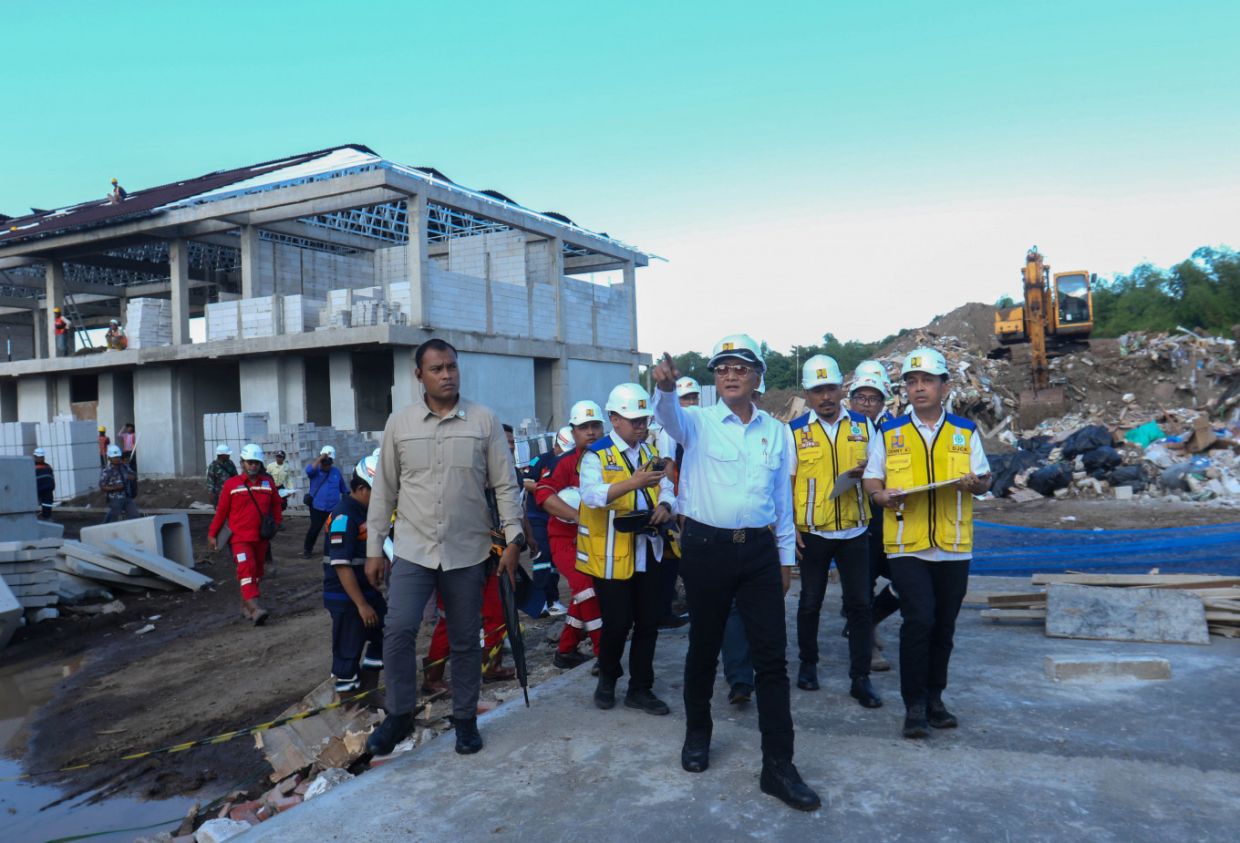
The public works portfolio in Indonesia has become the subject of renewed controversy following revelations that the ministry's official documentation for a high-level United Nations delegation to New York included family members of the sitting minister, Dody Hanggodo. The inclusion has triggered immediate questions about governance standards, appropriate use of state mechanisms, and whether government officials are adequately distinguishing between personal and official travel arrangements during a period when President Prabowo Subianto's administration has publicly committed to reducing unnecessary expenditure.
According to correspondence from the Public Works Ministry dated 29 June and subsequently shared across social media platforms, an eight-person delegation scheduled to travel to New York between 13 and 19 July lists Irma Hermawati, identified as the minister's wife, and Aurellia Tsabitha Meidirama, his daughter, among official participants. The document, bearing the signature of Ministry Secretary-General Apri Artoto, specifies that Irma would hold a diplomatic passport for the journey, while Aurellia would carry a standard passport. Both are identified alongside what appear to be ministry officials and policy specialists attending the gathering.
The delegation's stated purpose is to represent Indonesia at the High-level Meeting on the Midterm Review of the New Urban Agenda, a significant international forum convened by the United Nations General Assembly and administered through the UN Human Settlements Programme, commonly known as UN-Habitat. This meeting, scheduled for 16 and 17 July in Manhattan, addresses questions of sustainable urban development and implementation of housing and settlement policies—a thematic area ostensibly within the Public Works Ministry's mandate. The official purpose therefore provided plausible grounds for ministry representation at what remains a legitimate government function.
Nevertheless, the appearance of the minister's family members in formal delegation documentation has provoked substantial criticism online and among governance observers. Critics have questioned the necessity of their attendance and suggested that their inclusion sits uneasily alongside the broader austerity messaging emanating from the presidential palace. The timing is particularly sensitive given that President Prabowo's transition administration has publicly emphasised fiscal discipline and the elimination of wasteful spending across government agencies. Any indication that senior officials are circumventing such messaging generates immediate reputational damage to broader reform narratives.
Responding to the emerging controversy on Tuesday, Apri sought to provide reassurance by explicitly stating that no state budget allocation would finance the travel or accommodation expenses of Dody's family members. He characterised their inclusion in the documentation as a purely administrative measure designed to streamline visa processing through Indonesia's Foreign Ministry, asserting that the inclusion of names on official delegation rosters reflected standard procedure rather than substantive participation arrangements. Regarding the diplomatic passport issued to Irma, Apri invoked existing regulations to justify the procedure, suggesting that such documentation remained within established guidelines.
The ministry official's explanation, however, has not succeeded in quieting governance concerns or public scepticism. Maneger Nasution, a senior member of Indonesia's Ombudsman institution, responded publicly by urging the ministry to demonstrate substantially greater transparency regarding both the rationale for including family members in official delegation materials and the concrete mechanisms through which the government would prevent any utilisation of state resources or public facilities for their participation. Nasution's intervention signals that accountability institutions view the matter with sufficient gravity to warrant formal scrutiny.
Beyond the immediate transparency question, Nasution articulated a broader governance concern: that the ministry must affirmatively establish the legitimacy and legality of the family members' participation, demonstrate freedom from conflicts of interest, and prove that no administrative authority has been exercised for personal advantage or unofficial privilege. This formulation elevates the controversy beyond simple questions about budget allocation to encompass more fundamental issues regarding how state mechanisms are deployed and whether decision-making reflects public interest rather than personal convenience.
Context surrounding the minister himself adds additional layers to the governance debate. Prior to his entry into electoral politics through the Democratic Party, Dody maintained significant business relationships with Andi "Haji Isam" Syamsuddin Arsyad, a South Kalimantan-based entrepreneur whose corporate interests intersect substantially with initiatives promoted by President Prabowo, particularly ambitious food estate development schemes centred in Merauke, South Papua. Such pre-political business associations, while not inherently problematic, create baseline questions about potential conflicts of interest in ministerial decision-making that render questions of propriety particularly acute.
The 60-year-old minister has previously articulated grievances regarding what he characterised as efforts by a "deep state" apparatus to undermine his position, following the leak of an internal ministry audit document alleging that unnamed influential actors were seeking to implicate him in corruption allegations. These prior disputes suggest an already fractious relationship between Hanggodo and institutional accountability mechanisms, making the current delegation controversy emerge within a context of existing tension and suspicion.
For Malaysian observers and regional governance analysts, this Indonesian case study illustrates persistent vulnerabilities in how ministerial conduct is monitored and how the boundary between official and personal activity remains contested even in major government ministries. The controversy demonstrates that even explicit denials of budget utilisation do not satisfy modern transparency standards, which increasingly demand proactive demonstration of propriety rather than reactive denial of impropriety. The involvement of Indonesia's Ombudsman suggests institutional expectation that ministers should affirmatively justify such decisions rather than simply defend them against accusation.
The episode also underscores how austerity commitments from political leadership create heightened sensitivity to any ministerial behaviour that appears inconsistent with fiscal discipline messaging. When senior administrators include family members in official documentation for international delegations—regardless of whether public funds ultimately finance their participation—the appearance of circumventing the spirit of cost reduction has become sufficiently damaging to generate formal accountability responses.
For the Prabowo administration, this controversy occurring within the first months of its tenure presents a test of how seriously the stated commitment to good governance and fiscal responsibility will be enforced when applied to senior ministers aligned with the presidential coalition. The outcome may substantially influence whether similar questions arising in other ministries are treated with equivalent rigour or whether connections to presidential circles provide insulation from accountability pressure.

