Indonesian law enforcement agencies have successfully dismantled a sophisticated cross-border drug smuggling operation centred in Batam, detaining six Indonesian suspects and launching a manhunt for two Malaysian nationals believed to have supplied narcotics including etomidate to the network. The joint operation, conducted by the National Narcotics Agency (BNN) and Indonesia's Customs and Excise Directorate General, represents a significant disruption to trafficking activities that exploited the maritime proximity between Malaysia and the Riau Islands.
The breakthrough came when Customs officers at Soekarno-Hatta International Airport intercepted a package ostensibly containing Orange Fiber Xtra food supplement arriving from Malaysia. Laboratory analysis at the Customs and Excise Laboratory in Jakarta revealed the shipment held 3,4-Methylenedioxymethamphetamine (MDMA), ketamine, and other controlled substances—triggering an intensive joint investigation that would ultimately unravel the entire network. The discovery demonstrated how smugglers employ deceptive packaging and legitimate food product labelling to evade detection at international border checkpoints, a technique increasingly common in Southeast Asian drug trafficking.
The synicate operated with remarkable organisational efficiency across multiple fronts. According to BNN deputy for enforcement Insp. Gen. Aswin Sipayung, the operation encompassed drug importation through clandestine maritime routes, repackaging operations at concealed locations, and systematic distribution throughout the Riau Islands. The network's structure reflected the compartmentalisation typical of professional trafficking organisations, with distinct roles assigned to procurement, logistics, and retail operations. Authorities raided four separate locations linked to the syndicate, ultimately recovering evidence and suspects across Batam's commercial and residential districts.
The investigation accelerated following the arrest of a suspect identified as BAP, who was apprehended while collecting the intercepted package in Batam on Wednesday. His statement provided investigators with crucial leads that enabled rapid arrests of three additional suspects—ED, NC, and TFS—at a hotel in the Baloi district. ED allegedly placed the original order for the shipment, while his associates participated in the distribution chain. This cascading arrest pattern, facilitated by detailed suspect testimony, typifies modern law enforcement technique in tackling transnational organised crime networks where information from one subject rapidly dismantles operational cells.
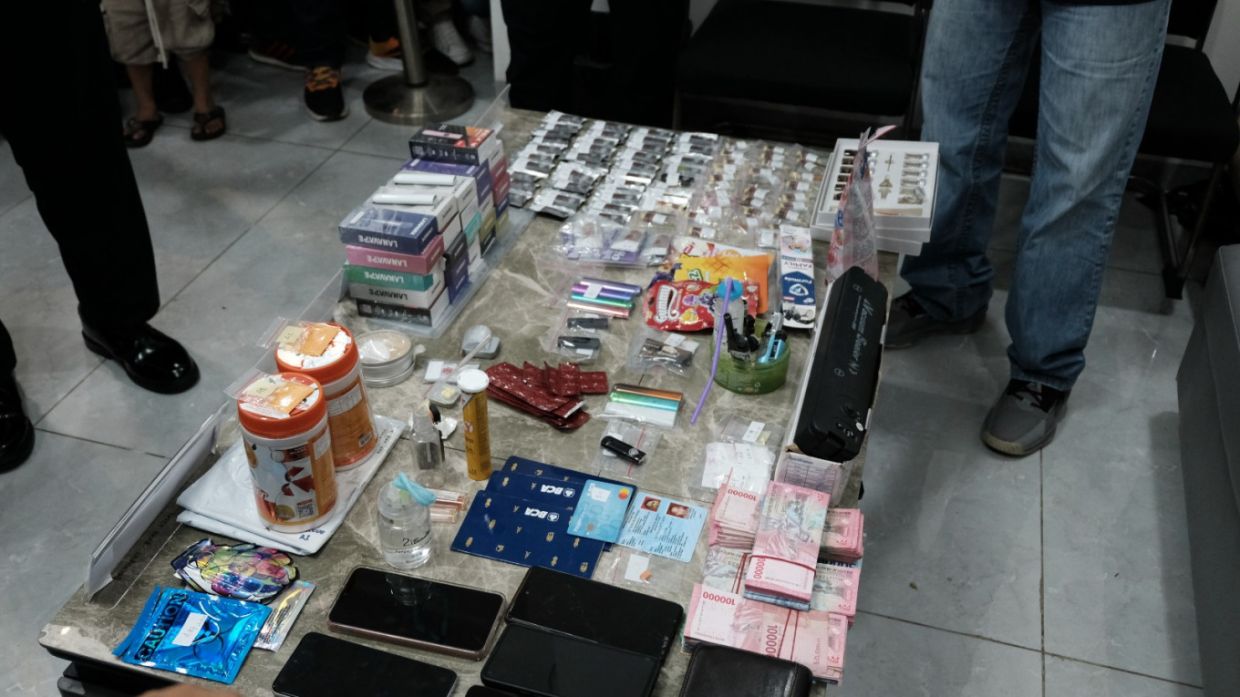
Subsequent raids on an apartment and boarding house in Teluk Tering and Batu Ampar uncovered extensive drug stockpiles and paraphernalia. Officers discovered dozens of electronic cigarette pods filled with etomidate, methamphetamine, Happy Five tablets, and Happy Water drinks at these premises occupied by suspects AJ and DA. The deployment of canine units during the Batu Ampar raid highlighted law enforcement's utilisation of modern detection technology in disrupting concealed drug caches. The physical seizures underscored the operation's substantial commercial scale, with confiscated quantities suggesting distribution beyond personal consumption toward mid-level retail trafficking.
Simultaneously, Customs personnel at Batam Centre International Ferry Terminal intercepted an independent smuggling attempt by Malaysian passenger PS arriving from Stulang Laut International Ferry Terminal in Johor Bahru with 48 cartridges of etomidate. The timing and nature of this separate interdiction raise investigative questions about potential connections to the main syndicate, particularly regarding whether PS operated within the broader network or represented parallel trafficking infrastructure exploiting the busy maritime corridor between Johor and Riau. Such overlapping operations suggest Batam functions as a critical transshipment hub for Malaysian-sourced narcotics destined for Indonesian consumption and potential onward distribution.
The cumulative seizures represent exceptional enforcement achievement in quantitative terms. Officers confiscated 1,076.18 grams of MDMA, 50 grams of methamphetamine, 25.6 grams of ketamine powder, 170 vape cartridges containing etomidate, 12 vials of etomidate totalling 226 grams, and numerous tablet quantities including 86 Happy Five pills and 10 ecstasy tablets. Beyond narcotics, authorities recovered 88 vape devices, nine bongs, digital scales, plastic sealing equipment, and four vehicles—a Toyota Alphard van, Toyota Agya hatchback, Chery SUV, and two motorcycles. Such comprehensive asset seizure disrupts the syndicate's operational capacity and removes commercial infrastructure from circulation.
The sophisticated concealment methodology employed by the network merits particular attention for regional law enforcement collaboration. Smugglers deliberately masked controlled substances within food supplement packaging and sealed dried food products with professional equipment to simulate legitimate commercial products. This deceptive stratagem exploited the volume of legitimate food and supplement imports crossing maritime borders, attempting to obscure narcotics within routine customs flows. The technique's prevalence across Southeast Asian ports indicates a coordinated smuggling sophistication requiring enhanced detection protocols at critical chokepoints.
Authorities continue pursuing Malaysian nationals identified as SL and WKC, designated as the syndicate's primary suppliers and placed on official wanted lists. Their status as alleged source suppliers indicates the Malaysian connection extended beyond simple logistics to active drug sourcing and wholesale provision—positioning these individuals as crucial links in the transnational supply chain. The ongoing manhunt reflects recognition that dismantling trafficking organisations requires pursuing supply-side actors, not merely retail-level operatives, to prevent network reconstitution.
The case carries significant implications for the Batam region's security posture. Batam Centre International Ferry Terminal, handling thousands of daily passengers crossing the narrow strait separating Malaysia and Indonesia, presents inherent vulnerability to trafficking given its high throughput and geographic positioning. The discovery of multiple attempts within a compressed timeframe suggests Batam functions as a preferred smuggling transit point, with traffickers confident in their ability to exploit border procedures. Enhanced bilateral cooperation between Malaysian and Indonesian authorities becomes essential for disrupting these cross-border flows systematically.
Batam Customs head Agung Widodo noted the enforcement action prevented potential harm to approximately 6,770 individuals while avoiding healthcare rehabilitation expenses estimated at Rp10.8 billion (US$599,000). These public health metrics underscore enforcement's social benefit, converting abstract seizure quantities into comprehensible human welfare outcomes. The calculation demonstrates commitment to quantifying narcotics enforcement impact beyond traditional criminal justice metrics, emphasizing drug suppression as public health intervention.
The suspects face prosecution under Indonesia's Law No. 35/2009 on Narcotics, specifically Articles 114(2), 132(1), and 112(2), which address serious trafficking offences carrying minimum five-year imprisonment sentences escalating to potential capital punishment. Maximum fines reach Rp10 billion, positioning this case among Indonesia's most severely penalised narcotics prosecutions. This stringent sentencing framework reflects Jakarta's uncompromising stance on transnational drug trafficking, particularly cases involving organised networks and significant quantity seizures.
Looking forward, the operation illustrates both the effectiveness of coordinated agency response and the persistent challenge posed by Malaysia-Indonesia maritime trafficking corridors. BNN and Customs coordination produced rapid investigation, successful arrests, and substantial seizures—demonstrating operational excellence. However, the continued operation of organised syndicates, the sophistication of concealment techniques, and the geographic inevitability of Batam's role as a trafficking hub suggest sustained enhancement of bilateral intelligence sharing, coordinated border surveillance, and supply-chain disruption targeting Malaysian source suppliers remains imperative for containing Southeast Asia's narcotics problem.

