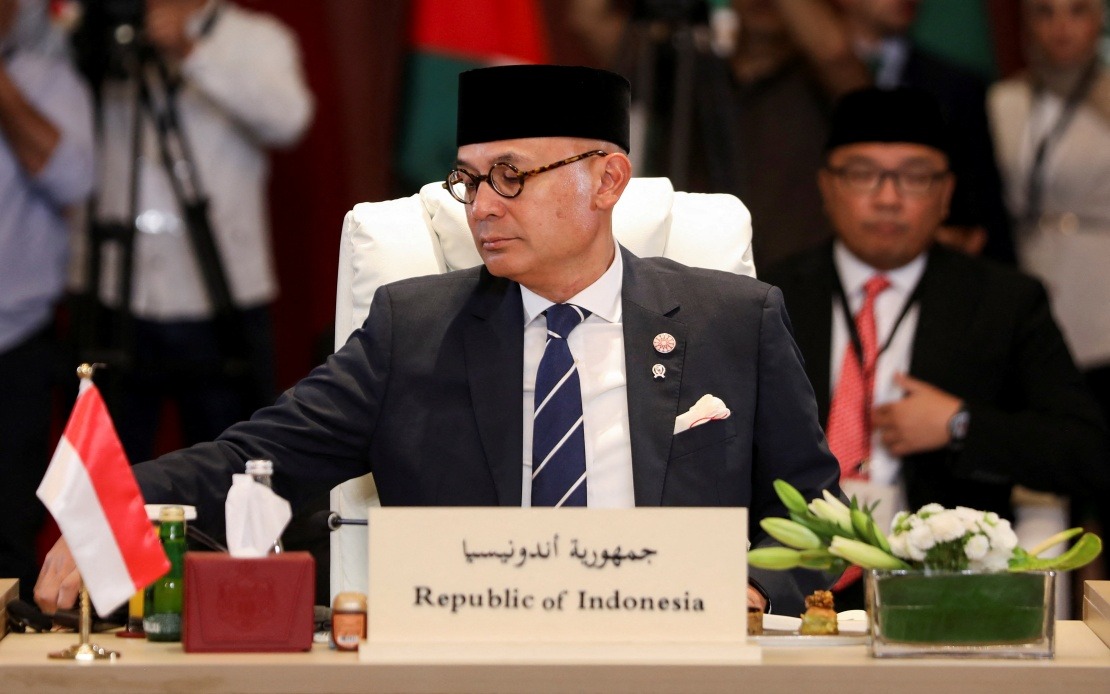
Indonesia has made a forceful call for the international community to forge a cohesive and unified coalition backing the Palestinian cause, arguing that the issue transcends religious boundaries and demands coordinated action. Speaking at a ministerial gathering in Amman, Jordan, Deputy Foreign Minister Arrmanatha Nasir stressed that the struggle for Palestinian statehood and rights concerns not only Muslims but all nations committed to international law and justice. His intervention signals Jakarta's determination to position itself as a leading voice in marshalling global support for what Indonesia views as a pressing humanitarian and legal matter.
Representing Foreign Minister Sugiono at the Ministerial Meeting on Jerusalem, Arrmanatha delivered a pointed critique of the international community's approach to the Palestinian issue. He cautioned that outdated strategies and fragmented responses have allowed Israel to continue violations without sufficient accountability. The deputy minister's core argument rests on a strategic observation: division among nations provides space for the stronger party to pursue its interests unchecked. By emphasising unity as a counterweight to Israeli actions, Indonesia is essentially calling for a diplomatic realignment that prioritises collective strength over individual national positioning.
The geopolitical context informing Indonesia's intervention has shifted markedly in recent years. The expansion of Israeli settlements across the occupied West Bank, ongoing military operations in Gaza, recent Israeli actions in Syria and Lebanon, and the volatile US-Iran dynamic have created what Jakarta views as an increasingly chaotic regional landscape. These developments, in Indonesian analysis, underscore the urgency of coordinated international engagement rather than piecemeal responses. For Southeast Asian observers, Indonesia's emphasis on the changing West Asian political environment reflects broader concerns about regional destabilisation and its potential spillover effects.
Indonesia has put forward five specific proposals aimed at operationalising its vision of international coordination. The first involves developing a unified strategy grounded in solidarity rather than competing national interests. The second emphasises strict adherence to international law and respect for International Court of Justice rulings, framing the Palestinian question as fundamentally a matter of legal principle. The third component seeks to expand the number of nations formally recognising Palestinian statehood, thereby increasing diplomatic legitimacy. These measures reflect a legalistic and institutionalist approach to the conflict, consistent with Indonesia's traditional emphasis on international governance frameworks.
The remaining proposals address more concrete dimensions of Palestinian welfare and self-determination. Indonesia advocates for intensified efforts to protect the Al Aqsa Mosque and broader holy sites, recognising the profound symbolic and religious significance these locations hold for Muslims and Palestinians. The country also emphasises the urgent need for sustained international engagement in Gaza's reconstruction, a humanitarian imperative given the extensive physical damage inflicted by conflicts. Additionally, Indonesia calls for support to Palestinian national unity initiatives, acknowledging that internal Palestinian divisions have historically weakened their negotiating position. Finally, Jakarta backs the continued mandate of the United Nations Relief and Works Agency for Palestine Refugees in the Near East, which provides essential services to millions of Palestinian refugees across the region.
The ministerial gathering itself demonstrated substantial regional alignment on Palestinian issues. The meeting brought together foreign ministers and senior officials from Malaysia, Algeria, Saudi Arabia, Iraq, Egypt, Türkiye, Tunisia, Somalia, Pakistan, Morocco, Palestine and Qatar, alongside the Secretary-General of the League of Arab States. This diverse coalition—spanning Arab states, Muslim-majority nations, and countries with varying geopolitical alignments—speaks to the breadth of concern about Israeli policies in Palestinian territories. For Indonesia, participation by Malaysia and other Southeast Asian neighbours strengthens the case that Palestinian concerns command attention far beyond the Middle East itself.
The adopted joint statement reflected consensus on several key points. Participants voiced support for strengthening Palestinian institutional capacity in Jerusalem, a recognition that state-building efforts require international backing. The statement explicitly rejected unilateral relocations of diplomatic missions to Jerusalem as violations of international law, a thinly veiled reference to the 2017 US recognition of Jerusalem as Israel's capital. This framing attempts to leverage international legal norms against what the coalition views as extralegal unilateral actions. The statement also called for coordinated media campaigns to publicise Israeli actions and their consequences for regional stability, suggesting that information and narrative management form part of the diplomatic toolkit.
Indonesia's consistent reaffirmation of support for Jordan's Hashemite Custodianship over Jerusalem's holy sites reflects both religious conviction and geopolitical calculation. By explicitly backing Jordan's custodianship role, Indonesia reinforces existing arrangements while signalling respect for established Arab state interests in managing Jerusalem's religious patrimony. This positioning also acknowledges that Indonesia, as a non-Arab Muslim-majority nation, understands its role as a supporter rather than a primary stakeholder in the conflict's resolution. The emphasis on supporting an independent Palestinian state according to international law similarly situates Indonesia within mainstream international consensus whilst advocating for stronger implementation of existing legal frameworks.
For Malaysia and other Southeast Asian nations, Indonesia's diplomatic initiative carries strategic implications. The formation of a broad coalition demonstrates that Palestinian issues can activate solidarity across diverse regions and political systems. It suggests that Southeast Asian nations, despite their geographic distance from the Middle East, perceive sufficient stakes in Palestinian self-determination to participate actively in international forums. This reflects both genuine concern for Palestinian rights and recognition that Middle Eastern conflicts can eventually influence regional security and stability in Southeast Asia.
The ministerial meeting's emphasis on legal frameworks and international institutions reflects a particular diplomatic philosophy. Rather than advocating for military intervention or radical restructuring of the regional order, participants pursued a strategy rooted in international law, institutional support, and coordinated advocacy. For Indonesia, this approach aligns with its foundational commitment to the United Nations system and international law as mechanisms for managing conflicts among unequal powers. The strategy implicitly acknowledges that smaller and mid-sized powers lack the capacity for unilateral action but can exercise influence through institutional channels and coalition-building.
Looking forward, Indonesia's five-point proposal provides a concrete agenda for international coordination on Palestinian issues. The emphasis on unity, legal compliance, institutional strengthening, and humanitarian support offers an alternative to both static acceptance of Israeli policies and more confrontational approaches. Whether this diplomatic framework gains traction will depend on whether major powers—particularly the United States and European nations—demonstrate willingness to align with the coalition's positions. For Indonesia and other participating nations, the exercise itself affirms their commitment to collective problem-solving and their determination to prevent Palestinian issues from fading from international attention.

